Steps
Confirm this is the right application for you
This process is for adults: you count as an adult applicant if you are at least 18 on the day you sign. Marrying a Canadian does not make you a citizen, and some people with a Canadian parent or grandparent may already be citizens.
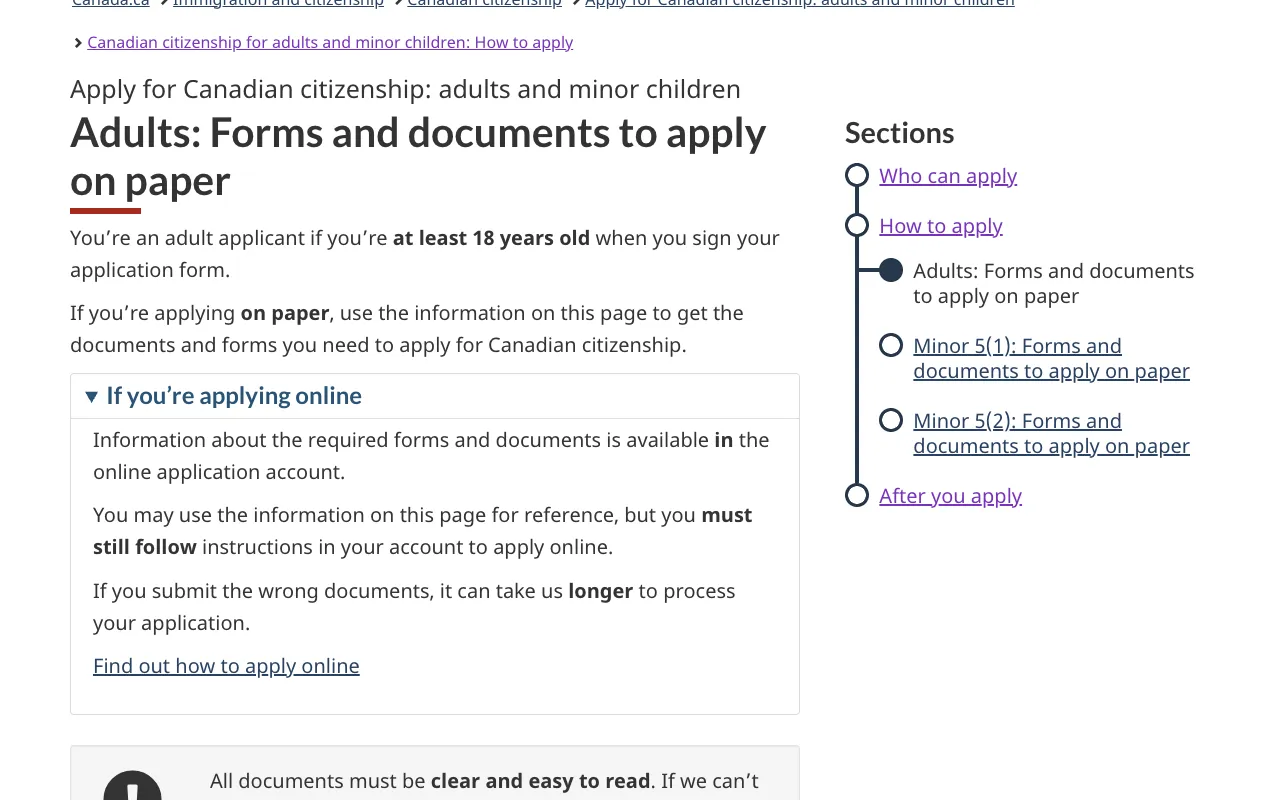
IRCC page · Canadian citizenship for adults: Forms and documents to apply on paper · Whole page · Live page - Your age on the day you sign decides which application you use and whether the language and test requirements apply to you.
- Spouses of Canadian citizens have to meet the same requirements as everyone else.
- If you have a Canadian parent or grandparent, check whether you may already be a citizen before you apply for a grant.
- Canada allows dual citizenship, but your other country may not. Check with that country's embassy or consulate if you're unsure.
Check your permanent resident status
You must hold valid permanent resident (PR) status. You must not have a removal order or unmet PR conditions, and you need to keep that status until you take the oath.
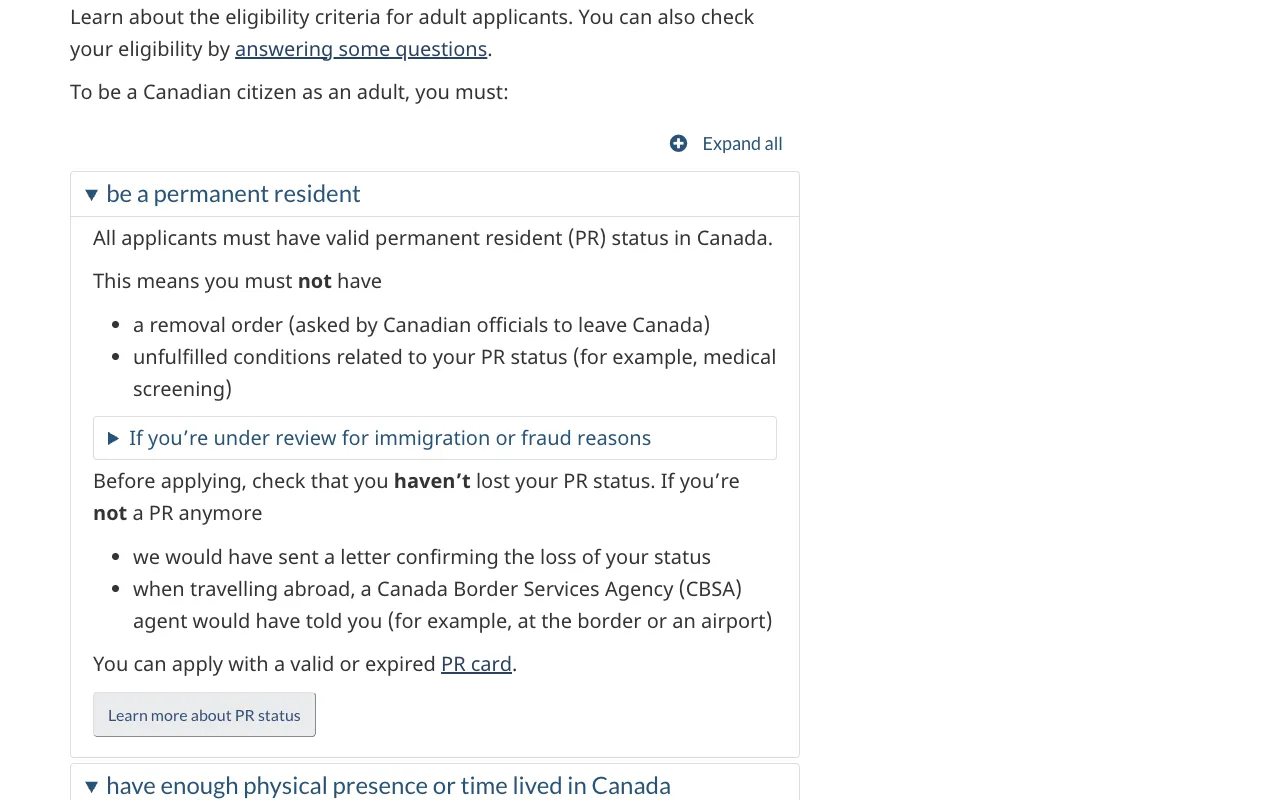
IRCC page · Canadian citizenship for adults and minor children: Who can apply · Whole page · Live page - You can apply even if your PR card has expired. The PR card is a document, not your status itself.
- If you are under review for immigration or fraud reasons, IRCC may suspend your application until the review is over.
- If you had lost PR status, IRCC would have sent you a letter, or a border officer would have told you.
- You need to stay a permanent resident while your application is in process, up to the oath.
Understand the 1,095-day physical presence rule and your eligibility period
You need at least 1,095 days of physical presence in Canada during the 5 years before the day you sign, and at least 730 of those days must be as a permanent resident.
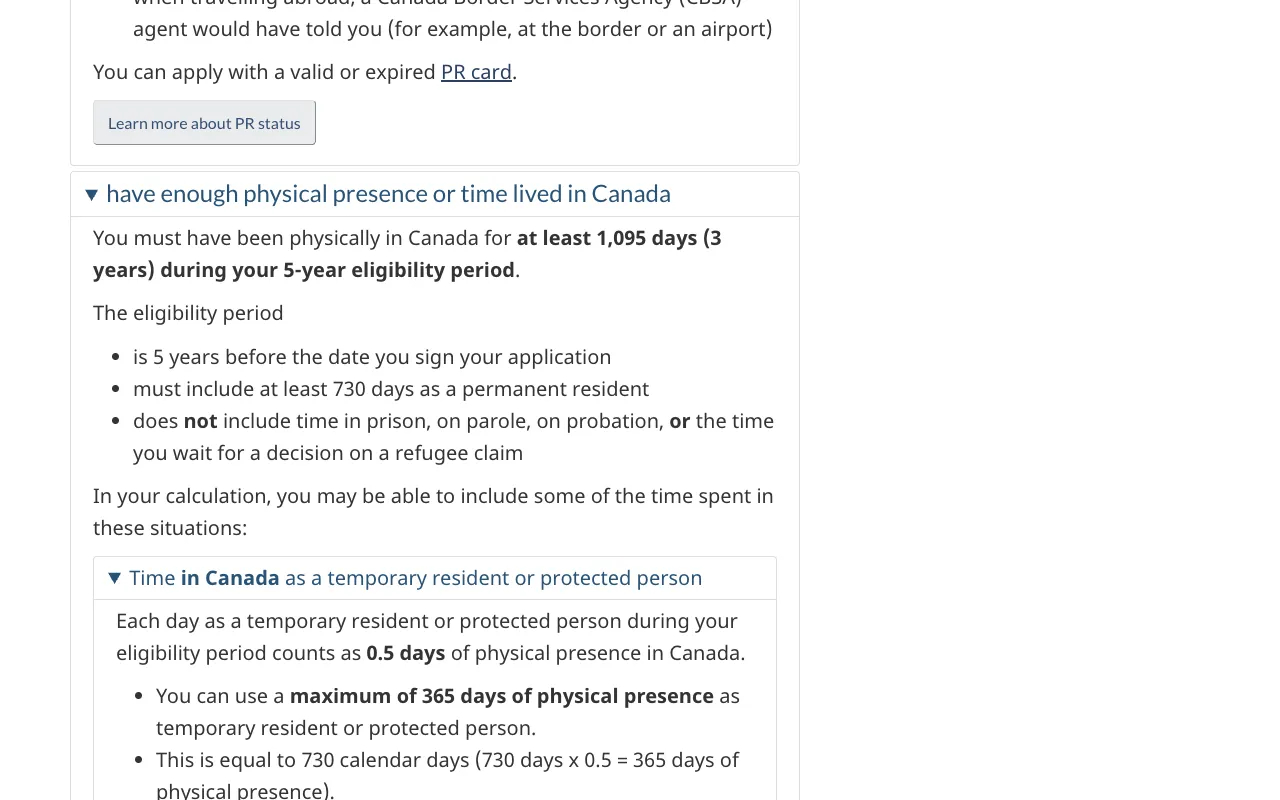
IRCC page · Canadian citizenship for adults and minor children: Who can apply · Whole page · Live page - Your eligibility period is the 5 years before the date you sign. IRCC's calculator ends the period on the day before your signing date.
- Days spent in prison, on parole or on probation don't count, and neither do days spent waiting for a decision on a refugee claim.
- You have to meet the requirement on the day before you sign, so don't sign early and expect to reach 1,095 days later.
- IRCC encourages you to apply with more than 1,095 days so that a small counting error doesn't leave you short.
Add credit for time before PR (temporary resident or protected person)
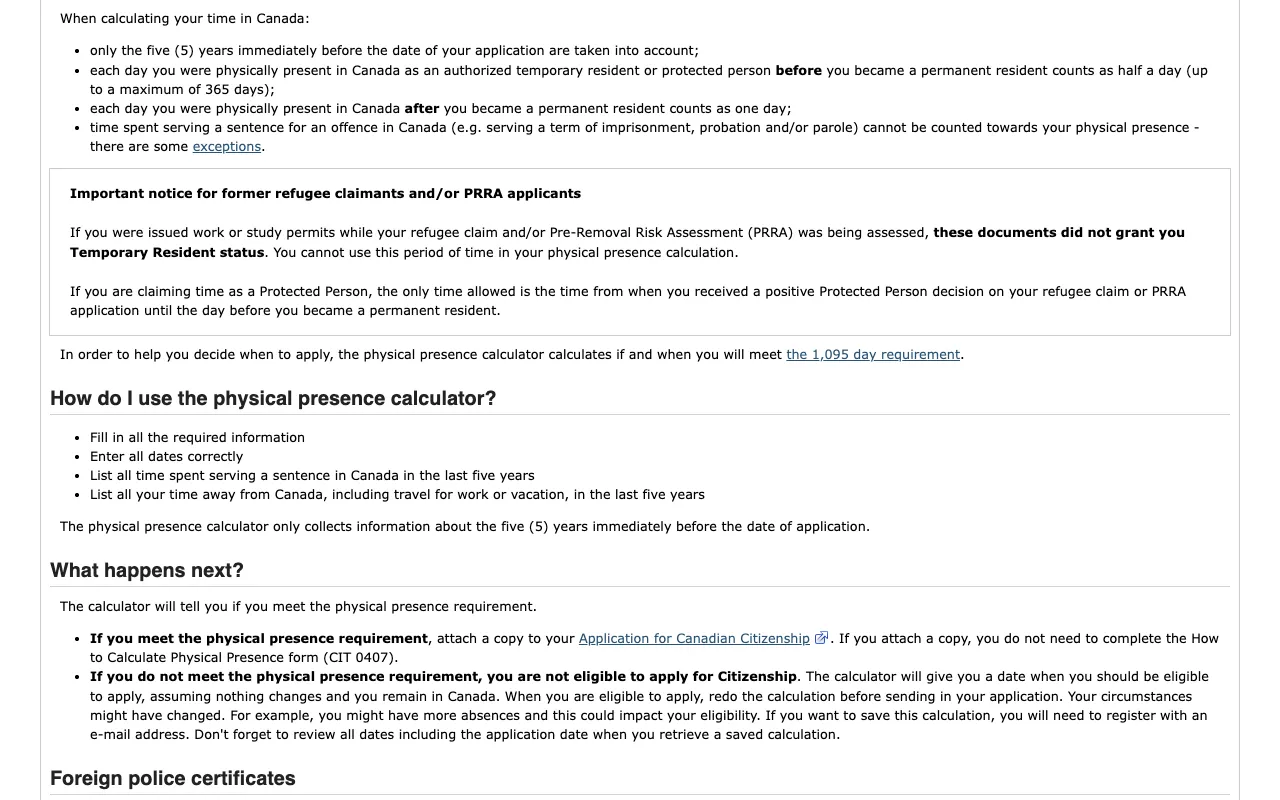
Each day you were in Canada as a temporary resident or protected person during the eligibility period, before you became a PR, counts as half a day. The credit is capped at 365 days.
IRCC page · Canadian citizenship for adults and minor children: Who can apply · Whole page · Live page - Temporary resident means a visitor, student, worker or temporary resident permit holder with valid status.
- Getting the full 365-day credit takes 730 calendar days in Canada with that status (730 x 0.5 = 365).
- Protected-person time counts only from the day your claim or PRRA was approved until the day before you became a PR.
- Work or study permits issued while your refugee claim or PRRA was being decided did not give you temporary resident status, so that time doesn't count.
- Time in Canada without authorized status doesn't count at all.
List every absence from Canada with exact dates
Declare every trip outside Canada in the eligibility period, for any reason, including same-day trips. That covers trips before you became a PR. IRCC's calculator counts the day you leave and the day you return as days in Canada.
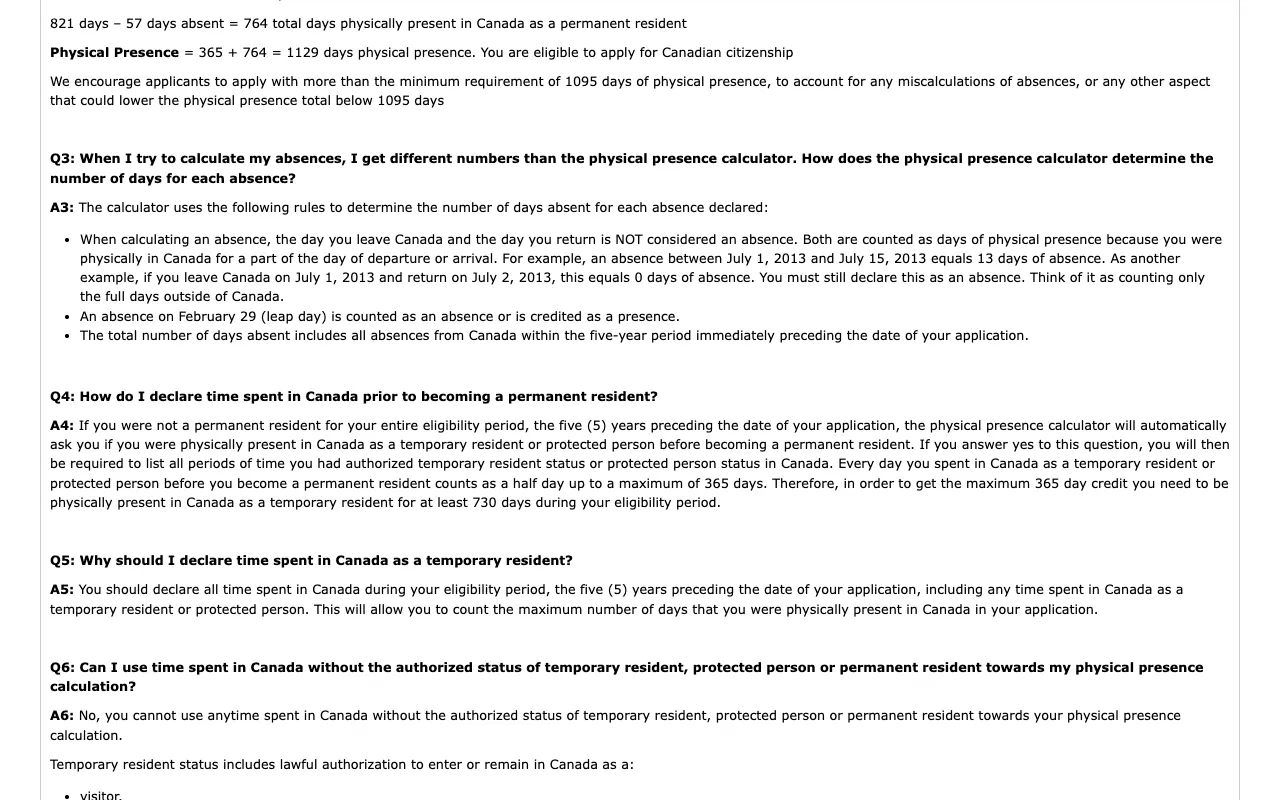
IRCC page · Physical Presence Calculator · Whole page · Live page - Only full days outside Canada count as absence. For example, leaving July 1 and returning July 15 is 13 days of absence. Leaving one day and returning the next is 0 days, but you still have to declare it.
- Day trips to the United States have to be listed.
- Absences for work, such as truck drivers or airline staff, still have to be declared.
- You need exact dates. IRCC suggests checking your passport, bank records, itineraries and receipts.
- An airport connection where you never leave the airport doesn't need to go in your travel journal. If you leave the airport, or pass through a country by car or train, record it.
- IRCC's travel journal is optional and for your own records. Don't send it in place of the calculation.
Do the official physical presence calculation
Online applicants must use the calculator inside their online account. Paper applicants print the result of IRCC's online Physical Presence Calculator, or fill in form CIT 0407 instead.
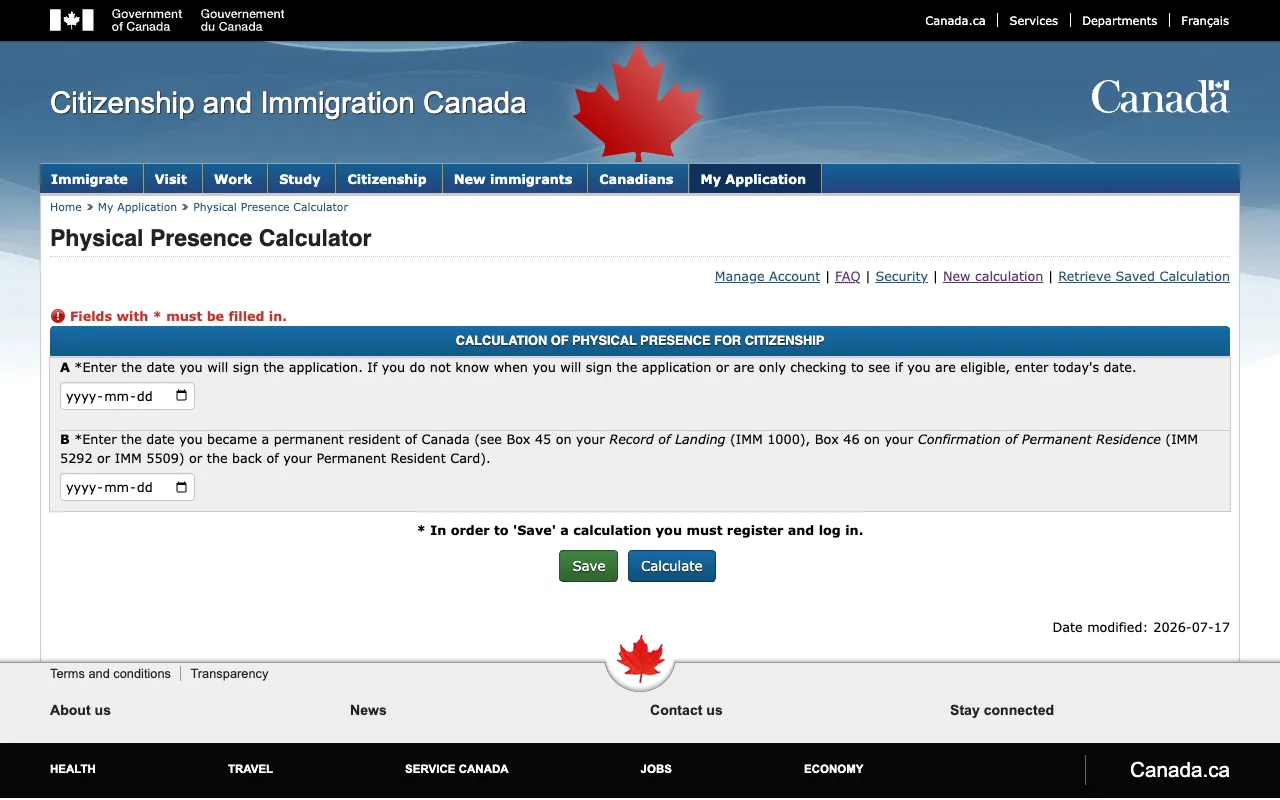
IRCC page · Physical Presence Calculator · Whole page · Live page - Online applicants can do a pre-check with the paper-application calculator, but the calculation in the online account is the one that counts.
- In the paper calculator, the application date is the date you will sign. If you are only checking, enter today's date.
- The calculator asks for your PR date, then any time as a temporary resident or protected person, then any time serving a sentence, then each absence.
- Your signature date on the application must match the application date used in the calculator.
- To save a calculation in the paper calculator, you have to register with an email address. If you come back later, redo or review all dates, including the application date.
- If IRCC returns your application, you may have to recalculate before you resubmit.
Check your income tax filing
You may need to have filed Canadian taxes for at least 3 of the 5 years before you apply. The application asks, for each year, whether you were required to file and whether you did.
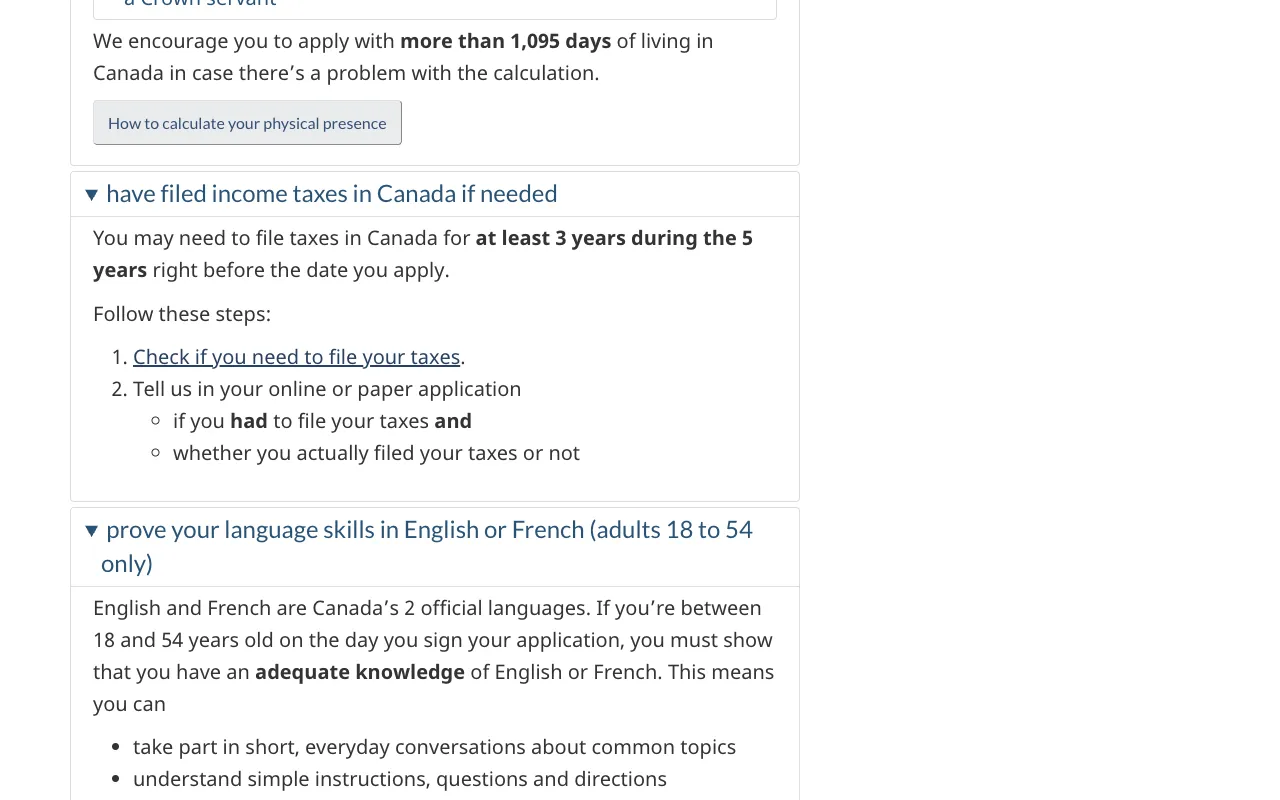
IRCC page · Canadian citizenship for adults and minor children: Who can apply · Whole page · Live page - Use the Canada Revenue Agency's newcomer information to work out whether you had to file in each year.
- On the paper form, fill in the tax chart for all 5 years, even years you didn't live in Canada.
- The application asks you to consent to IRCC and the CRA sharing your tax filing information. Without that consent, the paper application is returned as incomplete.
Get your English or French language proof (ages 18 to 54)
If you are 18 to 54 on the day you sign, you must send proof of speaking and listening at Canadian Language Benchmark (CLB/NCLC) level 4 or higher. Choose one accepted document.
IRCC page · Canadian citizenship for adults and minor children: Who can apply · Whole page · Live page - Accepted proof includes: secondary or post-secondary studies in English or French (in Canada or abroad); accepted third-party tests (CELPIP-G or CELPIP-General LS, IELTS General Training, PTE Core, TEF, TEFAQ, TEF IRN, TCF, TCFQ, DELF, DALF) at the required scores; LINC/CLIC certificates; and some provincial language program certificates.
- Expired test results are accepted.
- IELTS Academic is not accepted. Only IELTS General Training is.
- If your proof is missing, unreadable, or in another language without a certified translation, IRCC returns the whole application.
- You must keep meeting the language requirement up to the day you take the oath.
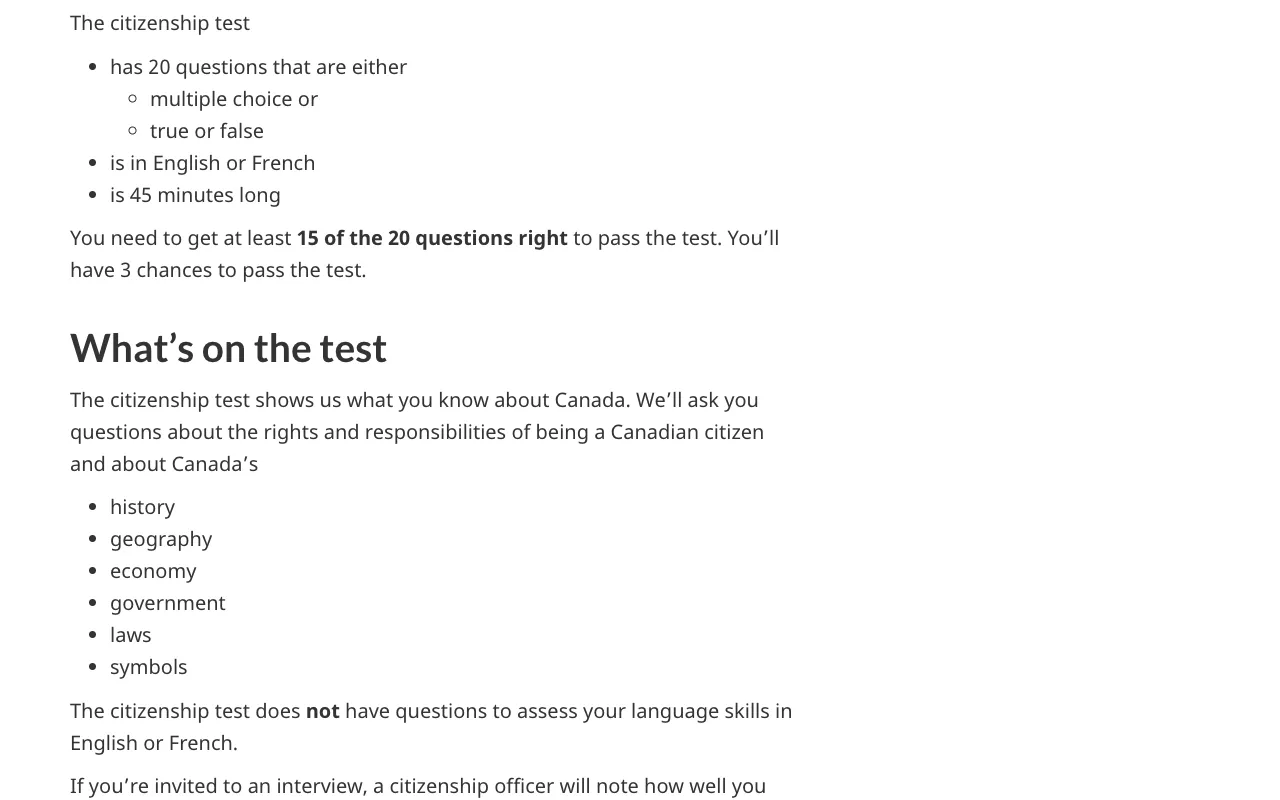
- Officials may also note how well you communicate at an interview. The citizenship test itself doesn't test language.
- If you can't meet this requirement for compassionate reasons (for example, a serious medical condition), you can ask for a waiver.
Make sure no prohibition applies to you
You can't become a citizen while a prohibition under the Citizenship Act applies, for example if you are in prison, on parole or probation, facing charges, under a removal order, or convicted of certain offences in the past 4 years.
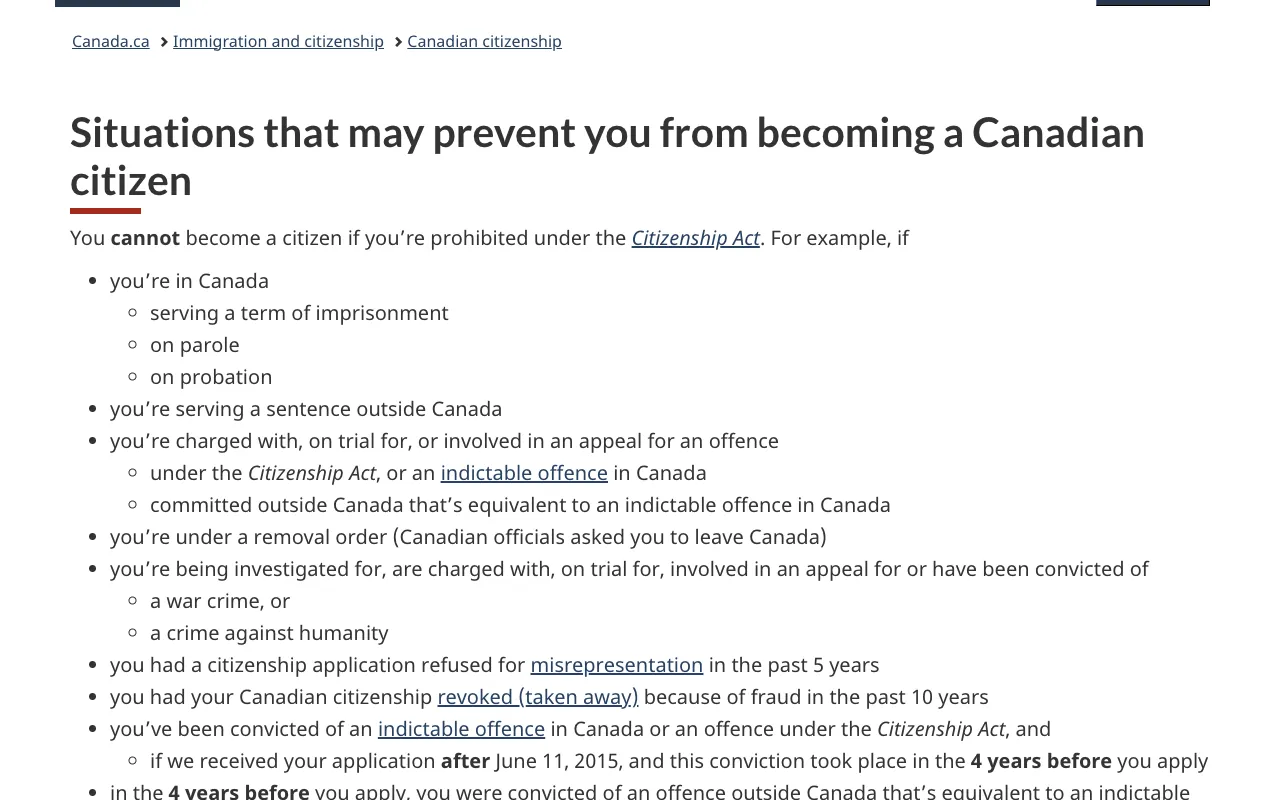
IRCC page · Situations that may prevent you from becoming a Canadian citizen · Whole page · Live page - If a prohibition applies, wait until it no longer does before you apply, and tell IRCC about the situation in your application.
- Not disclosing a prohibition and going on to take the oath can lead to your citizenship being revoked.
- If a prohibition starts to apply while IRCC is processing your application (for example, you are charged with a crime), contact IRCC as soon as possible.
- IRCC may ask for fingerprints or court documents, or for you to attend an interview.
Choose to apply online or on paper
IRCC recommends applying online. You must apply on paper if your calculation includes time outside Canada as a Crown servant (or as a Crown servant's family member), or if you want your representative to fill in and submit the application for you.
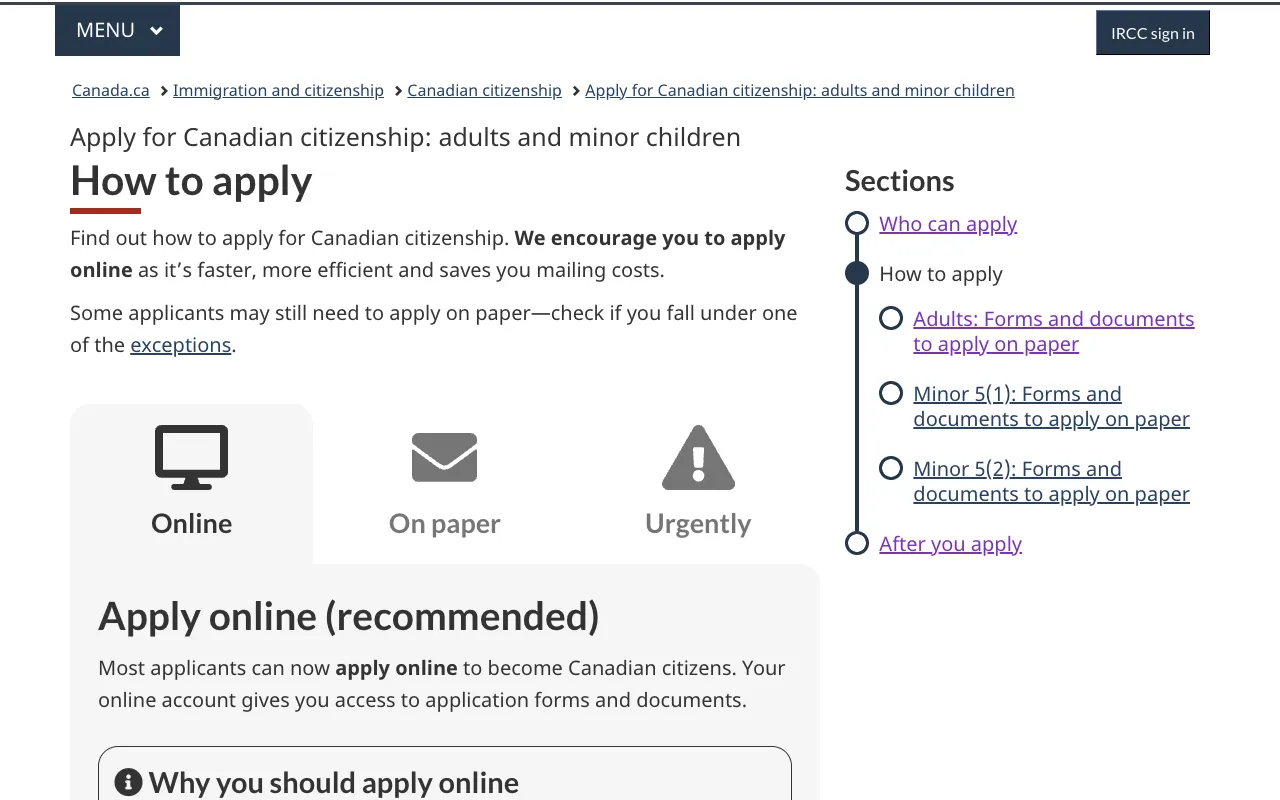
IRCC page · Canadian citizenship for adults and minor children: How to apply · Whole page · Live page - Online gives you built-in error checks and a confirmation email, with nothing to print or mail.
- Paper applications take longer to begin processing because IRCC has to scan them and check them for completeness by hand.
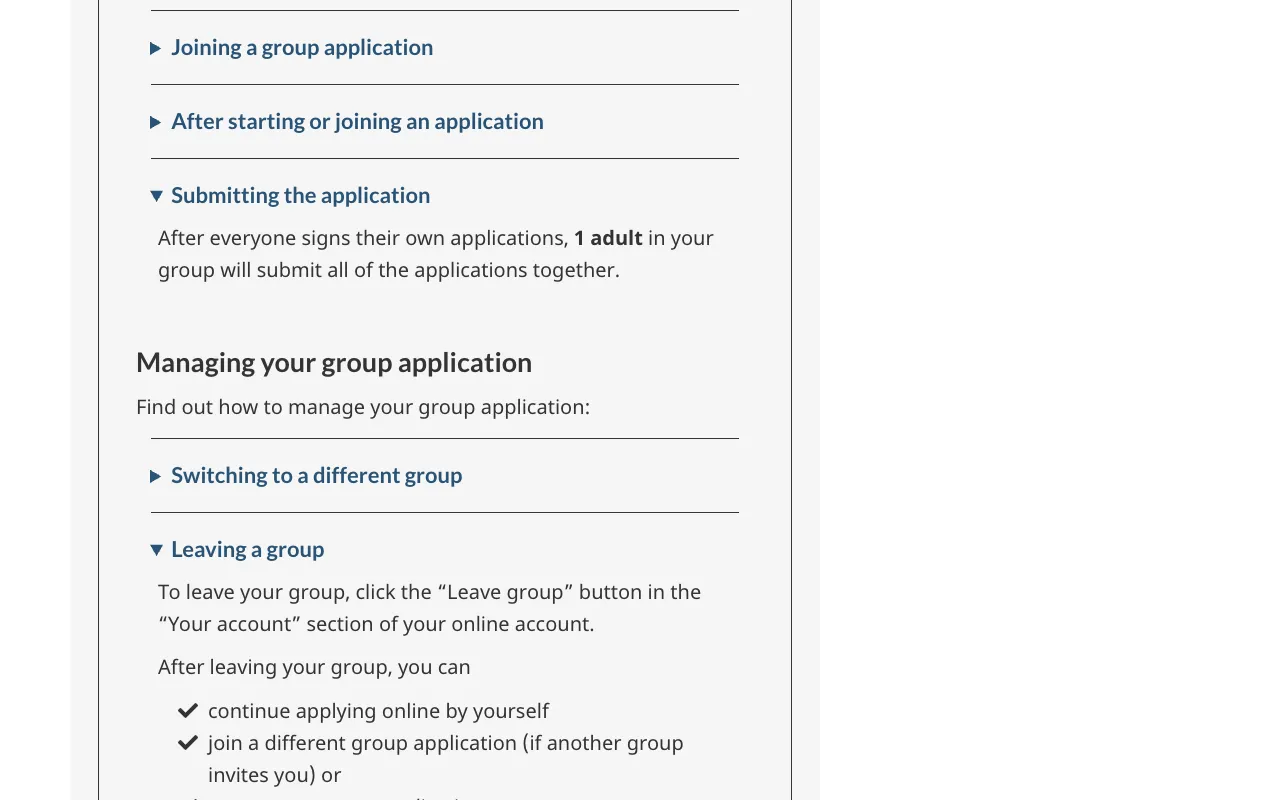
- Online, each adult needs their own account (1 adult per account). Adults can link accounts as a group. Each adult signs their own application, and one adult submits the whole group.
- If a representative helps you online, you still create the account, fill it in, sign and submit it yourself. Never share your password.
- Using a representative is optional, and it doesn't speed up or guarantee approval.
Gather your documents and photos
Collect your passport copies, language proof, two pieces of ID, citizenship photos, your physical presence calculation and any situational documents (see the documents list). Online, your account shows the documents you need.
IRCC page · Canadian citizenship for adults: Forms and documents to apply on paper · Whole page · Live page - Everything must be clear and readable. Unreadable documents can cause your application to be returned or delayed.
- Documents that aren't in English or French need a translation, sent together with the original.
- Citizenship photos are not the same as passport photos. Paper applications need 2 identical printed colour photos. Online applications need 1 digital photo.
- Photos must be taken no more than 6 months before you submit.
- The online application accepts .jpg, .jpeg, .png, .tif, .tiff and .pdf files.
Fill in the application
Online, you fill in the application inside your account. On paper, use the latest Application for Canadian Citizenship – Adults (CIT 0002), answer every question, click Validate to create the barcode page, then print it and sign by hand.
IRCC page · Canadian citizenship for adults and minor children: How to apply · Whole page · Live page - Answer every question unless the form tells you to skip it. Leaving gaps in the address or activity history gets the application returned.
- Copy your name, date of birth and UCI exactly as they appear on your PR documents.
- Date the form on the day you sign it, never in the past or future. The date must match the application date in your physical presence calculation.
- On paper, the barcode page appears only if you fill in the form on a computer and click Validate. Put that page on top of your application.
- The field-by-field guidance for CIT 0002 is in the forms section below.
Pay the fee and keep the receipt
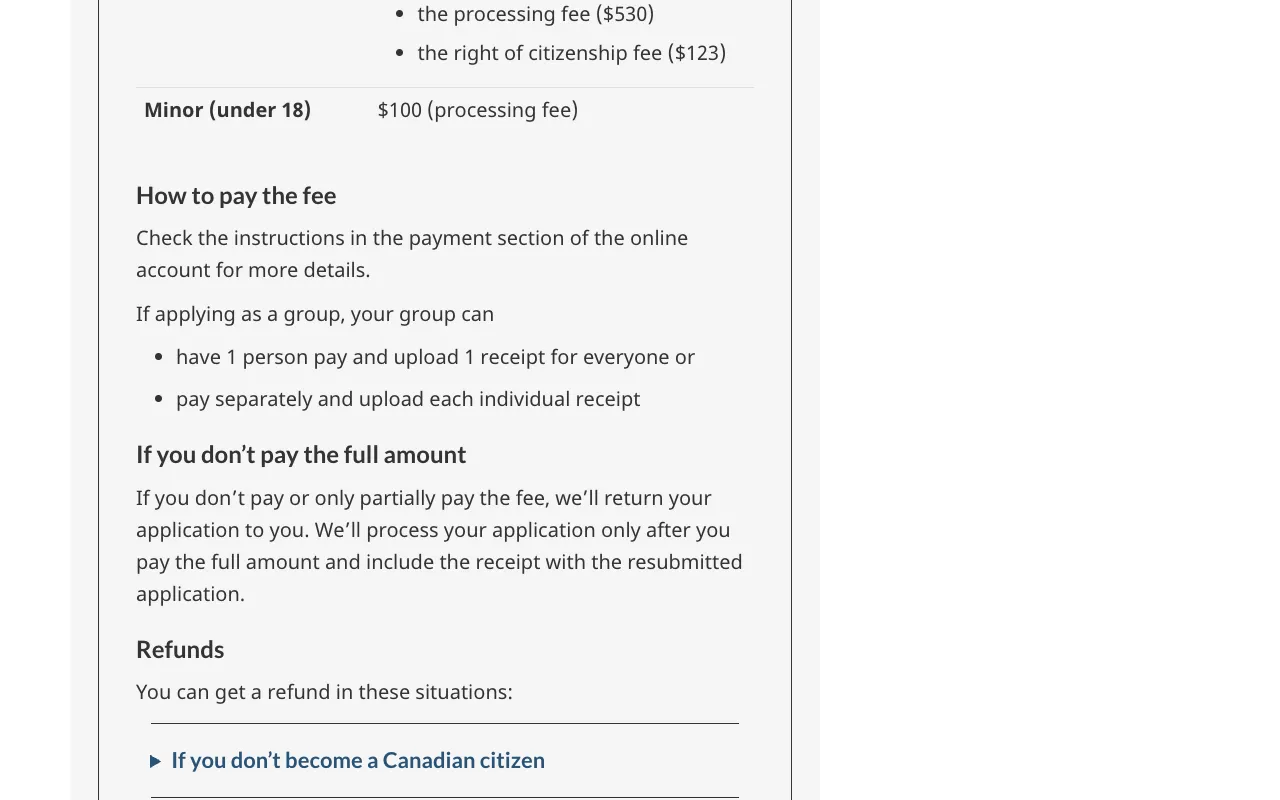
The adult fee is made up of a processing fee and a right of citizenship fee. Check the current amount on IRCC's fee list, pay online, then upload the receipt (online) or print it and include it (paper).
IRCC page · Canadian citizenship for adults and minor children: How to apply · Whole page · Live page - Pay only when you're ready to submit.
- A group can pay with one receipt or with separate receipts.
- If you pay nothing or only part of the fee, IRCC returns your application.
- If your application is refused, or closed after processing has started, adults get back the right of citizenship fee. If you withdraw before processing starts, you get a full refund.
- Fees change, so always check the fee list on the day you pay.
Sign and submit
Online, each adult signs their own application and one person submits it (alone or for the group). On paper, put the checklist and barcode page on top and mail the package soon after signing; IRCC returns it if it arrives more than 90 days after the signing date.
IRCC page · Canadian citizenship for adults and minor children: How to apply · Whole page · Live page - Make sure you were still eligible on the day before you signed.
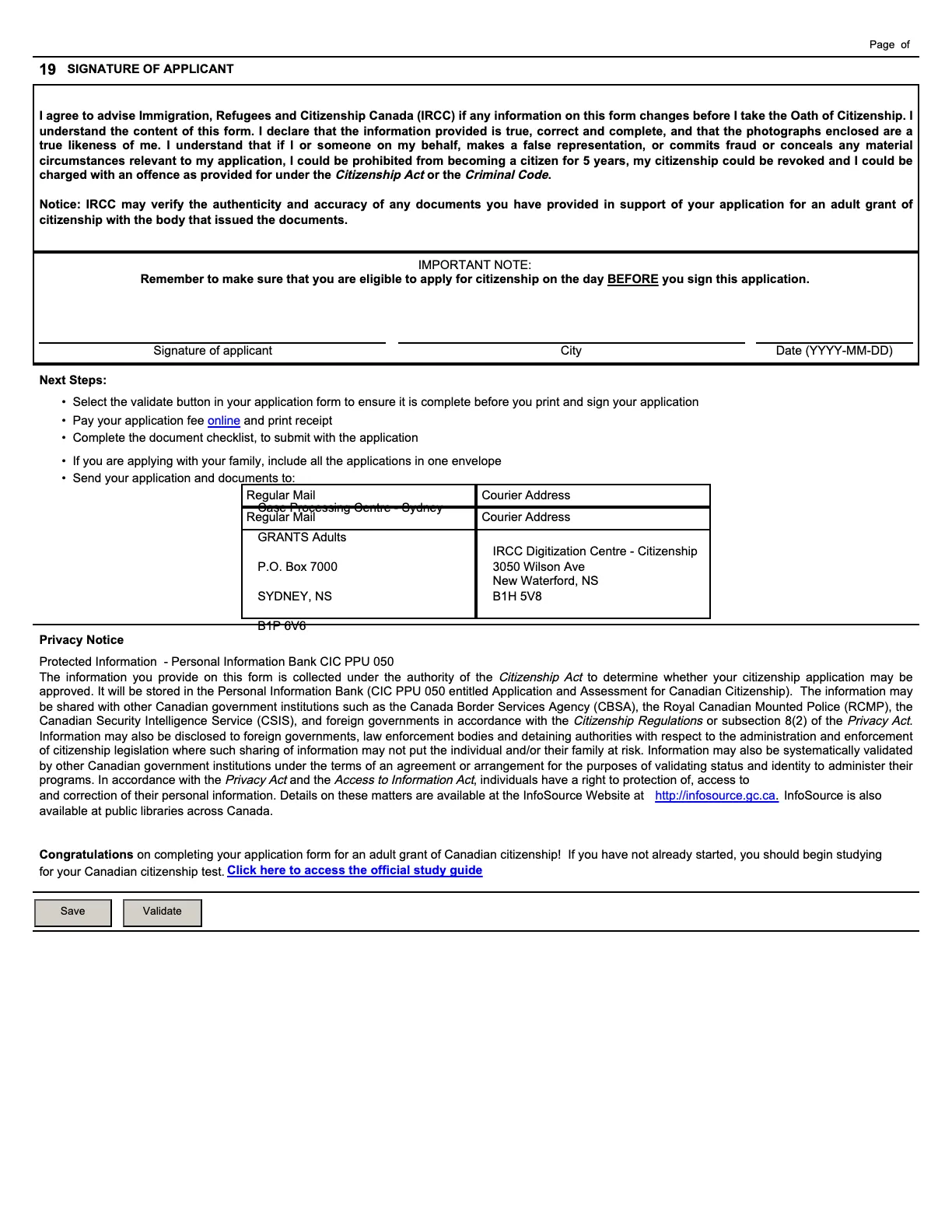
- Paper applications go by regular mail to Case Processing Centre – Sydney, Citizenship Grants, P.O. Box 7000, Sydney, NS B1P 6V6, or by courier to IRCC Digitization Centre – Citizenship, 3050 Wilson Ave, New Waterford, NS B1H 5V8. Confirm the address on the How to apply page before you send.
- Use a mail or courier service with tracking.
- If one application in a family or group is incomplete, IRCC returns them all. To have them processed together, put all the paper applications and receipts in one envelope.
Wait for the acknowledgement of receipt (AOR) and keep IRCC updated
IRCC first checks that your application is complete. If it is, you get an AOR with your application number and UCI, which means processing has started. If it isn't, IRCC returns it without processing your fee.
IRCC page · Canadian citizenship for adults and minor children: After you apply · Whole page · Live page - Online applicants get a confirmation email right away. That email is not the AOR.
- Watch for email from addresses ending in @cic.gc.ca, and check your spam folder.
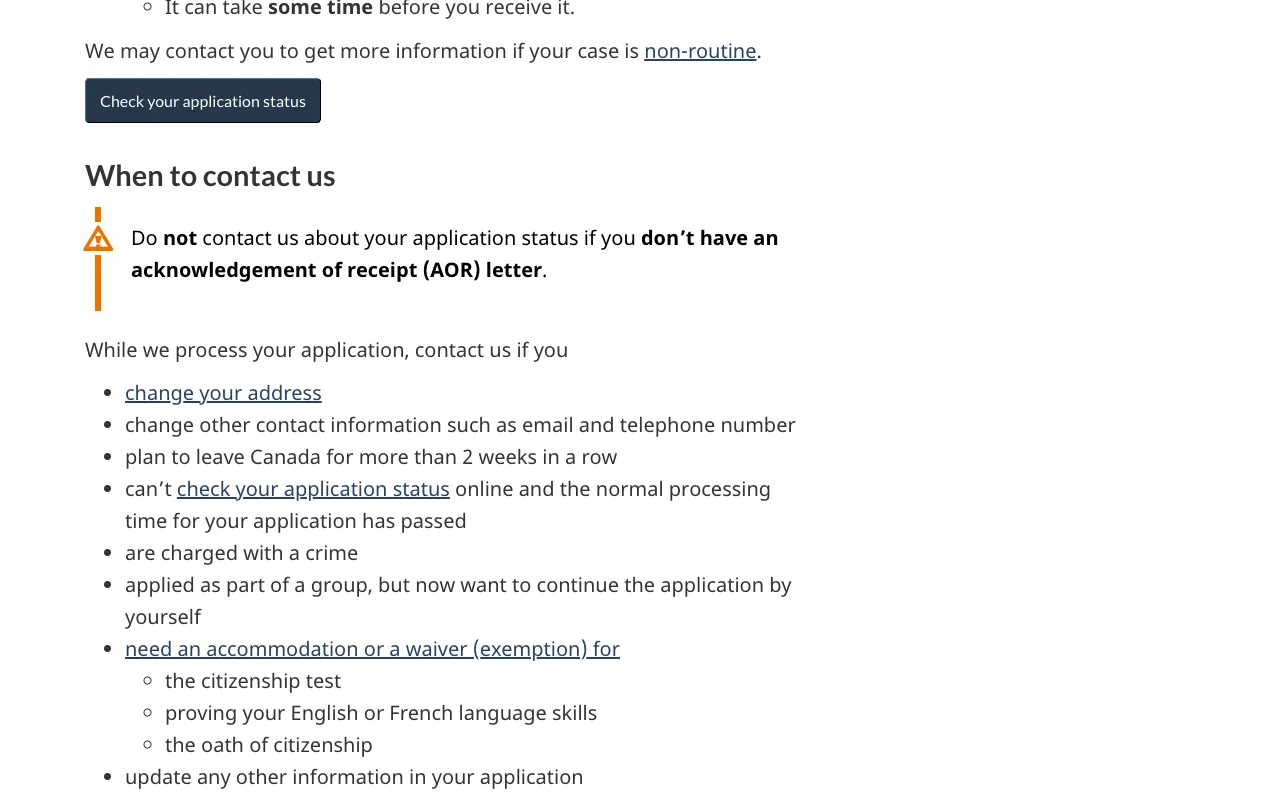
- You can check your status online only after you have the AOR. Don't contact IRCC about status before then.
- Tell IRCC if your address or contact details change, if you'll be outside Canada for more than 2 weeks in a row, or if you're charged with a crime.
- Canada Post mail forwarding doesn't forward parcels, and IRCC treats a returned application package as a parcel.
- If IRCC asks for fingerprints, get them taken by a police service, the RCMP or an RCMP-accredited company. Fingerprints taken at a Service Canada Centre are not accepted.
- IRCC's Quality Assurance Program picks some applications at random for a detailed review, which can include an interview.
Study for and take the citizenship test (ages 18 to 54)
The test has 20 multiple-choice or true/false questions, lasts 45 minutes, and you need 15 correct answers to pass. Most people take it online, within a 30-day window given in an emailed invitation. You get 3 chances.
IRCC page · Citizenship test: Study for the test · Whole page · Live page - Study from IRCC's official guide, Discover Canada. Every test question is based on it.
- IRCC's test page says most people get the invitation 1 to 3 months after their AOR. That timing can change, and you can't book the test yourself.
- The online test needs a desktop, laptop or tablet with a webcam and the Chrome or Safari browser. You can't use a mobile phone or a VPN. Have ID ready, such as your PR card (an expired one is fine).
- The 45-minute timer can't be paused. You must take the test alone, and the webcam takes random photos to confirm it's you.
- The score you see right after the online test is unofficial until an officer reviews it.
- If you fail all 3 attempts, IRCC invites you to a hearing with a citizenship official.
- If you need an accommodation (such as Braille, large print, an oral test or extra time), you can request one.
Attend an interview or hearing if invited
After the test, IRCC may invite you to an interview to check your identity, your documents and your eligibility. People who fail the test 3 times go to a hearing instead.
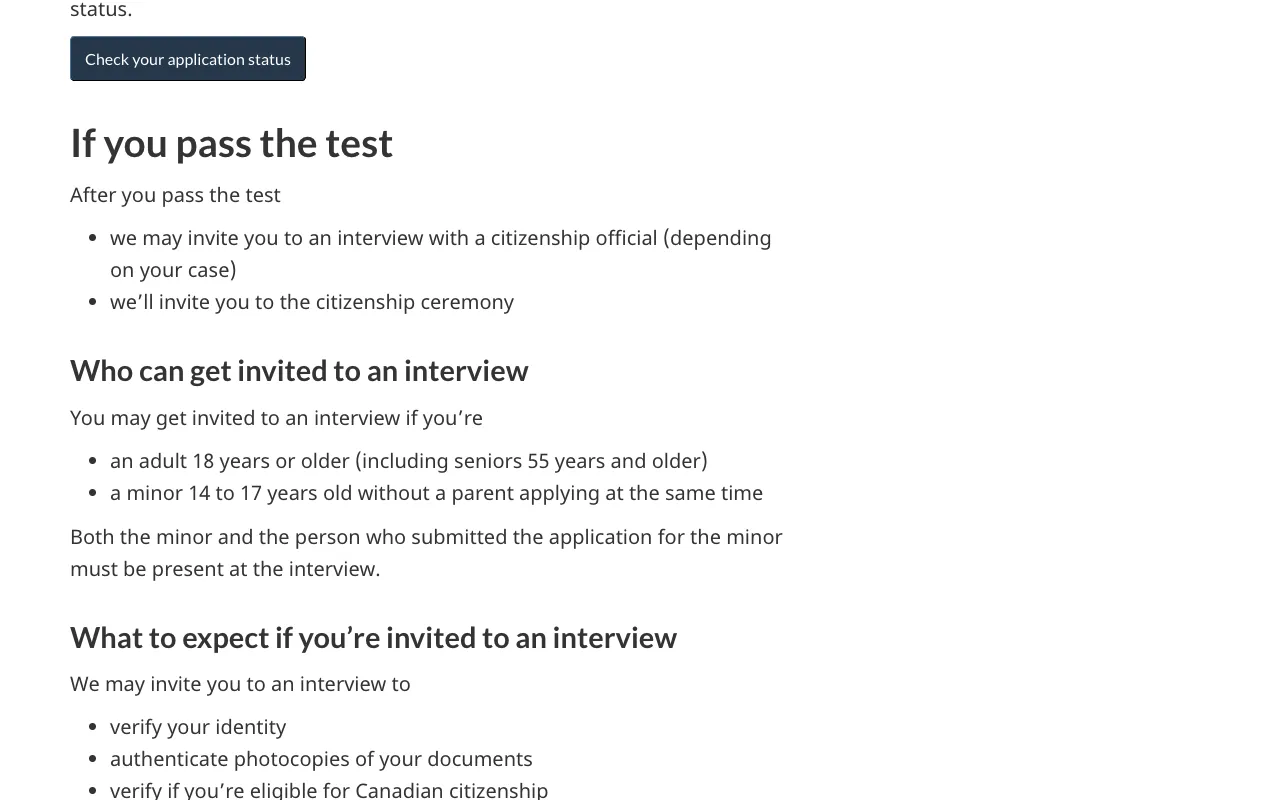
IRCC page · Citizenship test: Test results and next steps · Whole page · Live page - Adults of any age can be invited to an interview, including people 55 and older.
- Bring the original documents you sent copies of, and every passport or travel document you used in the 5 years before you applied.
- A hearing lasts 30 to 90 minutes. It can include an oral knowledge test (20 questions, 15 needed to pass), questions about your residence, and a language assessment.
- If you fail the hearing, your application is refused. You would have to reapply and pay the fees again.
Take the oath at your citizenship ceremony
Once your application is approved, IRCC invites you to a virtual or in-person ceremony at least 1 week ahead. Adults must take the oath there, and you become a citizen when you do.
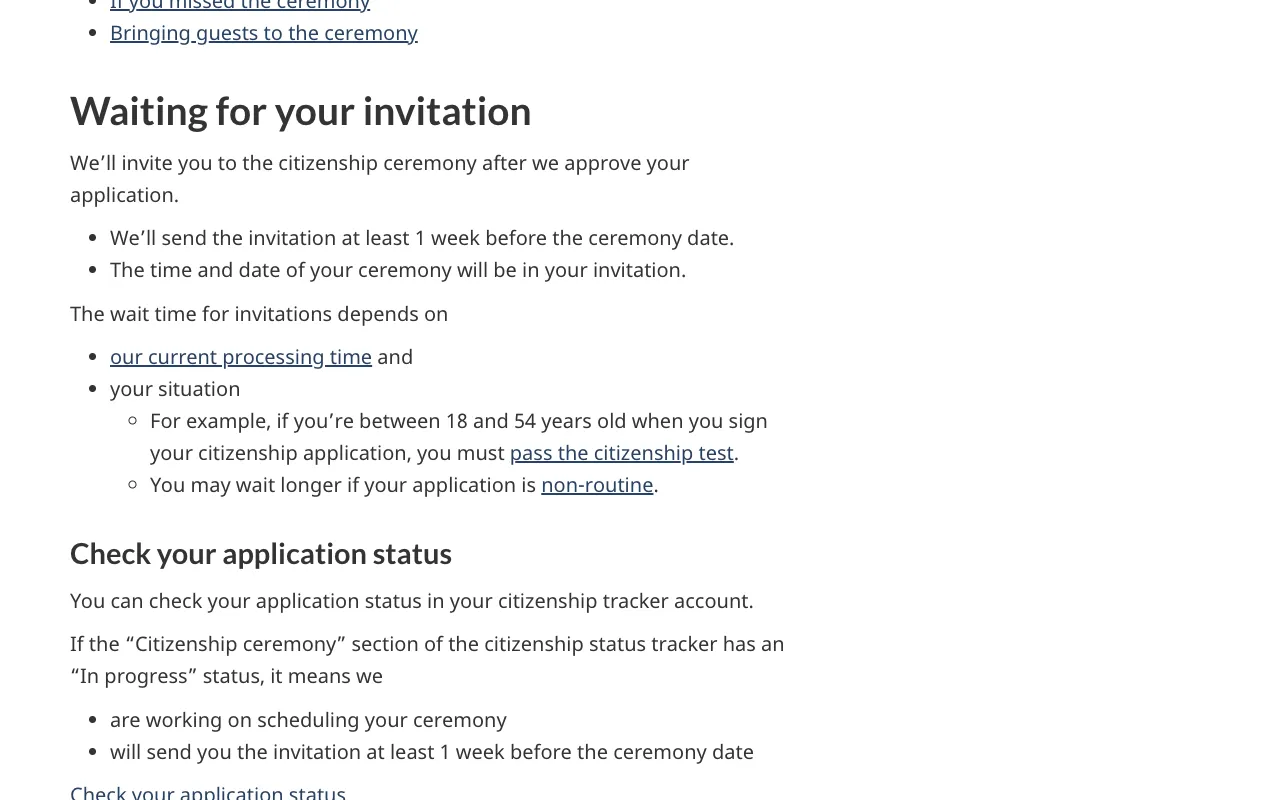
IRCC page · Citizenship ceremony: When to go to the ceremony · Whole page · Live page - Bring your invitation, your PR card (even if expired) or your Confirmation of Permanent Residence, and 2 pieces of ID. At least one ID must show both your photo and your signature.
- Your PR card is cut up (virtual ceremony) or collected (in person).
- Sign the Oath or Affirmation of Citizenship form on the day you take the oath, not the day before or after.
- You can swear the oath (with a holy book if you like) or affirm it.
- You can ask to reschedule once. If you then miss or can't attend the final invitation without a reasonable explanation, IRCC may close your application.
- Apply for a Canadian passport only after you have your citizenship certificate. Your PR card is gone after the ceremony, and the certificate is not a travel document.
Documents checklist
Gather these before you apply. Your personalized checklist from IRCC is the final word on what your application needs.
- Document checklist (CIT 0007)Every paper applicant (one checklist per application, including each family member)Paper applications only. Tick each item, stack your documents in checklist order, and put the checklist on top of the package. Online applicants follow the list in their account instead. Current version: CIT 0007 (10-2026). Official source for Document checklist (CIT 0007)
- Application for Canadian Citizenship – Adults (CIT 0002)Each adult paper applicantFill it in on a computer, click Validate to create the barcode page, print it and sign by hand. Put the barcode page on top. Current version on IRCC's page: February 2026. Online applicants fill in the application in their account. Official source for Application for Canadian Citizenship – Adults (CIT 0002)
- Physical presence calculation (Online Physical Presence Calculation printout or How to Calculate Physical Presence (CIT 0407))Every adult applicantPaper: include the printout from IRCC's online calculator, or a completed CIT 0407. Online: complete the calculator inside your account. The calculation's application date must match your signature date. Applications sent without a calculation are returned. Official source for Physical presence calculation (Online Physical Presence Calculation printout or How to Calculate Physical Presence (CIT 0407))
- All passports and travel documents during your eligibility periodEvery adult applicantColour copies of the identity page of every passport or travel document you held during the 5-year eligibility period: name, photo, date and place of birth, document number, issue and expiry dates. If a validity was extended, include the page with the extension stamp. If you had none, explain why in question 14. Bring the originals if you are asked to. Official source for All passports and travel documents during your eligibility period
- Language skills document (adults 18 to 54 only)Applicants aged 18 to 54 on the day they signSend one accepted proof at CLB/NCLC 4 or higher in speaking and listening. Education documents not in English or French need a certified translation, plus a letter from the school confirming the language of instruction and the school's address and phone number. Expired test results are accepted. To ask for a waiver instead, include the waiver request with the application. Official source for Language skills document (adults 18 to 54 only)
- 2 pieces of personal identificationEvery adult applicantOne photocopy of each ID, both sides if there is information on the back. Each must show your name, photo and date of birth. If one of them is your PR card (valid or expired is fine), the other must be issued by the federal, a provincial or a territorial government. Foreign IDs must be government-issued, and need a certified translation if they aren't in English or French. Your passport identity page can count as one of the two. Official source for 2 pieces of personal identification
- 2 citizenship photosEvery adult applicantPaper: 2 identical printed colour photos, 50 mm x 70 mm, with your name, the photographer's or studio's name and full address, and the date the photo was taken on the back. Online: 1 digital photo. Photos must be no more than 6 months old and must not be altered. Citizenship photo specifications are different from passport photo specifications. Official source for 2 citizenship photos
- Fee receiptEvery adult applicant (a group can use one combined receipt)Pay online. Paper applicants print the receipt and include it. Online applicants upload it to their account. Check the current amount on IRCC's fee list. Official source for Fee receipt
- Use of a Representative form (IMM 5476)Applicants who have a paid or unpaid representativeOnce you name a representative, IRCC sends correspondence to them instead of you. A paid representative must be a member in good standing of a provincial or territorial law society, the Chambre des notaires du Québec, or the College of Immigration and Citizenship Consultants. Official source for Use of a Representative form (IMM 5476)
- Police certificateApplicants who, in the past 4 years and since turning 18, spent 183 days or more in a row in one country outside CanadaYou need one for each such country. Exception: time in your country of origin immediately before you landed as a PR, if it falls within the 4 years. The certificate must be issued after your last stay in that country, or within 6 months of the date you sign. If you can't get one, explain why in question 10b. IRCC may ask for a police certificate at any point during processing. Official source for Police certificate
- Certified translationAnyone sending a document that isn't in English or FrenchSend the translation together with the original-language document. A certified translator is a member of a Canadian provincial or territorial translators' organization. If the translator isn't certified, they must be fluent in both languages, must not be you or a close family member, and must provide a sworn affidavit. Either way, the translation must include all text on the original and the date it was done. Official source for Certified translation
- Name change documentApplicants who legally changed their name (or had an IRCC error in their name corrected)Which documents you need depends on where and why you changed your name: marriage, divorce or civil union documents, a legal change-of-name document, a court order or an adoption order. If you changed it outside Canada, you also need an updated passport or ID and a document showing the new name. After processing starts, you can change your name only if IRCC made an error or you legally changed it. Official source for Name change document
- Date of birth change documentsApplicants who want the certificate to show a date of birth different from their immigration documentExamples: a verification of status document showing the corrected date, or a court order together with the Request to Correct a Date of Birth form (IRM 0003). You can't change your date of birth after you submit. Official source for Date of birth change documents
- Change of gender or sex identifier form (IRM 0002)Applicants who want the certificate to show a gender different from their immigration documentFill in the Request for a Change of Sex or Gender Identifier form (IRM 0002). Official source for Change of gender or sex identifier form (IRM 0002)
- Residence outside Canada as or with a Crown servant (Cit 0177)Applicants counting time outside Canada as a Crown servant or as a Crown servant's family memberYou must apply on paper if you count this time. Fill in the Residence Outside of Canada form (CIT 0177) and include the supporting documents it asks for. Official source for Residence outside Canada as or with a Crown servant (Cit 0177)
- Guardianship documentThe legal guardian or caregiver of an adult applicantOne of: a power of attorney, a court order, or a sworn affidavit. Include a certified translation if it isn't in English or French. Official source for Guardianship document
- Waiver (exemption) documentsApplicants asking to be excused from the language, test or oath requirementTypically the Waiver Request Form (CIT 0116), plus the Medical Opinion Form for Citizenship Waivers (CIT 0547) for medical reasons, and any other supporting evidence. Requests are assessed case by case and approval isn't guaranteed. Official source for Waiver (exemption) documents
- Colour photocopy of proof that you are registered under the Indian ActApplicants registered under the Indian Act (as listed on the checklist)This appears only on the October 2026 checklist (CIT 0007 (10-2026)). Accepted documents: Certificate of Indian Status, Secure Certificate of Indian Status, or Temporary Confirmation of Registration Document. The Adults forms-and-documents page (last updated 2026-04-21) doesn't list it yet and doesn't explain when it applies. See notes. Official source for Colour photocopy of proof that you are registered under the Indian Act
What to write where
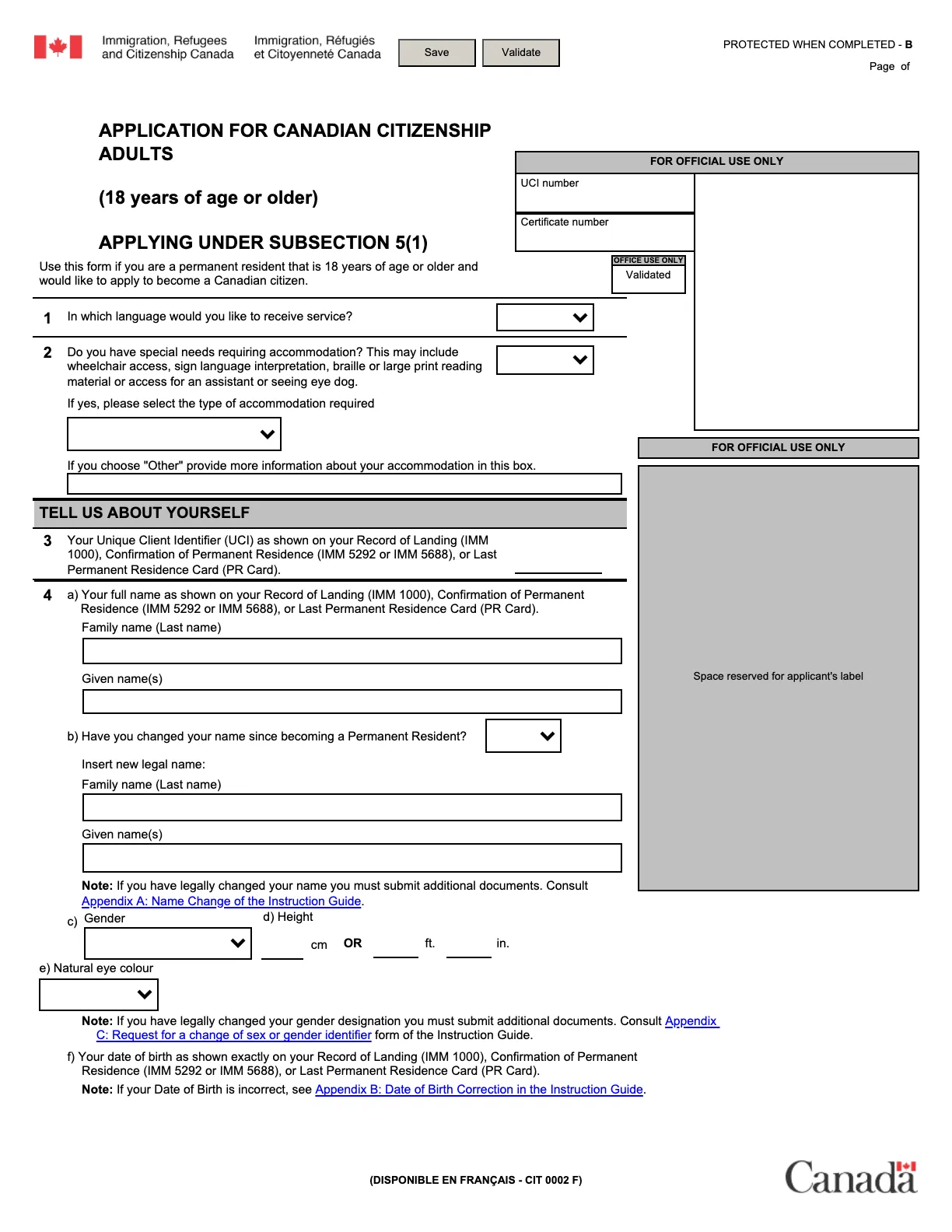
Field by field, in the order the form asks, with each one outlined on the form. Labels are as IRCC prints or documents them; the examples are made up.
CIT 0002 – Application for Canadian Citizenship – Adults (paper, version February 2026)
General application information
 12
- 1 In which language would you like to receive service?
What they’re asking: Which language, English or French, IRCC should use with you.
Choose English or French for how IRCC communicates with you and serves you in person.
e.g.
EnglishOfficial source for the field “In which language would you like to receive service?”
- 2 Do you have special needs requiring accommodation?
What they’re asking: Do you need IRCC to accommodate any special needs?
Answer No or Yes. If yes, pick the type of accommodation from the drop-down, and describe it in the box if you choose "Other".
Official source for the field “Do you have special needs requiring accommodation?”
TELL US ABOUT YOURSELF
12345678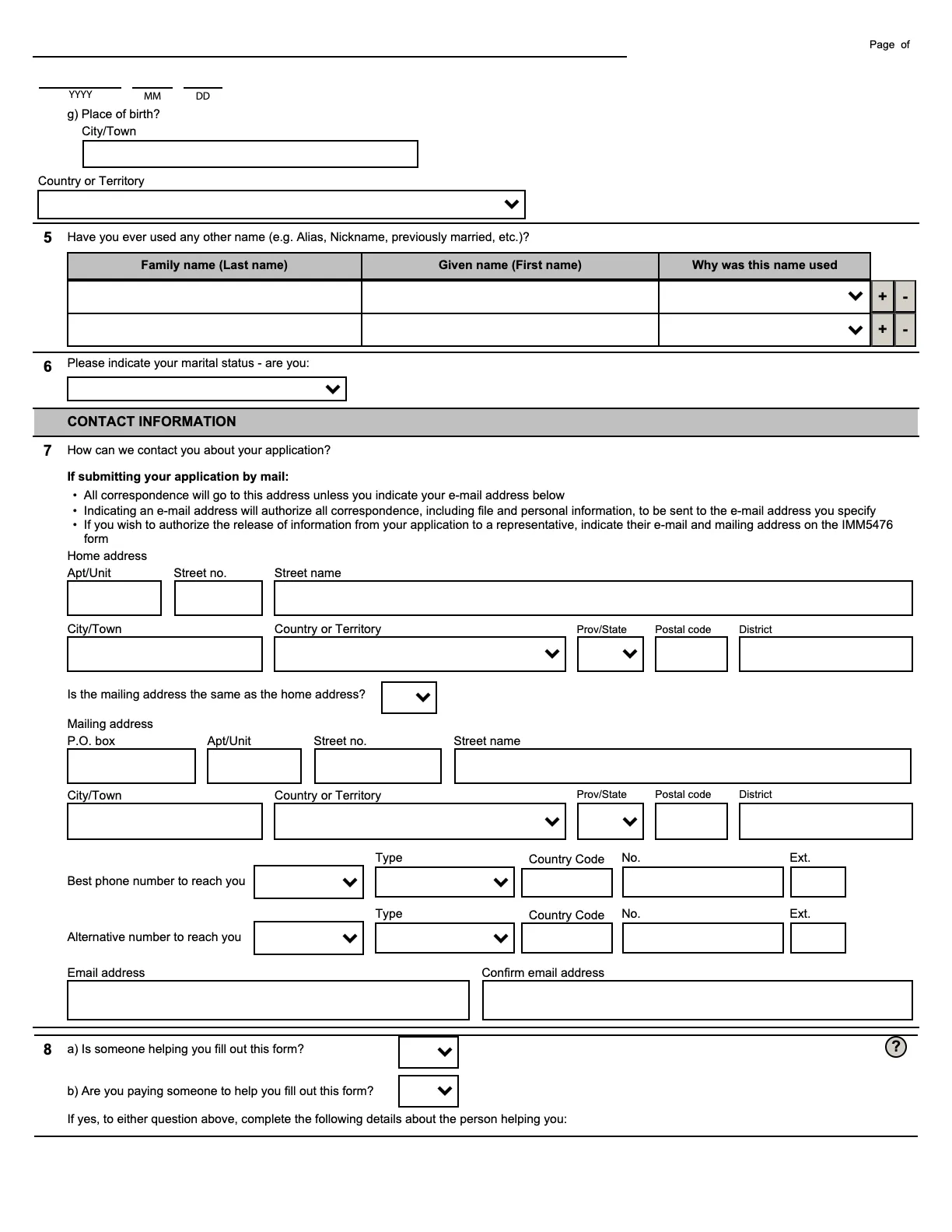 91011
- 1 Your Unique Client Identifier (UCI) as shown on your Record of Landing (IMM 1000), Confirmation of Permanent Residence (IMM 5292 or IMM 5688), or Last Permanent Residence Card (PR Card).
What they’re asking: Your IRCC client number (UCI), copied from your immigration document.
Copy your UCI, an 8- or 10-digit number, exactly as it appears on your latest immigration document. On a PR card it is next to the photo. On a COPR it is in the top right corner.
- 2 Family name (Last name)
What they’re asking: Your last name, exactly as your latest immigration document shows it.
Question 4a. Copy your family name exactly as it appears on your most recent immigration document.
e.g.
SMITH- 3 Given name(s)
What they’re asking: Your first and any middle names, exactly as on your immigration document.
Question 4a. Copy your given names exactly as on your immigration document. If you don't have a given name, leave it blank.
e.g.
AlexWatch out: Typing "*", "Not applicable" or "NA" when you have no given name.
- 4 Have you changed your name since becoming a Permanent Resident?
What they’re asking: Has your legal name changed since you became a permanent resident?
If yes, enter your new legal name and include the name change documents (see the name change document entry).
Official source for the field “Have you changed your name since becoming a Permanent Resident?”
- 5 Gender
What they’re asking: Your gender: female, male, or another gender.
Choose F, M or X (another gender). If you have legally changed your gender designation, extra documents are needed.
Watch out: Choosing F or M when it doesn't match the sex shown on the passport or travel document you send.
- 6 Height
What they’re asking: How tall you are.
Enter your height in centimetres or in feet and inches.
e.g.
170 cm- 7 Natural eye colour
What they’re asking: What colour your eyes naturally are.
Pick your natural eye colour from the list.
- 8 Your date of birth as shown exactly on your Record of Landing (IMM 1000), Confirmation of Permanent Residence (IMM 5292 or IMM 5688), or Last Permanent Residence Card (PR Card).
What they’re asking: Your date of birth, exactly as your immigration document shows it.
Enter your date of birth exactly as on your immigration document, even if you believe it is wrong (corrections have their own process). Use * for an unknown month or day.
- 9 Place of birth?
What they’re asking: The city or town and country where you were born.
Enter your city or town and country or territory of birth, written as they appear in your passport or travel document if they are shown there.
e.g.
Lyon, France- 10 Have you ever used any other name (e.g. Alias, Nickname, previously married, etc.)?
What they’re asking: Have you ever gone by another name?
Question 5. List every other name you have used, such as your birth name, maiden name, previous married names or nicknames, and pick the reason for each. Skip it if this doesn't apply to you.
- 11 Please indicate your marital status - are you:
What they’re asking: Your current marital status, using IRCC's definitions.
Question 6. Choose your current status using IRCC's definitions. For example, common-law means living together continuously in a marital-type relationship for at least one year.
Official source for the field “Please indicate your marital status - are you:”
CONTACT INFORMATION
123456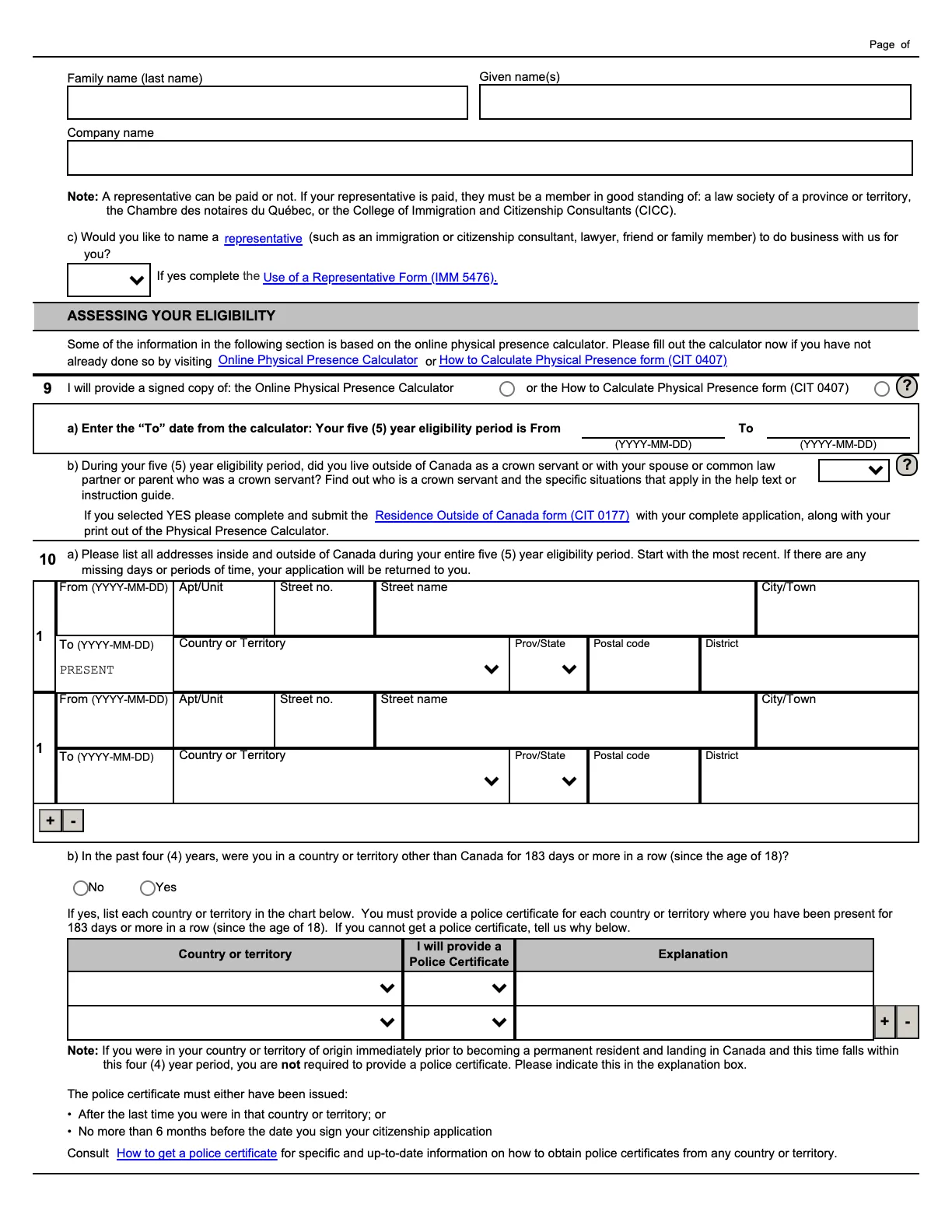 7
- 1 Home address
What they’re asking: Where you live now in Canada.
Question 7. Enter your current home address in Canada. Write words like Street or Avenue in full. Only directions such as NW or SE may be abbreviated.
e.g.
123 Sample Street, TorontoWatch out: Relying on Canada Post mail forwarding. It doesn't forward parcels, and a returned application package counts as a parcel.
- 2 Is the mailing address the same as the home address?
What they’re asking: Does your mail go to the same address where you live?
Choose Yes, or choose No and enter your mailing address.
Official source for the field “Is the mailing address the same as the home address?”
- 3 Best phone number to reach you
What they’re asking: The phone number where IRCC can most easily reach you.
Choose Canada/US or Other and the phone type, then enter the full number with country and area codes, plus any extension. The alternative number is optional.
e.g.
1 416 555-0100Official source for the field “Best phone number to reach you”
- 4 Email address
What they’re asking: An email address you check often, where IRCC can send your file information.
Enter an email address you check often, and add IRCC's sending domains to your safe senders. Giving an email authorizes IRCC to send your file information there. You need an email address to get an e-certificate.
e.g.
alex.smith@example.com- 5 Is someone helping you fill out this form?
What they’re asking: Did anyone help you put this application together?
Question 8a. Say whether anyone helped you. If yes, give their name (and company, if there is one).
Official source for the field “Is someone helping you fill out this form?”
- 6 Are you paying someone to help you fill out this form?
What they’re asking: Is the person helping you being paid?
Question 8b. Say whether the person helping you is paid. Paid representatives must be authorized (lawyer, Québec notary or licensed consultant).
Official source for the field “Are you paying someone to help you fill out this form?”
- 7 Would you like to name a representative (such as an immigration or citizenship consultant, lawyer, friend or family member) to do business with us for you?
What they’re asking: Do you want someone to deal with IRCC on your behalf?
Question 8c. If yes, fill in and include the Use of a Representative form (IMM 5476). IRCC will then write to your representative instead of you.
ASSESSING YOUR ELIGIBILITY
12345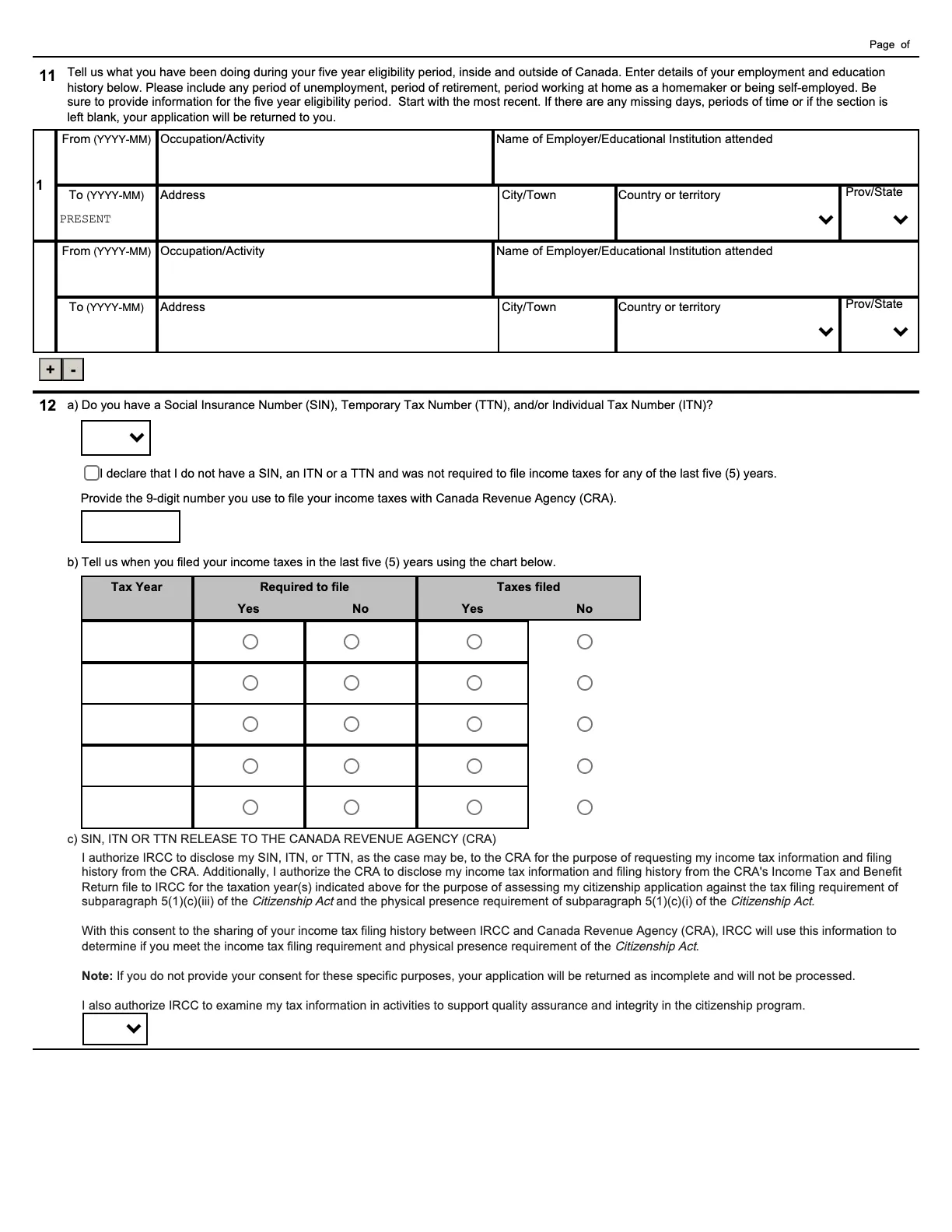 6789
 1011121314
 151617
- 1 I will provide a signed copy of: the Online Physical Presence Calculator
What they’re asking: Which physical presence calculation you're sending: the online printout or form CIT 0407.
Question 9. Tick whether you are sending the online calculator printout or the CIT 0407 form. IRCC strongly prefers the online calculator. (The form says "signed copy", but IRCC's instructions say you don't have to sign it. See notes.)
- 2 Enter the “To” date from the calculator: Your five (5) year eligibility period is From
What they’re asking: The start and end dates of your five-year eligibility period, from the calculator.
Question 9a. Copy the From and To dates of your eligibility period from the calculator summary or printout. The To date is the last day of the period. The tax years in question 12 fill in automatically from these dates.
- 3 During your five (5) year eligibility period, did you live outside of Canada as a crown servant or with your spouse or common law partner or parent who was a crown servant?
What they’re asking: Did you live abroad as, or with, a Canadian government or Armed Forces employee?
Question 9b. Most people answer No. Answer Yes only if you, or your spouse, partner or parent, were employed outside Canada by the Canadian Armed Forces, the federal public administration or a provincial or territorial public service (not as a locally engaged person). If Yes, include form CIT 0177.
- 4 Please list all addresses inside and outside of Canada during your entire five (5) year eligibility period.
What they’re asking: Everywhere you've lived, in Canada and abroad, over the five years.
Question 10a. Start with your current address and work backwards, with no gaps, covering the whole 5 years. Include foreign addresses where you lived, worked or studied. Vacation stays with friends, or at hotels and resorts, aren't needed.
e.g.
123 Sample Street, TorontoWatch out: Leaving gaps or leaving the section blank, which gets the application returned.
- 5 In the past four (4) years, were you in a country or territory other than Canada for 183 days or more in a row (since the age of 18)?
What they’re asking: Since turning 18, in the last four years, were you abroad 183+ days straight?
Question 10b. Count only unbroken stays in a single country. Several shorter trips don't add up. If Yes, list each country and whether you will send a police certificate, and give an explanation if you can't get one or if the stay was in your country of origin just before you landed.
- 6 Tell us what you have been doing during your five year eligibility period, inside and outside of Canada.
What they’re asking: What you were doing each month of the five years: work, study, or otherwise.
Question 11. List all work and study, including English or French language training, month by month (YYYY-MM) across the 5 years, most recent first. Also list time unemployed, retired, caregiving, homemaking, volunteering or self-employed. Type "present" for activities that are still going on.
e.g.
2023-01 to present, cookWatch out: Missing months or leaving the section blank, which gets the application returned.
- 7 Do you have a Social Insurance Number (SIN), Temporary Tax Number (TTN), and/or Individual Tax Number (ITN)?
What they’re asking: Do you have a Social Insurance Number, or a temporary or individual tax number?
Question 12a. If yes, enter the 9-digit number you use to file taxes with the CRA. If no, tick the declaration that you have none of these numbers and didn't have to file.
- 8 Tell us when you filed your income taxes in the last five (5) years using the chart below.
What they’re asking: For each of the five tax years, did you have to file, and did you?
Question 12b. For each tax year, tick whether you were required to file and whether you did. Fill in every year, even years you weren't living in Canada.
- 9 SIN, ITN OR TTN RELEASE TO THE CANADA REVENUE AGENCY (CRA)
What they’re asking: Do you let IRCC and the Canada Revenue Agency share your tax filing information?
Question 12c. This consent lets IRCC and the CRA share your tax filing information so IRCC can check the tax and physical presence requirements.
Watch out: Not giving consent. IRCC returns the application as incomplete.
Official source for the field “SIN, ITN OR TTN RELEASE TO THE CANADA REVENUE AGENCY (CRA)”
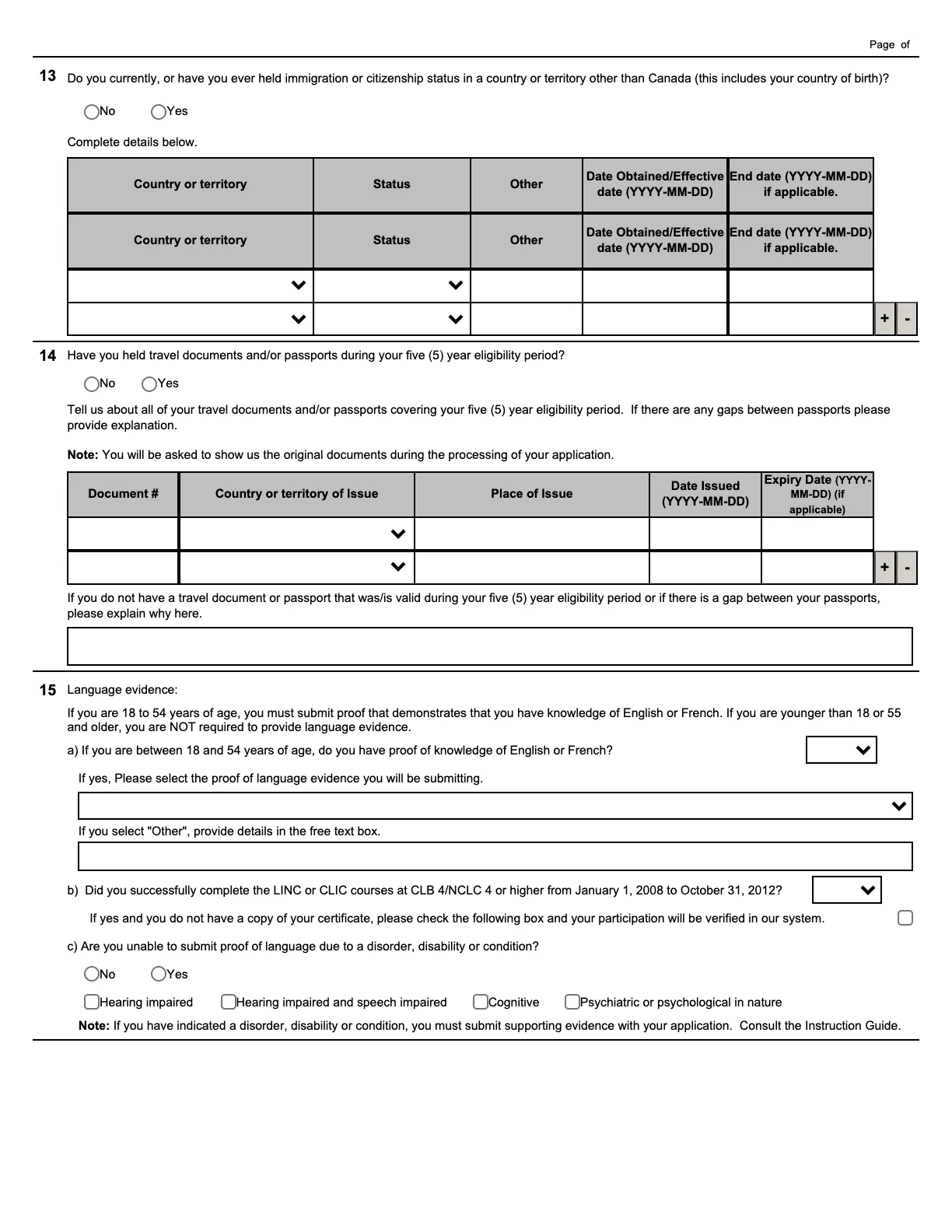
- 10 Do you currently, or have you ever held immigration or citizenship status in a country or territory other than Canada (this includes your country of birth)?
What they’re asking: Have you ever held citizenship or immigration status elsewhere, including your birth country?
Question 13. If yes, list each country, the status you held (for example citizen, permanent resident, worker or student), the date you got it, and the end date if it has ended.
- 11 Have you held travel documents and/or passports during your five (5) year eligibility period?
What they’re asking: Every passport or travel document you held during the five years.
Question 14. List every passport or travel document covering the period: number (no spaces), issuing country, place of issue, issue date and expiry date. Explain any gap, or explain if you had none.
- 12 If you are between 18 and 54 years of age, do you have proof of knowledge of English or French?
What they’re asking: If you're 18 to 54, do you have proof of English or French?
Question 15a. If yes, pick the proof you are sending from the list. If it isn't listed, choose "Other" and describe it (for example, a Nova Scotia PENS certificate).
- 13 Did you successfully complete the LINC or CLIC courses at CLB 4/NCLC 4 or higher from January 1, 2008 to October 31, 2012?
What they’re asking: Did you complete LINC or CLIC at CLB 4+ between January 2008 and October 2012?
Question 15b. If you completed LINC or CLIC in that period and don't have the certificate, tick the box and IRCC will verify it in its system.
- 14 Are you unable to submit proof of language due to a disorder, disability or condition?
What they’re asking: Does a disorder, disability or condition stop you from giving language proof?
Question 15c. If yes, tick the type of condition and include supporting evidence. For a language or knowledge waiver, that usually means the CIT 0116 form, and CIT 0547 for medical reasons.
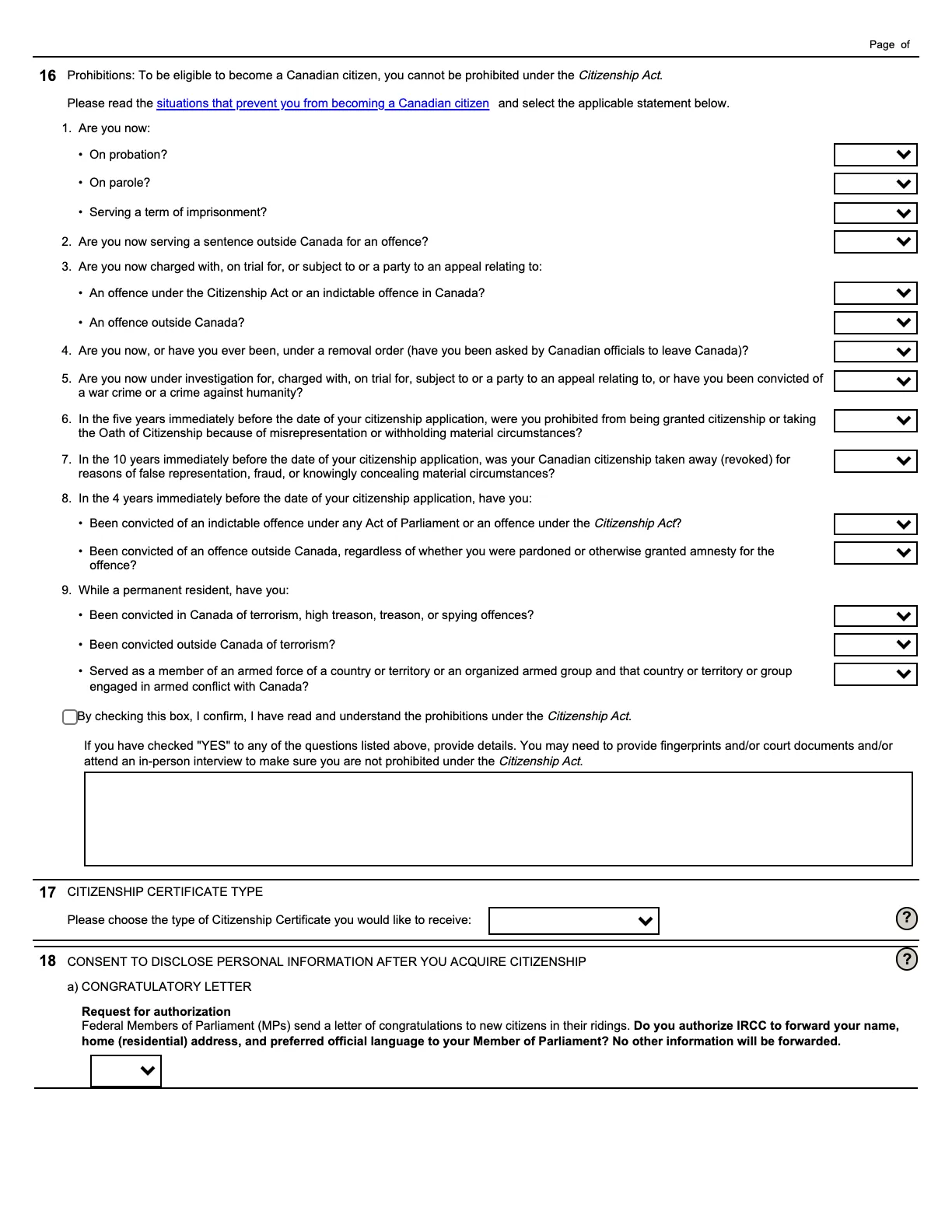
- 15 Prohibitions: To be eligible to become a Canadian citizen, you cannot be prohibited under the Citizenship Act.
What they’re asking: Nine yes-or-no questions on whether the law bars you from citizenship.
Question 16. Answer Yes or No to each of the 9 numbered prohibition questions. They cover imprisonment, parole or probation; sentences outside Canada; current charges; removal orders; war crimes; past misrepresentation or revocation; convictions in the last 4 years; and certain offences or armed service while a PR.
- 16 By checking this box, I confirm, I have read and understand the prohibitions under the Citizenship Act.
What they’re asking: Confirm you've read and understood the list of prohibitions.
Tick to confirm you have read the list of prohibitions.
- 17 If you have checked "YES" to any of the questions listed above, provide details.
What they’re asking: If you answered yes to any prohibition question, give the details.
Give details for any Yes answer. IRCC reviews these case by case and may ask for fingerprints, court documents or an interview.
Watch out: Not disclosing a prohibition and going on to the oath anyway. Citizenship can be revoked.
CITIZENSHIP CERTIFICATE TYPE
1- 1 Please choose the type of Citizenship Certificate you would like to receive:
What they’re asking: Do you want a paper or an electronic citizenship certificate?
Question 17. Choose Paper or Electronic. You can have only one type. An e-certificate requires an email address on the form.
CONSENT TO DISCLOSE PERSONAL INFORMATION AFTER YOU ACQUIRE CITIZENSHIP
1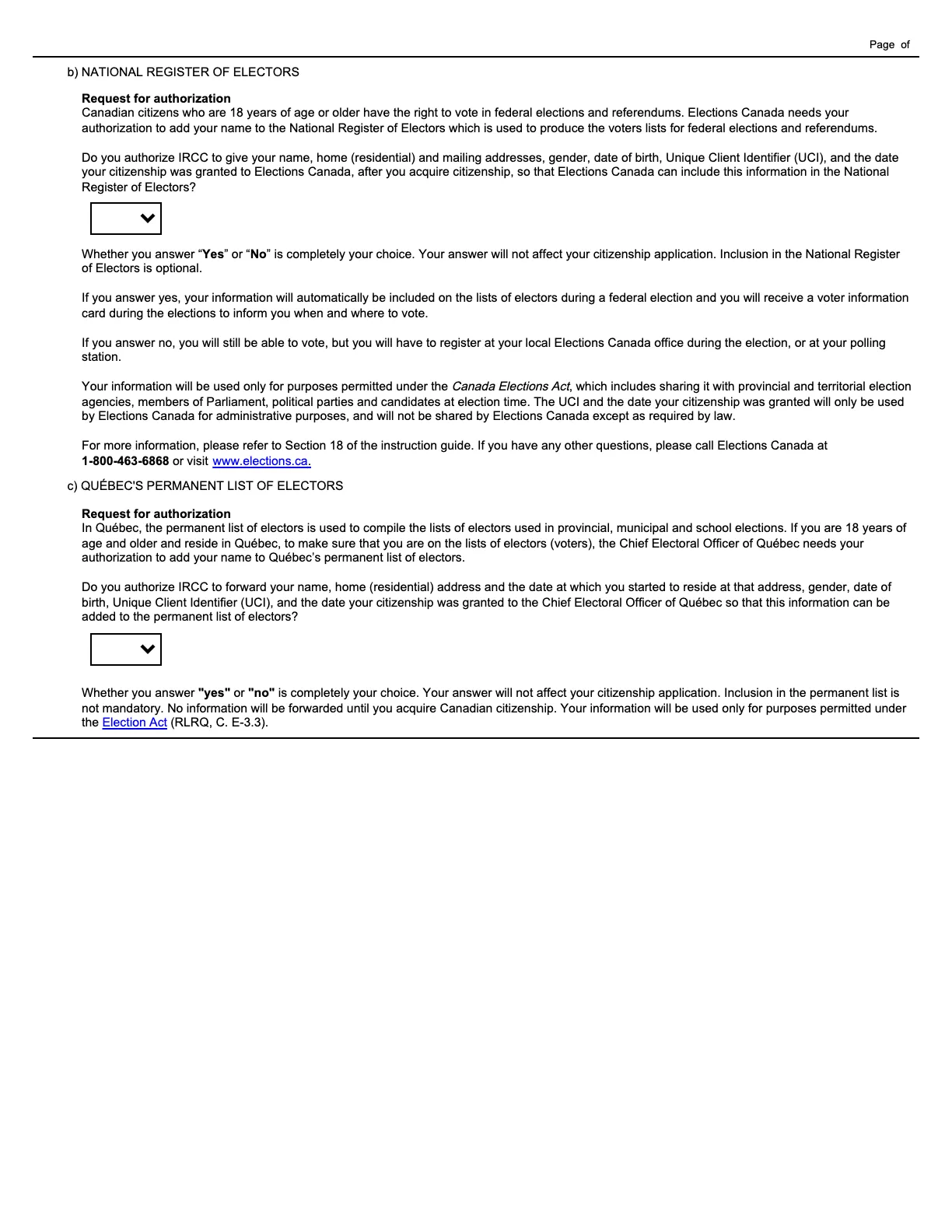 23
- 1 CONGRATULATORY LETTER
What they’re asking: Can IRCC share your details so your federal MP can congratulate you?
Question 18a. Optional consent for IRCC to give your name, address and preferred language to your federal MP so they can send a congratulations letter.
- 2 NATIONAL REGISTER OF ELECTORS
What they’re asking: Do you agree to be added to Elections Canada's voter register once you're a citizen?
Question 18b. Optional consent to add you to Elections Canada's register once you are a citizen. Your answer doesn't affect your application, and you can still vote either way.
Official source for the field “NATIONAL REGISTER OF ELECTORS”
- 3 QUÉBEC'S PERMANENT LIST OF ELECTORS
What they’re asking: Québec residents 18 or older only: do you want to join Québec's voter list?
Question 18c. Only for Québec residents aged 18 or older. Optional consent to add you to Québec's permanent list of electors. Your answer doesn't affect your application.
Official source for the field “QUÉBEC'S PERMANENT LIST OF ELECTORS”
SIGNATURE OF APPLICANT
 1234
- 1 Signature of applicant
What they’re asking: Your handwritten signature, confirming your answers are true and complete.
Question 19. Read the declaration, print the validated form, and sign it by hand in pen. Signing confirms your information is true and complete and that the photos look like you.
- 2 City
What they’re asking: The city you're applying from.
Type the city you are applying from.
e.g.
Toronto- 3 Date (YYYY-MM-DD)
What they’re asking: The date you sign, which must match your calculator's application date.
Enter the date you actually sign, which must equal the application date in your physical presence calculation. Mail the package soon after.
e.g.
2027-01-15Watch out: A date that doesn't match the calculator, a future (post-dated) date, or a date more than 90 days before IRCC receives the application. All of these get it returned.
- 4 Validate
What they’re asking: The button that checks for missing fields and makes the barcode page.
Click Validate (top or bottom of the form) after filling it in on a computer. It flags missing fields and creates the barcode page, which goes on top of your application.
Watch out: Filling the form in by hand, which means no barcode page is created.
IRCC Physical Presence Calculator (for paper applications; also usable as a pre-check before applying online)
CALCULATION OF PHYSICAL PRESENCE FOR CITIZENSHIP
12- 1 Enter the date you will sign the application.
What they’re asking: The date you'll sign your application, or today's date if just checking.
Field A. Enter the exact date you will sign. If you are only checking eligibility, enter today's date. The calculator sets your 5-year window from this date.
e.g.
2027-01-15Watch out: Using a calculation whose application date differs from the date you sign the form.
Official source for the field “Enter the date you will sign the application.”
- 2 Enter the date you became a permanent resident of Canada
What they’re asking: The date you became a permanent resident, from your PR documents.
Field B. Copy the date you became a PR from your PR documents, as the calculator describes.
Official source for the field “Enter the date you became a permanent resident of Canada”
Temporary resident or protected person status in Canada
 24
- 1 Did you have Canadian temporary resident status (i.e. as a visitor, international student, temporary worker, temporary resident permit holder), and/or were a protected person) between [start of your eligibility period] and [the day before you became a PR]?
What they’re asking: Before PR, were you in Canada as a visitor, student, worker or protected person?
The calculator fills in the dates. Answer Yes if you had authorized TR or protected-person status in Canada during that window.
- 2 Type
What they’re asking: What kind of status you had during each period.
For each period, choose Visitor, International Student, Temporary Worker, Temporary Resident Permit Holder or Protected Person.
e.g.
International StudentWatch out: Listing time on a work or study permit issued while a refugee claim or PRRA was pending. That wasn't temporary resident status.
- 3 From date:
What they’re asking: When that status period started.
Start date of that status period (YYYY-MM-DD). Then click Add Entry.
e.g.
2019-09-01- 4 To date:
What they’re asking: When that status period ended.
End date of that status period. Protected-person time ends the day before you became a PR.
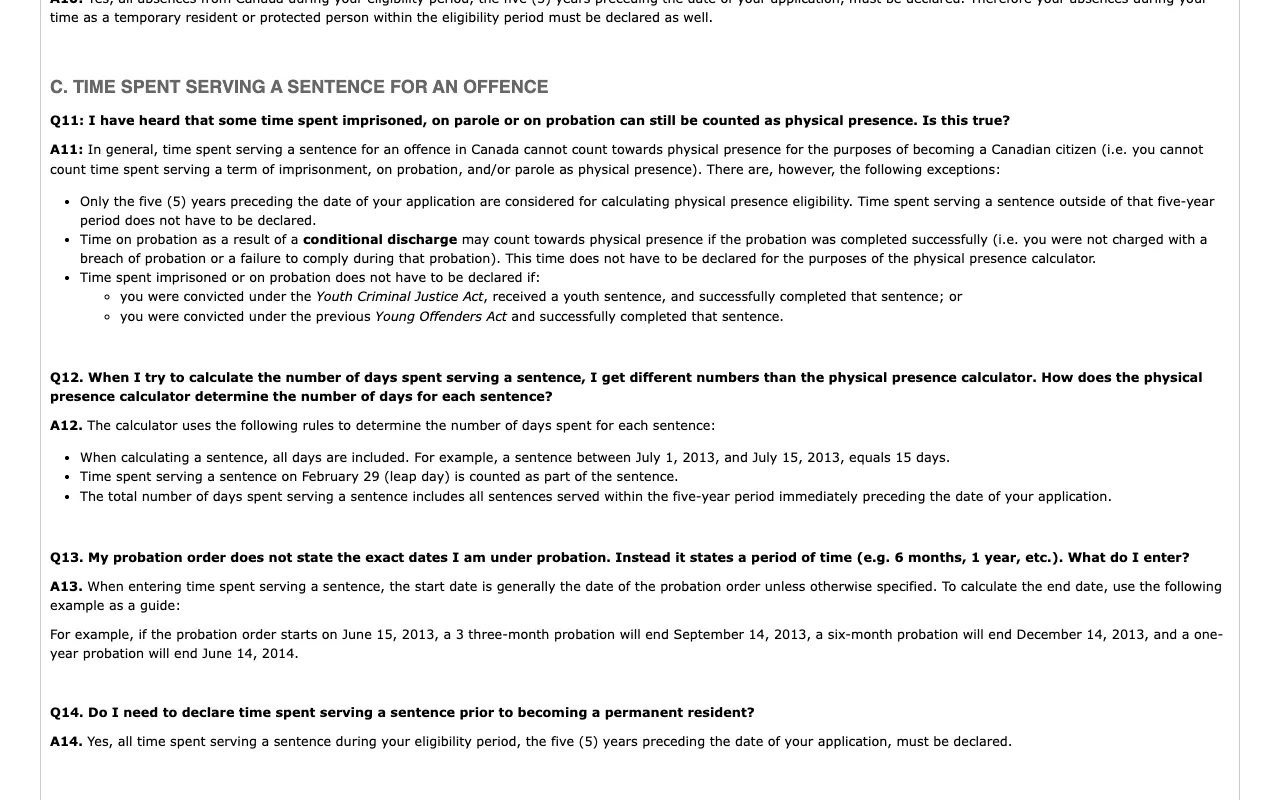
Time spent serving a sentence
 1
- 1 Did you spend time serving a sentence for an offence in Canada (e.g. "term of imprisonment", conditional sentence, probation and or parole) between [start] and [end of your eligibility period]?
What they’re asking: Did you serve a sentence in Canada, like prison, probation or parole, in this period?
Read IRCC's exceptions before you answer. For example, successfully completed probation after a conditional discharge, and completed youth sentences, don't have to be declared.
Absences from Canada
34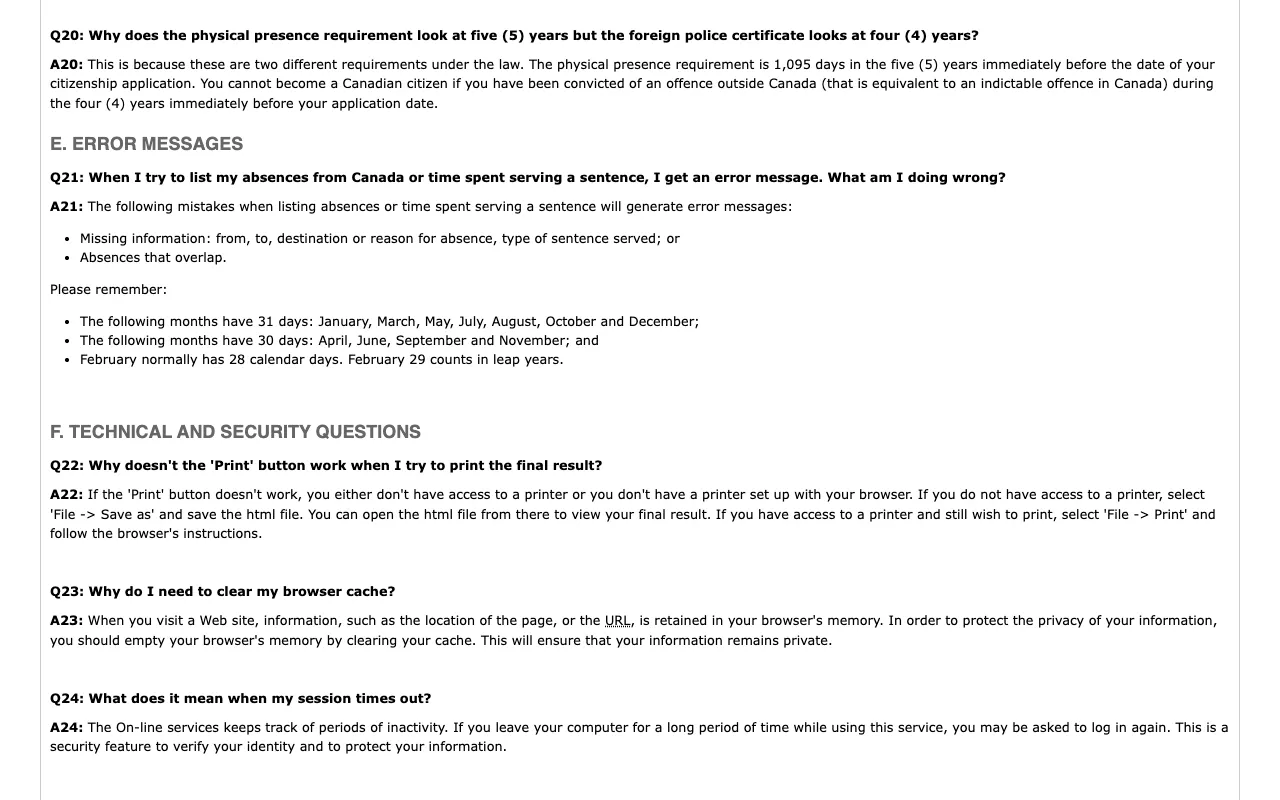 5
- 1 Did you leave Canada between [start] and [end of your eligibility period]?
What they’re asking: Did you leave Canada at all during your eligibility period, even for a day?
Answer Yes if you left Canada for any reason, including same-day trips.
- 2 Destination:
What they’re asking: The first country you went to on this trip.
Pick the first country you went to. If the trip covered several countries, name the others in the Reason field.
- 3 Date you left Canada:
What they’re asking: The exact day you left Canada on this trip.
The exact departure date. The calculator counts this day as a day in Canada.
- 4 Date you returned to Canada:
What they’re asking: The exact day you came back to Canada.
The exact return date. This day also counts as a day in Canada, so only the full days in between count as absence.
Official source for the field “Date you returned to Canada:”
- 5 Reason: (Max 400 characters)
What they’re asking: Why you travelled, plus any other countries on the same trip.
A short reason, such as vacation, work or family, plus any other countries visited on the same trip. Then click Add Absence. Click Calculate when every absence is listed.
e.g.
VacationWatch out: Leaving an entry incomplete or entering overlapping absences. The calculator shows an error for both.
Official source for the field “Reason: (Max 400 characters)”
Online citizenship application account (only the parts IRCC's public pages describe)
Physical presence calculator
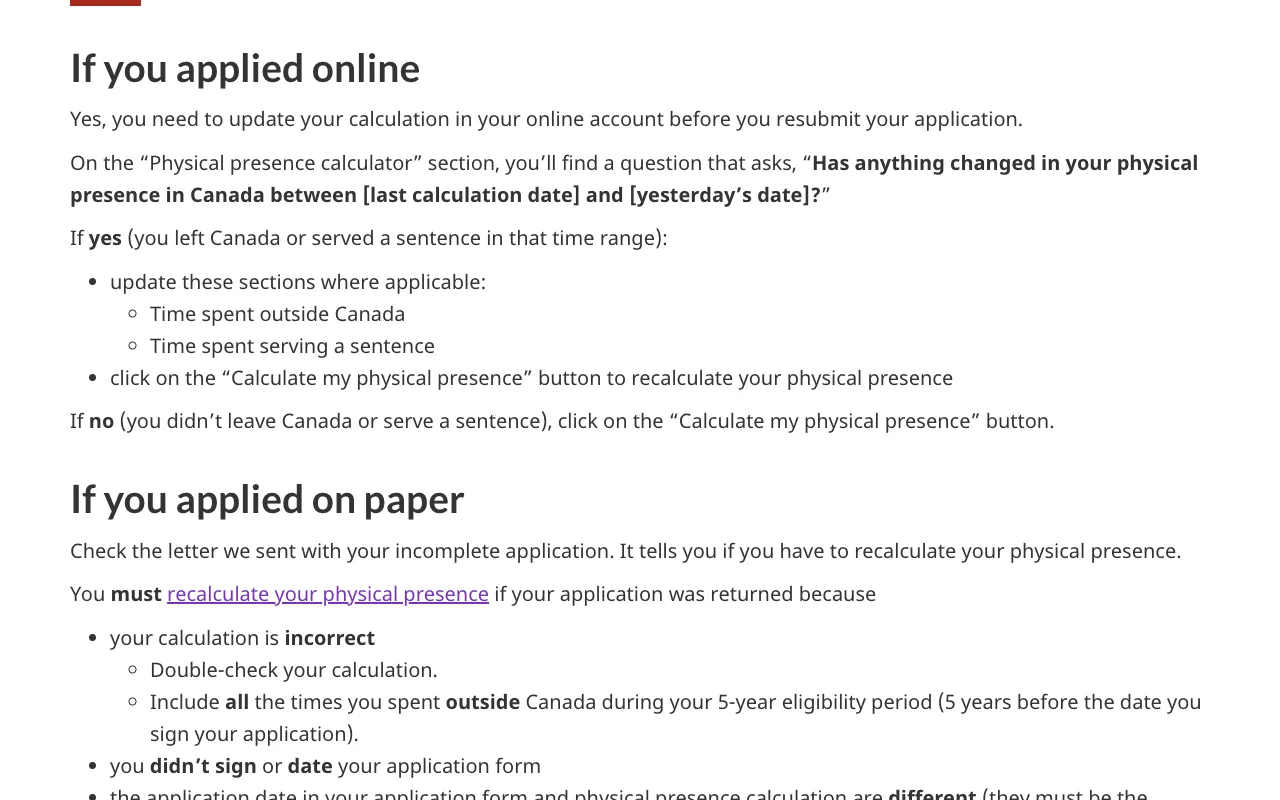 1234
- 1 Time spent outside Canada
What they’re asking: Your trips outside Canada, entered in your online account's calculator.
Enter or update your absences from Canada in the account's calculator. Online applicants must use this calculator, available only after you create an account.
- 2 Time spent serving a sentence
What they’re asking: Any time you spent serving a sentence during your eligibility period.
Enter or update any time served on a sentence in the eligibility period.
Official source for the field “Time spent serving a sentence”
- 3 Calculate my physical presence
What they’re asking: The button that runs your physical presence calculation.
The button that runs the calculation. If your application was returned, press it again (after updating anything that changed) before you resubmit.
Official source for the field “Calculate my physical presence”
- 4 Has anything changed in your physical presence in Canada between [last calculation date] and [yesterday’s date]?
What they’re asking: Since your last calculation, did you leave Canada or serve a sentence?
Appears when you recalculate before resubmitting. Answer Yes if you left Canada or served a sentence in that range.
Your account
1- 1 Leave group
What they’re asking: The button to leave a group application.
Button for leaving a group application. If you had already signed, you will have to sign again.
Co-applicants applying with you
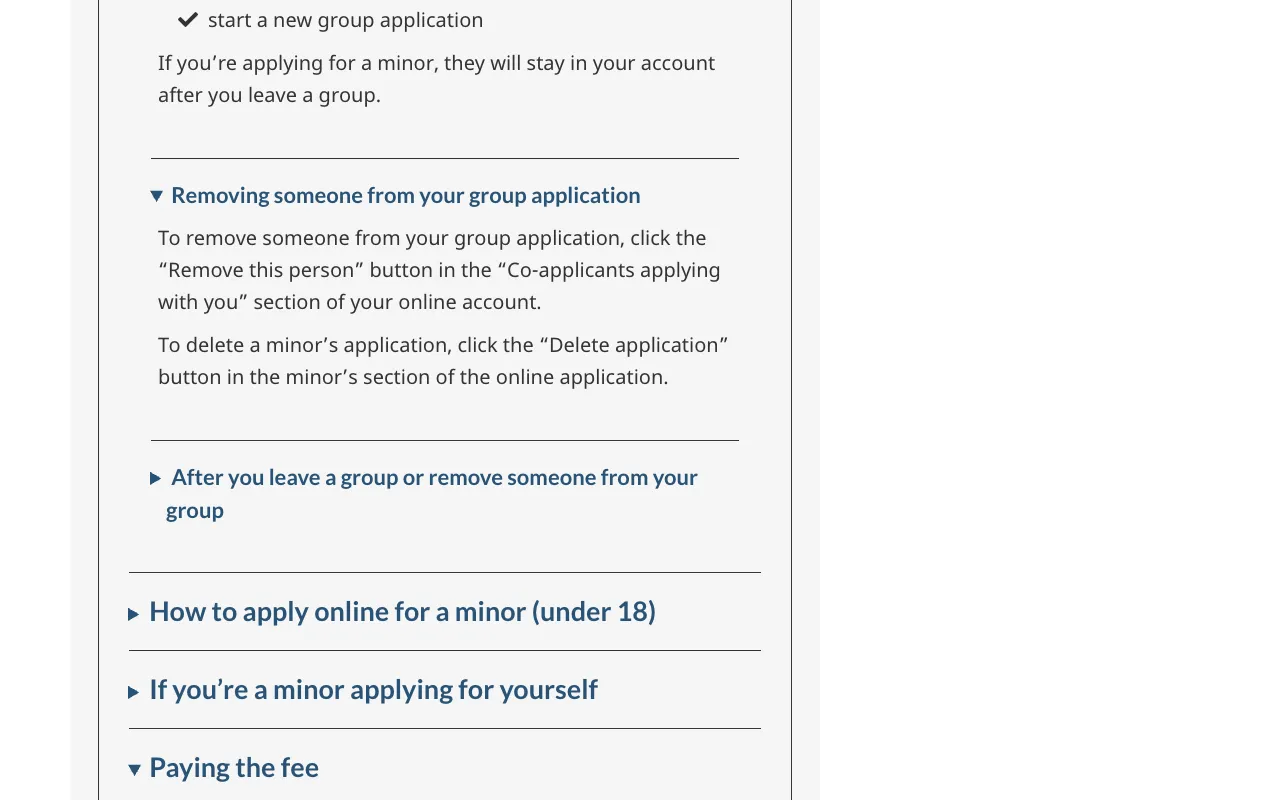 1
- 1 Remove this person
What they’re asking: The button to take someone off your group application.
Button for removing someone from your group application.
Mistakes IRCC warns about
- Signing the application on a different date from the application date used in the physical presence calculation. Official source for this mistake
- Mailing the application more than 90 days after signing it, or post-dating it. Official source for this mistake
- Applying with fewer than 1,095 days, or miscounting absences or sentences. A shortfall found later means refusal, and the processing fee is not refunded. Official source for this mistake
- Not declaring day trips (for example to the United States) or work-related absences. Official source for this mistake
- Counting time on a work or study permit issued while a refugee claim or PRRA was being decided as temporary resident time. Official source for this mistake
- Sending the application without a physical presence calculation (the travel journal doesn't replace it). Official source for this mistake
- Leaving gaps in the address history (question 10) or the work and activity history (question 11). Official source for this mistake
- Missing, unreadable or untranslated language proof (ages 18 to 54), or sending IELTS Academic instead of General Training. Official source for this mistake
- Not consenting to the IRCC and CRA tax information release (question 12c). Official source for this mistake
- Using passport-style photos, or photos that are altered or older than 6 months. Official source for this mistake
- Paying only part of the fee, or not including the receipt. Official source for this mistake
- Sending a family or group package in which one application is incomplete. Every application in it comes back. Official source for this mistake
- Giving your representative your online account password, or letting them fill in your online application. If they are to complete and submit it for you, you have to apply on paper. Official source for this mistake
- Relying on mail forwarding after you move. Tell IRCC your new address instead. Official source for this mistake
- Getting fingerprints taken at a Service Canada Centre when IRCC asks for them. Official source for this mistake
- Using an outdated version of the application form. Official source for this mistake
- Missing your ceremony twice without contacting IRCC. The application can be closed. Official source for this mistake
- Planning travel right after the ceremony without a Canadian passport. Your PR card is gone, and the certificate isn't a travel document. Official source for this mistake
After you apply
- Online applicants get an automatic confirmation email right after submitting. It isn't the acknowledgement of receipt (see the AOR step).
- IRCC checks the application for completeness. If it's complete you get an AOR with your application number and UCI and can then check your status online. If it's incomplete, IRCC returns it, doesn't process the fee, and tells you what is missing (see the AOR step).
- While you wait, tell IRCC about changes to your address or contact details, absences of more than 2 weeks in a row, or criminal charges. Reply to requests within the stated time, usually 30 days (see the AOR step).
- IRCC may ask for fingerprints or extra documents, or select your file for a Quality Assurance review that includes an interview (see the AOR step).
- Applicants aged 18 to 54 get an emailed test invitation with a 30-day window and 3 attempts. Pass mark: 15 out of 20 (see the citizenship test step).
- After the test, IRCC may invite you to an interview. If you fail all 3 test attempts, you are invited to a hearing (see the interview or hearing step).
- Once approved, you get a ceremony invitation at least 1 week ahead. You take the oath, sign the Oath or Affirmation of Citizenship form that day, and receive a paper certificate or an e-certificate (see the ceremony step).
- After you have your citizenship certificate, apply for a Canadian passport before you travel (see the ceremony step).
Not covered here
- Applying for a minor with a Canadian parent or a parent applying at the same time (minor 5(2)) (Official page)
- Applying for a minor without a Canadian parent or a parent applying at the same time (minor 5(1)) (Official page)
- Counting time outside Canada as a Crown servant or a Crown servant's family member (paper only, form CIT 0177) (Official page)
- Canadian Armed Forces members or veterans (Official page)
- Adopted children born outside Canada (Official page)
- Stateless people born to a Canadian parent (Official page)
- Proof of citizenship (citizenship certificate) for people who may already be Canadian (Official page)
- Requesting a waiver of the language, test or oath requirement (detailed criteria and forms) (Waiver for citizenship requirements)
- Requesting urgent processing (Official page)
- Withdrawing your application (Official page)
- What to do if your application is refused (Official page)
- Country-by-country instructions for police certificates (Official page)
- Whether you had to file a Canadian tax return in a given year (Canada Revenue Agency) (Official page)
- Field-by-field help for the paper How to Calculate Physical Presence form (CIT 0407) (How to Calculate Physical Presence (CIT 0407))
- Advice for your individual situation, which this guide doesn't give. IRCC explains how to choose a representative (Official page)
Official IRCC pages
- Apply for Canadian citizenship: adults and minor children (IRCC section overview)
- Who can apply (eligibility)
- Check if you are eligible to apply for citizenship (questionnaire)
- How to apply (online and on paper)
- Apply online (online citizenship application account)
- Calculate your physical presence (which calculator to use)
- Physical Presence Calculator (for paper applications and pre-checks)
- Physical Presence Calculator FAQ
- Adults: Forms and documents to apply on paper
- Application for Canadian Citizenship – Adults (CIT 0002) and step-by-step instructions
- Document Checklist (CIT 0007)
- How to Calculate Physical Presence (CIT 0407)
- Find out if you have the language proof for citizenship
- Citizenship photo specifications
- Situations that may prevent you from becoming a Canadian citizen
- Fee list (check current citizenship fees)
- Pay your fees online
- Check processing times
- After you apply
- Check your application status
- Citizenship test
- Discover Canada (official study guide)
- Citizenship ceremony
- Record your trips outside Canada (travel journal)
- Accessibility accommodations
- Waiver for citizenship requirements