Steps
Check whether you need a study permit
Most foreign nationals need a study permit to study at a DLI in Canada. A few groups are exempt, most commonly people taking a program of 6 months or less.
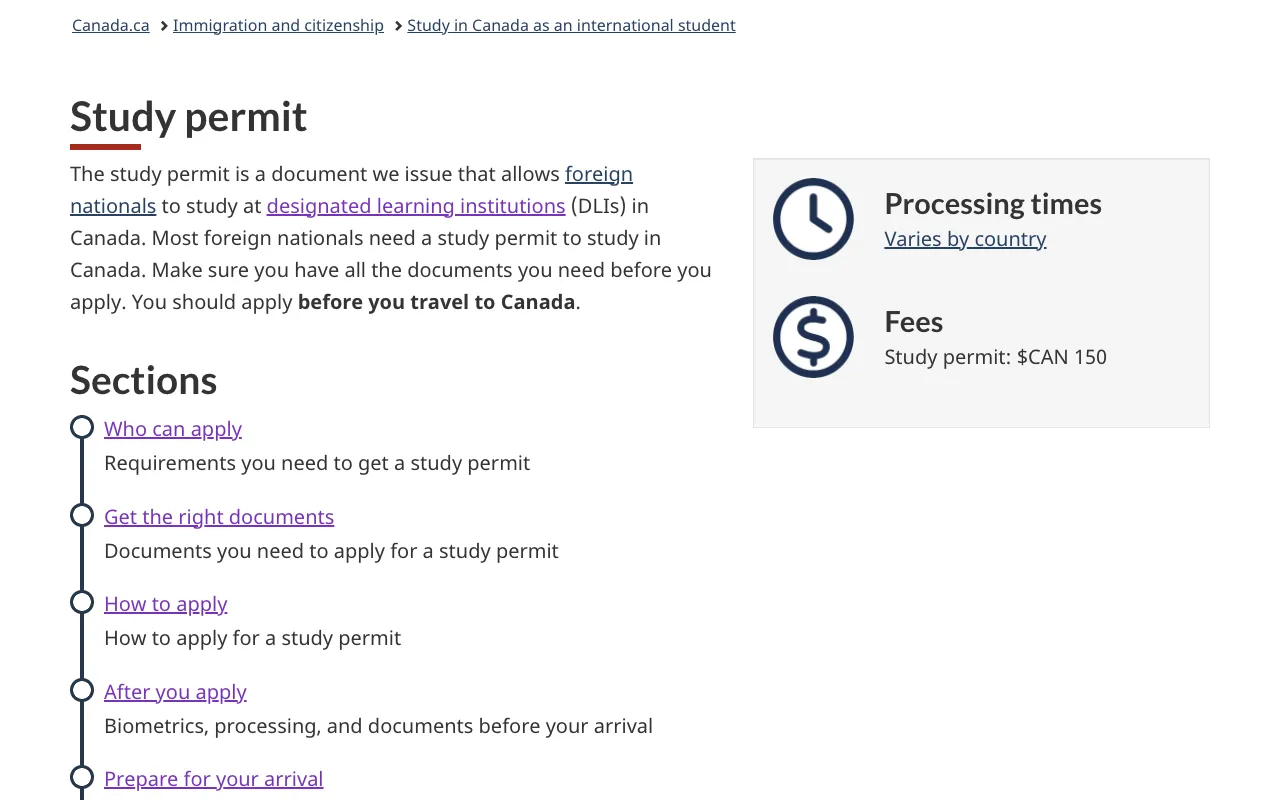
IRCC page · Study permit · Whole page · Live page - IRCC's 'Who can study without a permit' page lists the exceptions. They include short programs (6 months or less), some family and staff of accredited foreign representatives, members of designated foreign armed forces on duty, Registered Indians in Canada, and certain minor children.
- If your program is 6 months or less but you plan to continue into another program, IRCC says you should apply for a study permit before you come. Without one, you would have to apply from outside Canada later.
- Some activities are not considered study at all, such as distance learning and audited courses.
Make sure you meet the basic requirements
You must be enrolled at a DLI, prove you can pay your costs, be law-abiding and in good health, and convince an officer that you will leave Canada when your permit expires.
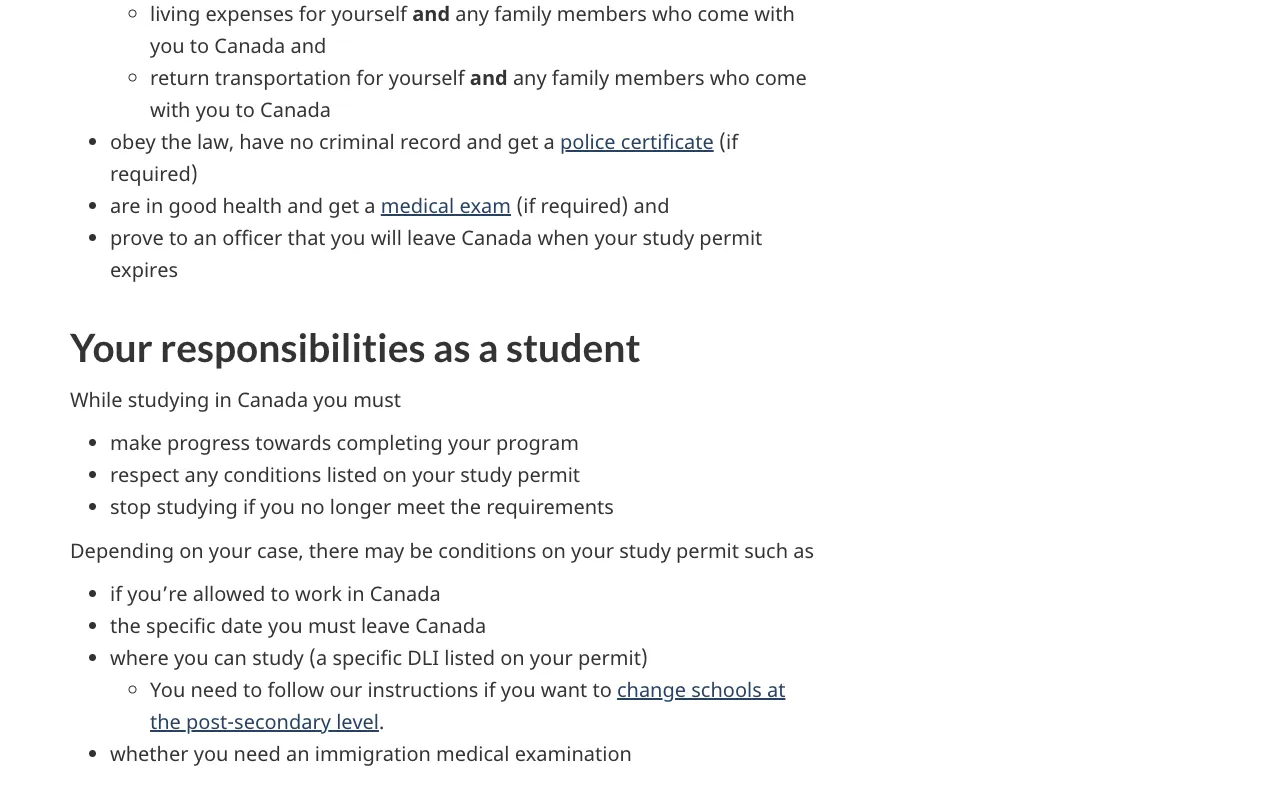
IRCC page · Study permit: Who can apply · Whole page · Live page - Be enrolled at a DLI.
- Show you have enough money for tuition, living expenses for you and any family members who come with you, and return transportation.
- Have no criminal record and get a police certificate if one is required.
- Be in good health and get a medical exam if one is required.
- Convince an officer that you will leave Canada when your study permit expires.
- If you might want a post-graduation work permit (PGWP) later, check its requirements before you submit. PGWP eligibility can depend on when you submit your study permit application and, for some levels of study, on your field of study.
Get a letter of acceptance from a designated learning institution (DLI)
Apply to a school. Post-secondary schools must appear on IRCC's DLI list. The school gives you a letter of acceptance (LOA), which you include with your application.
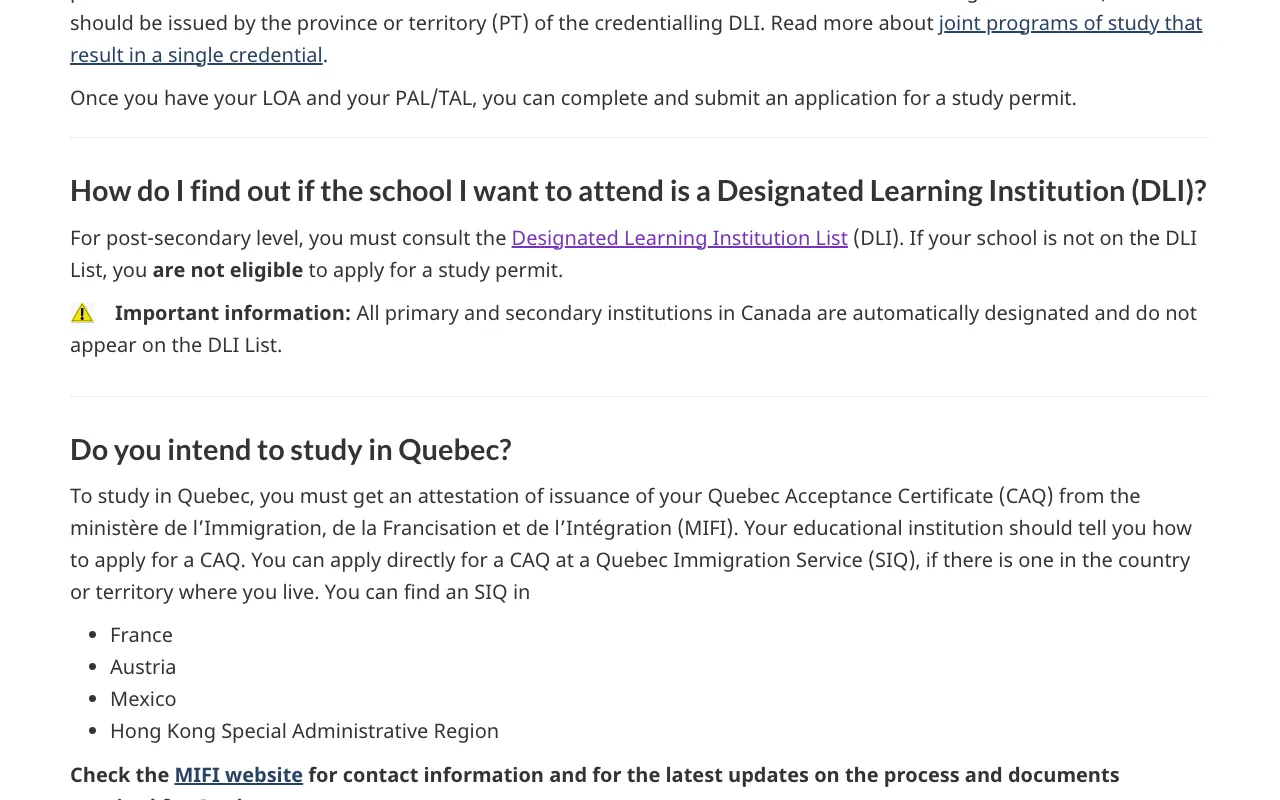
IRCC page · Guide 5269 - Applying for a Study Permit outside Canada · Whole page · Live page - Post-secondary schools: check the DLI list before you commit. If the school isn't on the list, you can't apply for a study permit to attend it.
- All primary and secondary schools in Canada are automatically designated, so they don't appear on the list.
- Write down the school's DLI number. You enter it in the 'Details of intended study in Canada' section of the form.
- The LOA must be on the school's official letterhead. It must show the exact tuition you have to pay, your expected start and finish dates, and the date by which you must register.
- For post-secondary students, IRCC asks the school to confirm your LOA is valid. If the school doesn't respond by the deadline, IRCC returns your application and refunds the processing fee.
- Exception: you don't need an LOA if you're the family member of someone whose study permit or work permit was approved in writing before you come to Canada.
Get your provincial or territorial attestation letter (PAL/TAL), or a CAQ for Quebec
Most applicants need a PAL/TAL from the province or territory where they'll study, obtained through the school. Students going to Quebec need a Quebec Acceptance Certificate (CAQ) instead. People who are exempt must show proof.
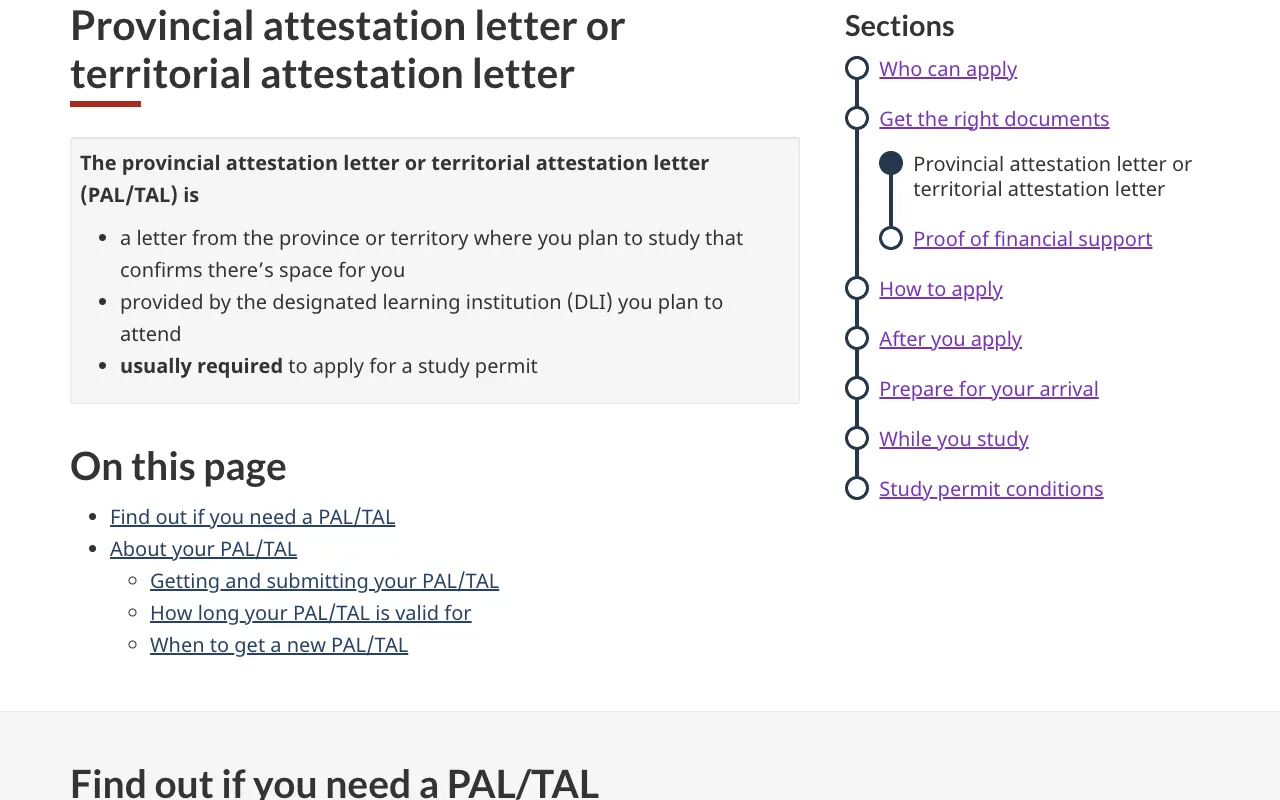
IRCC page · Study permit: Get the right documents Provincial attestation letter or territorial attestation letter · Whole page · Live page - A PAL/TAL confirms you have one of the province's or territory's available study spaces. Your DLI tells you how to apply for it. In most cases you must accept your offer and pay part or all of your tuition first.
- Submit the PAL/TAL with your study permit application, not afterwards. Each study permit applicant needs one, even when family members apply together.
- The PAL/TAL must be valid on the day you apply. It doesn't need to be valid when your studies start. You can't use one issued in a previous study permit cap year.
- Once an application that used a PAL/TAL has been approved or refused, you can't reuse that PAL/TAL.
- Exemptions include preschool, primary and secondary school, degree-granting master's or doctoral programs at a public DLI (from January 1, 2026), some exchange students, and Global Affairs Canada scholarship holders. Check IRCC's full list. If you're exempt, upload proof that you meet the exception.
- Quebec: you need an attestation of issuance of your CAQ from the Government of Quebec. Your school can tell you how to apply.
Gather proof of financial support
Show that, without working in Canada, you can pay tuition, living expenses for yourself and any family members who come with you, and travel to and from Canada.
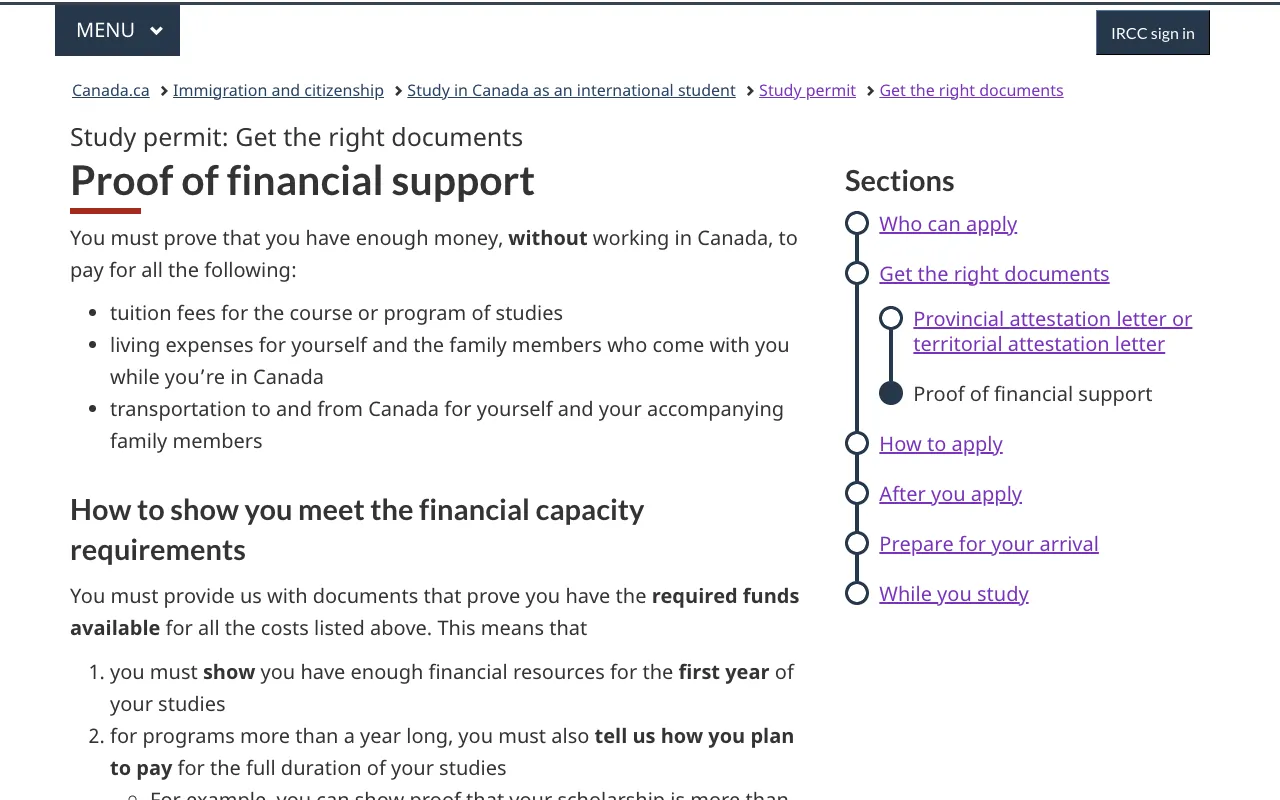
IRCC page · Study permit: Get the right documents - Proof of financial support · Whole page · Live page - Show you have enough money for your first year of studies. For programs longer than a year, also explain how you'll pay for the rest of the program, for example a multi-year scholarship or proof that your parents are employed.
- IRCC publishes a minimum amount for living expenses (not including tuition and travel) that depends on family size and is updated every year. Check the current table on IRCC's proof of financial support page. Quebec has its own requirements for the CAQ.
- Examples of documents IRCC accepts: proof you paid first-year tuition and housing, a student or education loan, a scholarship, a guaranteed investment certificate (GIC) from a Canadian financial institution, 6 months of bank statements that show where the money came from, or a letter from the person or institution supporting you. IRCC says the list isn't complete.
- If your country has foreign exchange controls, you must prove you'll be allowed to take the money out of the country.
Prepare your identity, medical, police and other supporting documents
Collect your passport copy, photos, a letter of explanation, and any medical exam, police certificate, custodian documents or visa-office-specific documents that apply to you.
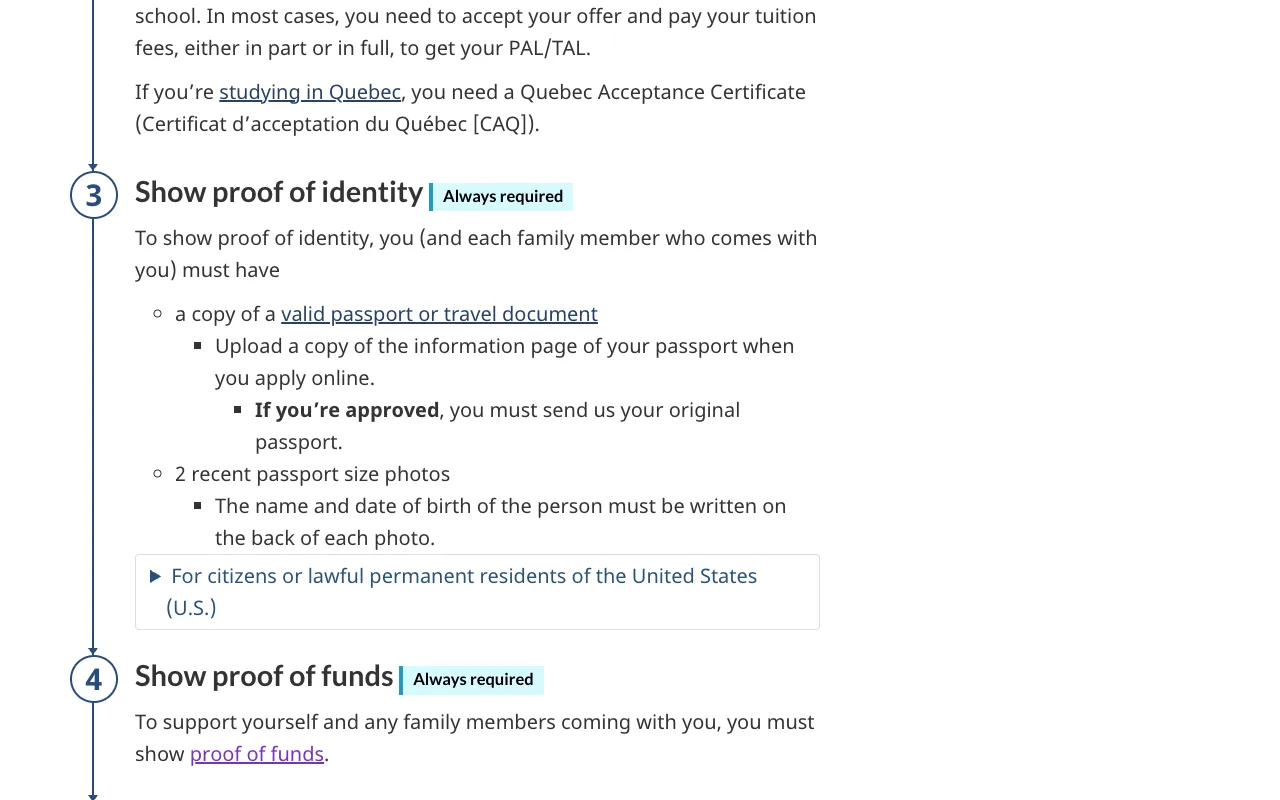
IRCC page · Study permit: Get the right documents · Whole page · Live page - You and each family member coming with you need a valid passport or travel document. Upload a copy of the passport information page.
- Write a letter of explanation (IRCC recommends it) saying why you want to study in Canada and showing you understand your responsibilities as an international student.
- You may need a medical exam, for example if you'll stay more than 6 months and recently spent time in certain countries, or if you'll work in jobs where public health must be protected.
- IRCC may ask for a police certificate. If you think you'll need one, apply early.
- Children under 17 who aren't coming with a parent or legal guardian need a custodian in Canada.
- Get your local visa office instructions by choosing your country on IRCC's How to apply page. They may list extra documents.
- Any document that isn't in English or French needs a translation. If the translator isn't a certified translator, include their affidavit. You and your family members can't do the translations.
Confirm where you can apply from: outside Canada, inside Canada, or at the port of entry
Most people must apply before they travel to Canada. Some people already in Canada can apply from inside, and a few groups can apply when they arrive at the border.
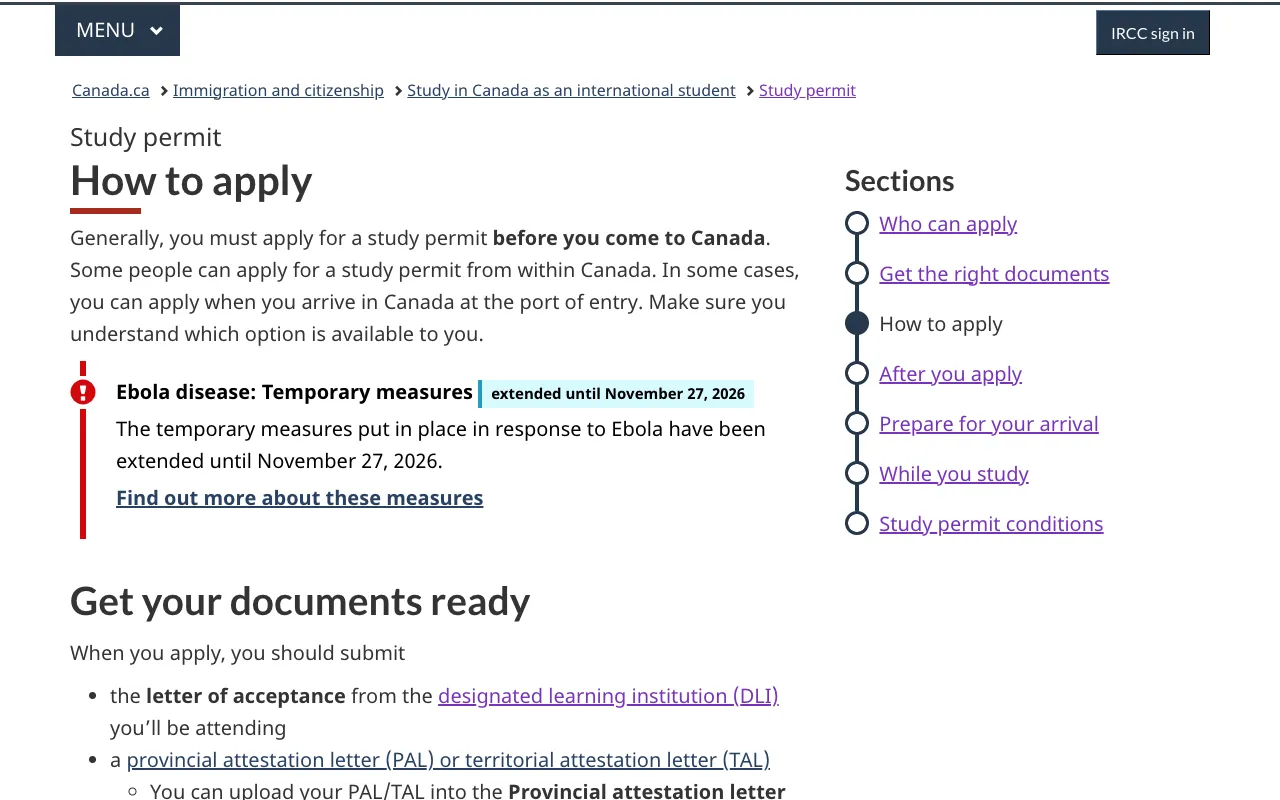
IRCC page · Study permit: How to apply · Whole page · Live page - From inside Canada: only in certain situations. Examples include holding a valid study or work permit, having a spouse, common-law partner or parent with a valid study or work permit, being a minor child in primary or secondary school, being an exchange or visiting student, or having completed a short course required for acceptance at a DLI. See IRCC's How to apply page for the full list.
- In-Canada applicants fill out IMM 5709 instead of IMM 1294. Our study permit extension walkthrough covers that form.
- At a port of entry: only if you're a US citizen, a US permanent resident, someone lawfully admitted to the US for permanent residence, or a resident of Greenland or Saint-Pierre and Miquelon.
- If you're in Canada but not in one of the eligible situations, you must leave Canada and apply from outside.
Apply online through your IRCC secure account
Study permit applications must be submitted online, from outside or inside Canada. Paper is allowed only in two situations.
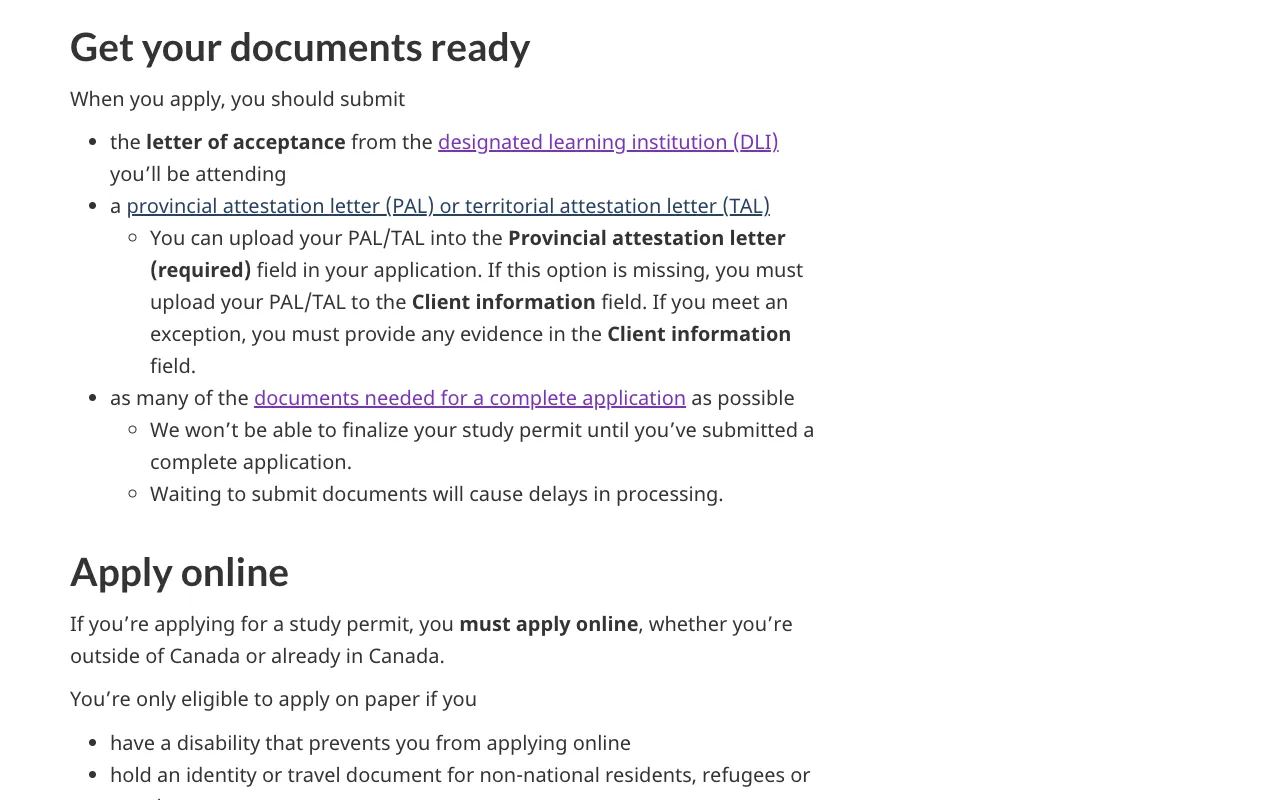
IRCC page · Study permit: How to apply · Whole page · Live page - You can apply on paper only if a disability prevents you from applying online, or if you hold an identity or travel document for non-national residents, refugees or stateless persons.
- You need a scanner or camera to make electronic copies of your documents, and a valid credit or debit card.
- Read Guide 5269 before you start.
- Answer the online questions. IRCC uses your answers to create a personalized document checklist.
- Upload your LOA only in the space meant for the LOA. Anything else you put there may be shared with your school.
- Upload your PAL/TAL in the 'Provincial attestation letter (required)' field. If that field isn't there, use the 'Client information' field. Proof of a PAL/TAL exemption also goes in 'Client information'.
- If you need an eTA or visitor visa, IRCC issues it with your study permit. You don't apply for it separately or pay another fee.
- Submit as complete an application as you can. IRCC won't finalize your study permit until the application is complete, and sending documents later causes delays.
Fill out IMM 1294 and the other forms that apply to you
Every person who needs a study permit fills out their own IMM 1294 (Application for a Study Permit Made Outside of Canada), plus Family Information (IMM 5707) and any other forms their checklist lists.
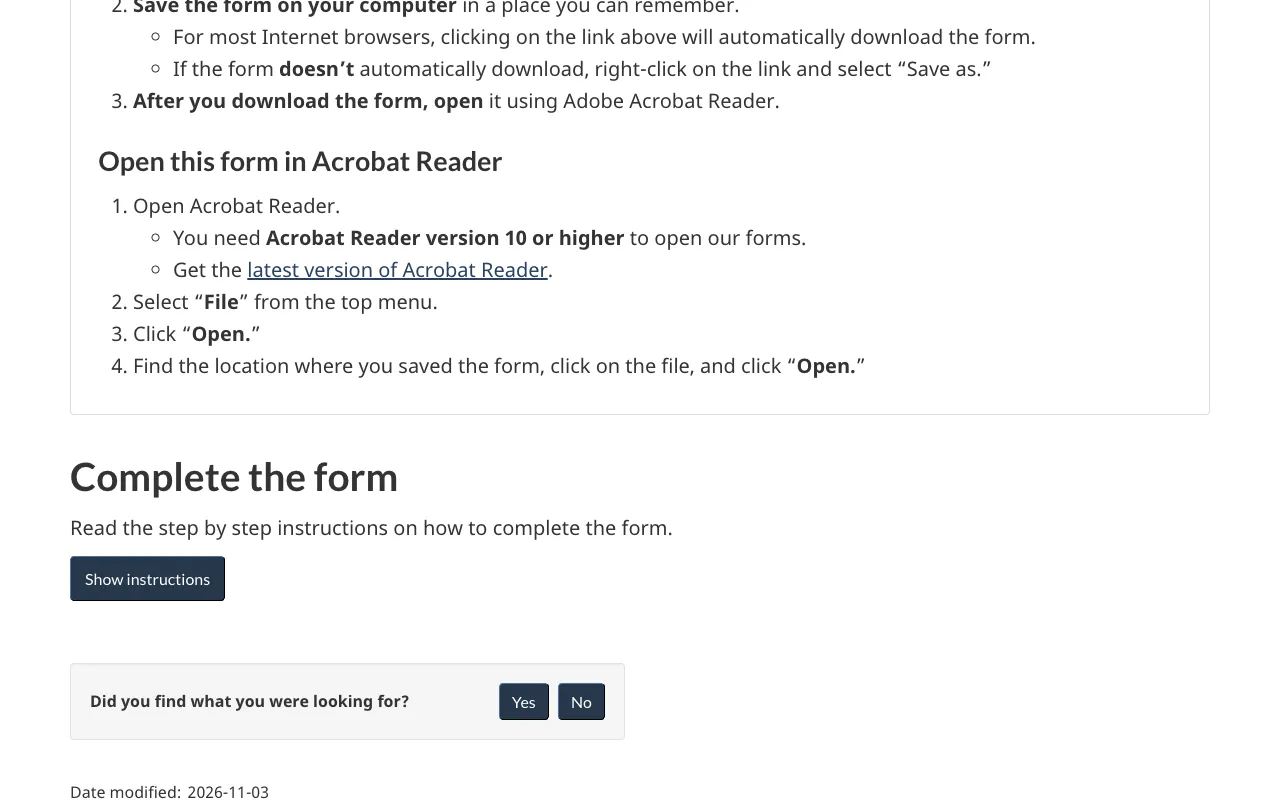
IRCC page · Application for a Study Permit Made Outside of Canada (IMM 1294) · Whole page · Live page - Download the PDF to a computer and open it in Adobe Reader (version 10 or higher). It may not work in a web browser or on a phone or tablet.
- Answer every question. If a question doesn't apply, write 'Not Applicable' or 'NA'. Names are the exception: if you have no given name, leave that box empty.
- Validate a form you filled out on a computer to generate its barcode page.
- If you apply online, you don't need to print and sign IMM 1294. Leave the signature section empty.
- Family Information (IMM 5707) is for applicants aged 18 or older and minors travelling alone. Other forms if they apply: IMM 5409 (common-law union), IMM 5646 (custodian for a minor), IMM 5476 (use of a representative) and IMM 5475 (release of information to someone else).
- Accompanying family members fill out their own application forms. Applications can be submitted together.
Pay the fees
You pay the study permit processing fee and, in most cases, the biometrics fee at the end of the online application.
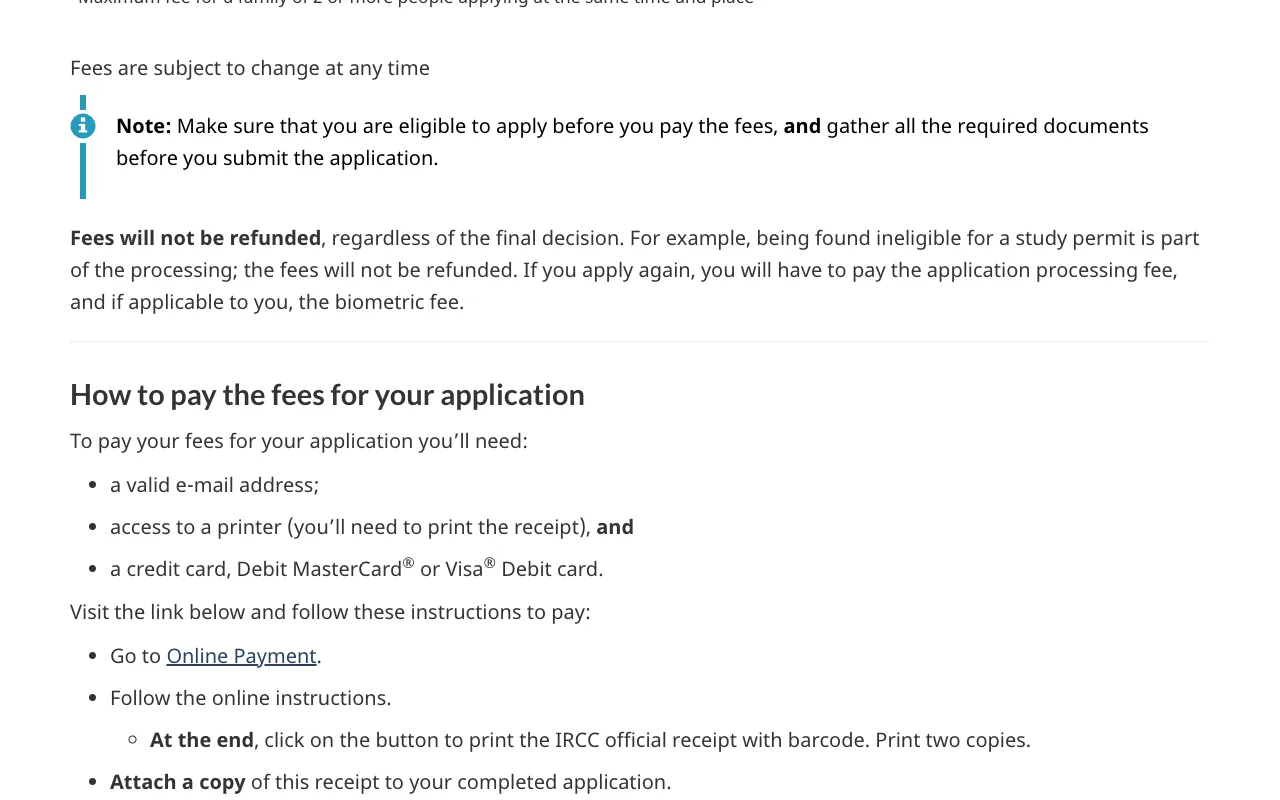
IRCC page · Guide 5269 - Applying for a Study Permit outside Canada · Whole page · Live page - Fees change, so check the current amounts on IRCC's fee list instead of relying on old figures.
- Pay the biometrics fee at the same time as the processing fee to avoid delays.
- You pay any third parties directly, for example the panel physician for a medical exam, the police for a certificate, or a visa application centre for its services.
- IRCC generally doesn't refund fees once it has processed your application, whatever the decision.
Give your biometrics (fingerprints and photo)
Most applicants aged 14 to 79 must give biometrics after they receive a biometric instruction letter (BIL). You have 30 days from the date on the letter.
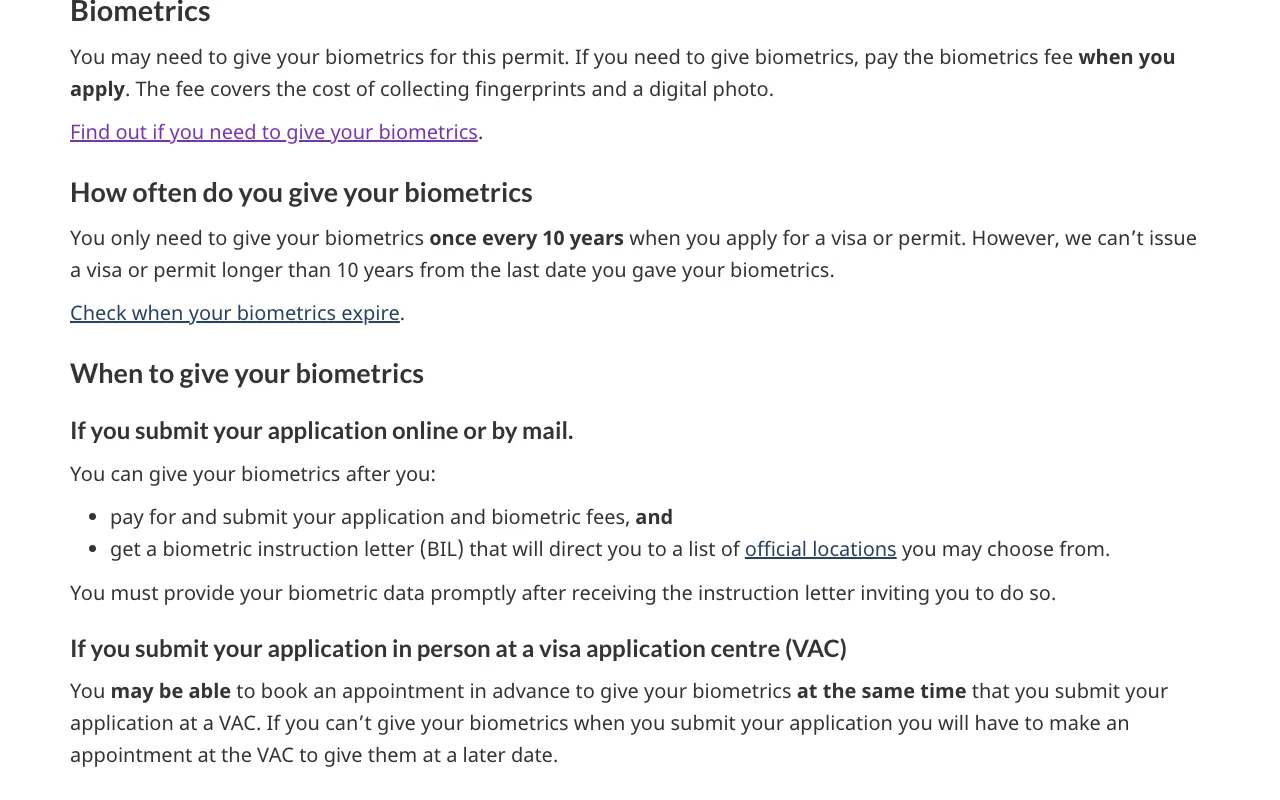
IRCC page · Guide 5269 - Applying for a Study Permit outside Canada · Whole page · Live page - Wait for your BIL, then book an appointment at an official collection point. Outside Canada (except the US) this is usually a visa application centre (VAC). In Canada it's a designated Service Canada office.
- Biometrics are valid for 10 years, but IRCC can't issue a permit that runs past 10 years from the date you last gave them. You can check when yours expire with IRCC's online tool.
- IRCC starts processing your application after it receives your biometrics.
Respond to IRCC while your application is processed
IRCC checks that your application is complete. It may ask for more information, an interview, a medical exam or a police certificate.
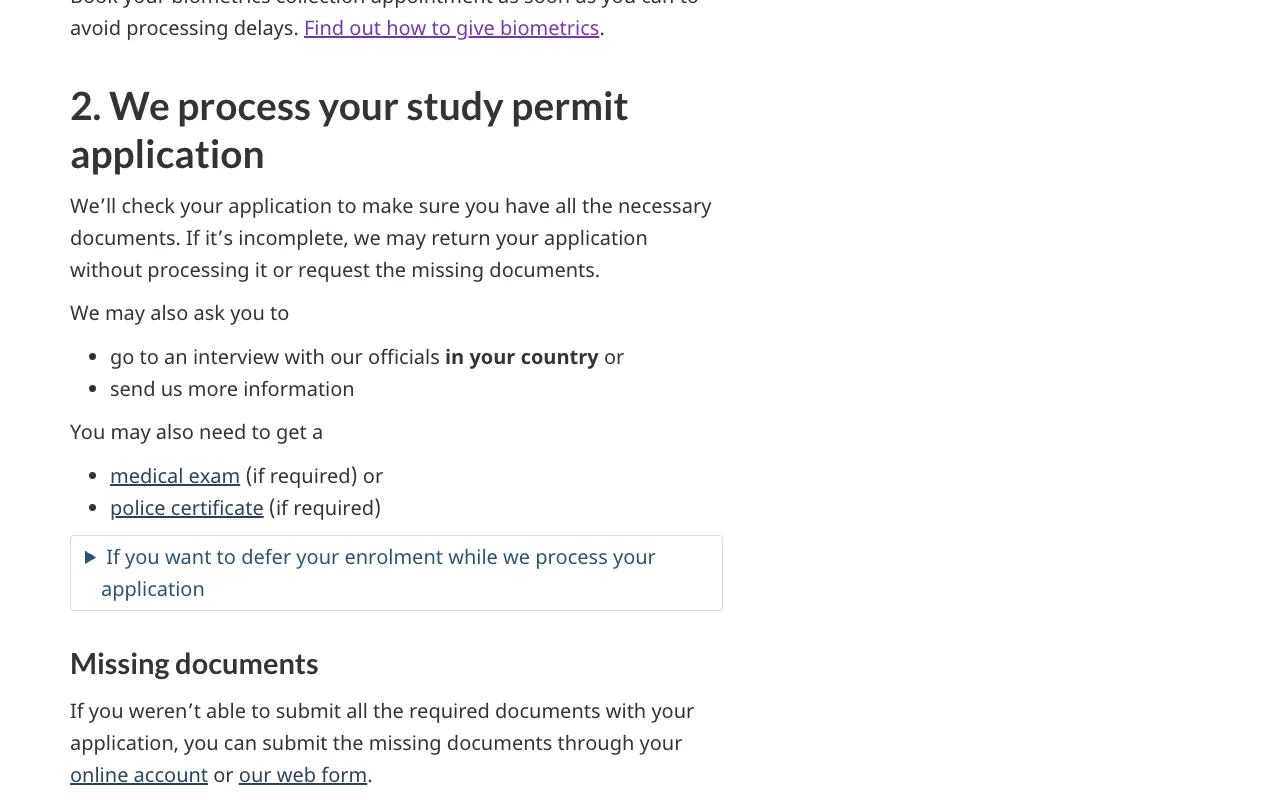
IRCC page · Study permit: After you apply · Whole page · Live page - If your application is incomplete, IRCC may return it without processing or ask for the missing documents.
- You may be asked to attend an interview or to send more information.
- Send missing documents through your online account or IRCC's web form.
- If your address, phone number or other contact information changes, update your application.
- Deferring your start date: get the deferral approved by your DLI, get an updated LOA, and submit it through your account or the web form.
- Changing to a different DLI while the application is still being processed: send the new LOA and, if needed, a new PAL/TAL through the IRCC web form.
- You can follow progress in IRCC's application status tracker using your unique client identifier (UCI) and application number.
Get the decision
If you applied from outside Canada and are approved, you get a port of entry letter of introduction (this is not the permit itself) plus an eTA or visitor visa if you need one. If you're refused, IRCC sends a letter explaining why.
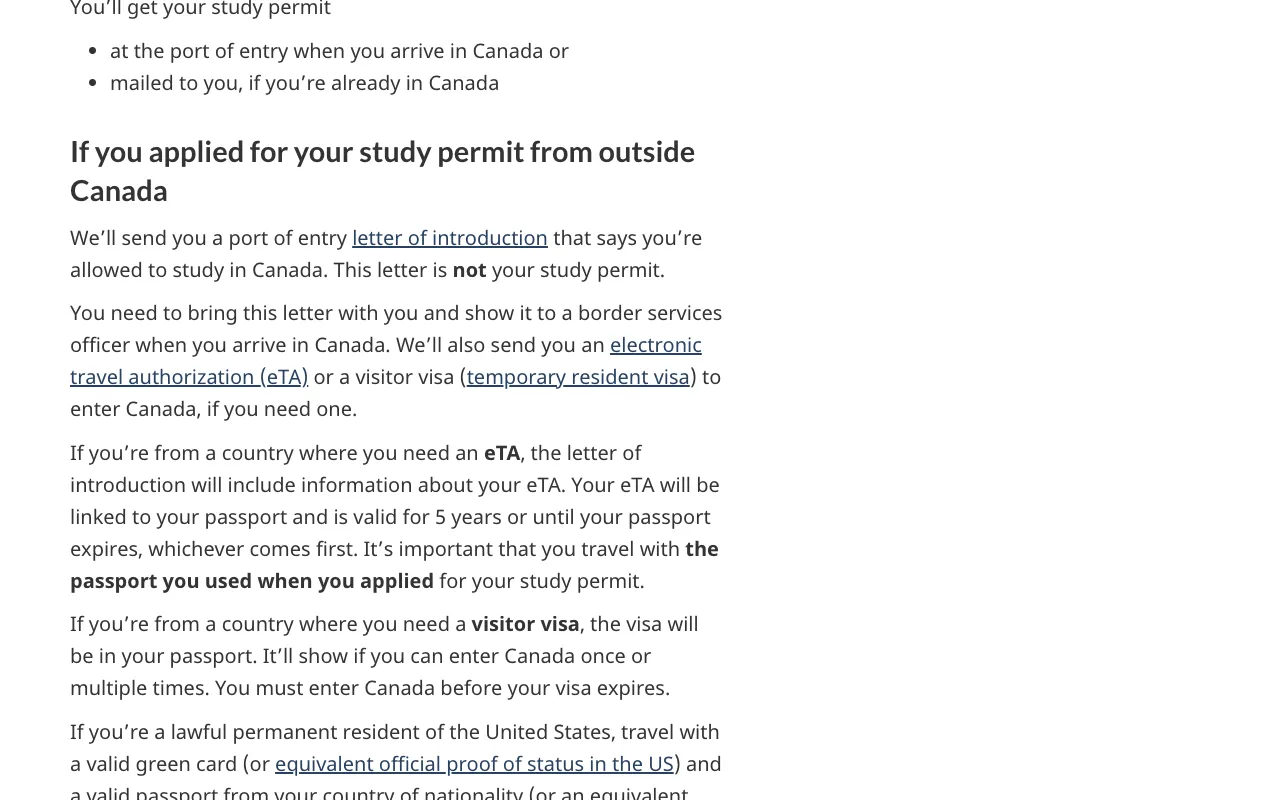
IRCC page · Study permit: After you apply · Whole page · Live page - Bring the letter of introduction with you and show it to the border services officer. It contains the permit reference number used to issue your study permit.
- An eTA is linked to the passport you applied with and is valid for 5 years or until that passport expires, whichever comes first. Travel with that same passport.
- If you need a visitor visa, it's placed in your passport, so IRCC will ask you to send the original passport. You must enter Canada before the visa expires.
- Common reasons for refusal include: no valid LOA, not enough money to support yourself, not passing a required medical exam, or not convincing the officer that your main purpose is to study or that you'll leave at the end of your studies.
- If you have questions about a refusal, contact the visa office that sent the refusal letter.
Travel to Canada and get your study permit at the port of entry
A border services officer checks your documents and whether you still meet the requirements. If you do, the officer issues your study permit.
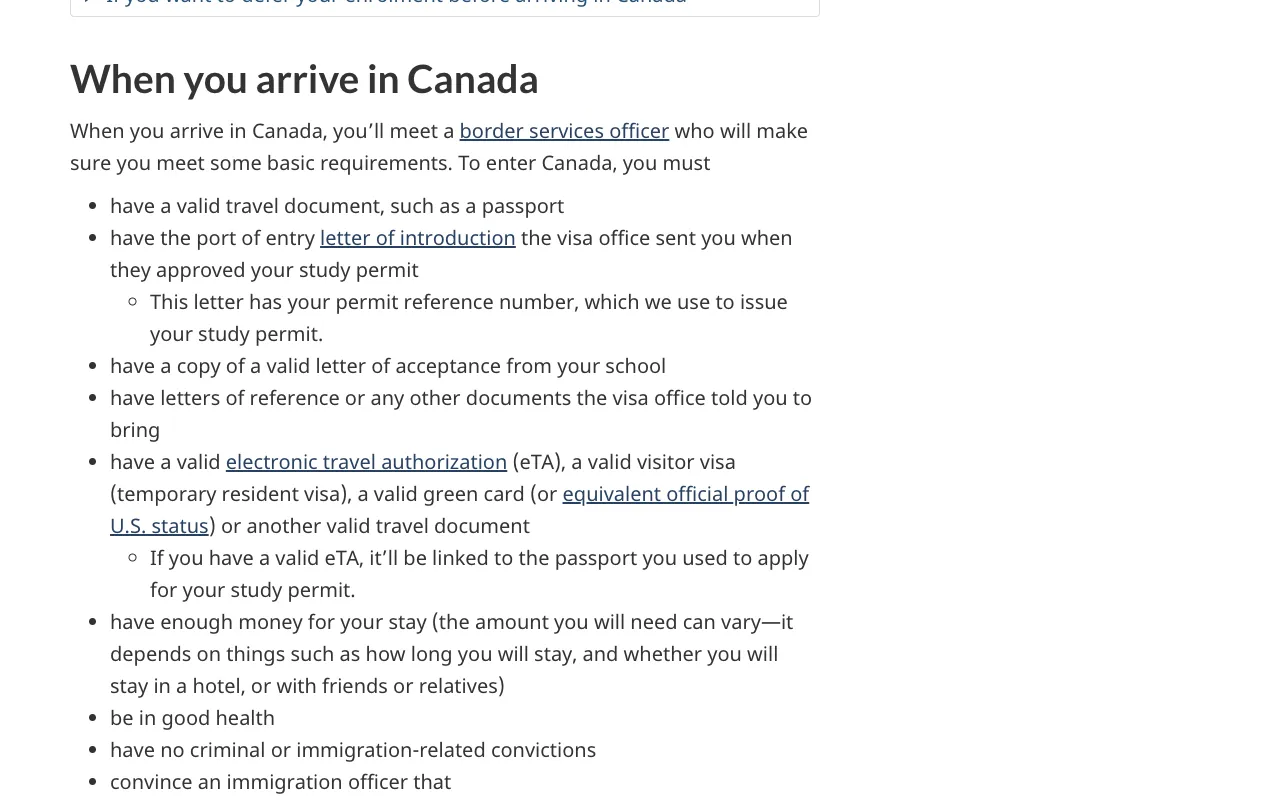
IRCC page · Study permit: Prepare for arrival · Whole page · Live page - Bring your valid passport or travel document, the letter of introduction, a copy of your valid LOA, any letters of reference or other documents the visa office told you to bring, your eTA, visitor visa or green card (as applicable), and proof that you have enough money for your stay.
- If you needed a medical exam, it's valid for 12 months and must still be valid on the day you enter, even if your letter of introduction hasn't expired.
- The officer decides whether you can enter and how long you can stay. If your circumstances changed after you applied, you may be refused entry.
- If your school needs proof that you entered Canada, ask the officer to stamp your passport before you leave customs.
- If you deferred your start date after approval, bring the DLI's deferral approval, your updated LOA and a valid letter of introduction.
After you arrive: follow your study permit conditions
Stay enrolled at a DLI, keep actively studying, follow any conditions printed on your permit, and leave or apply to extend before the permit expires.
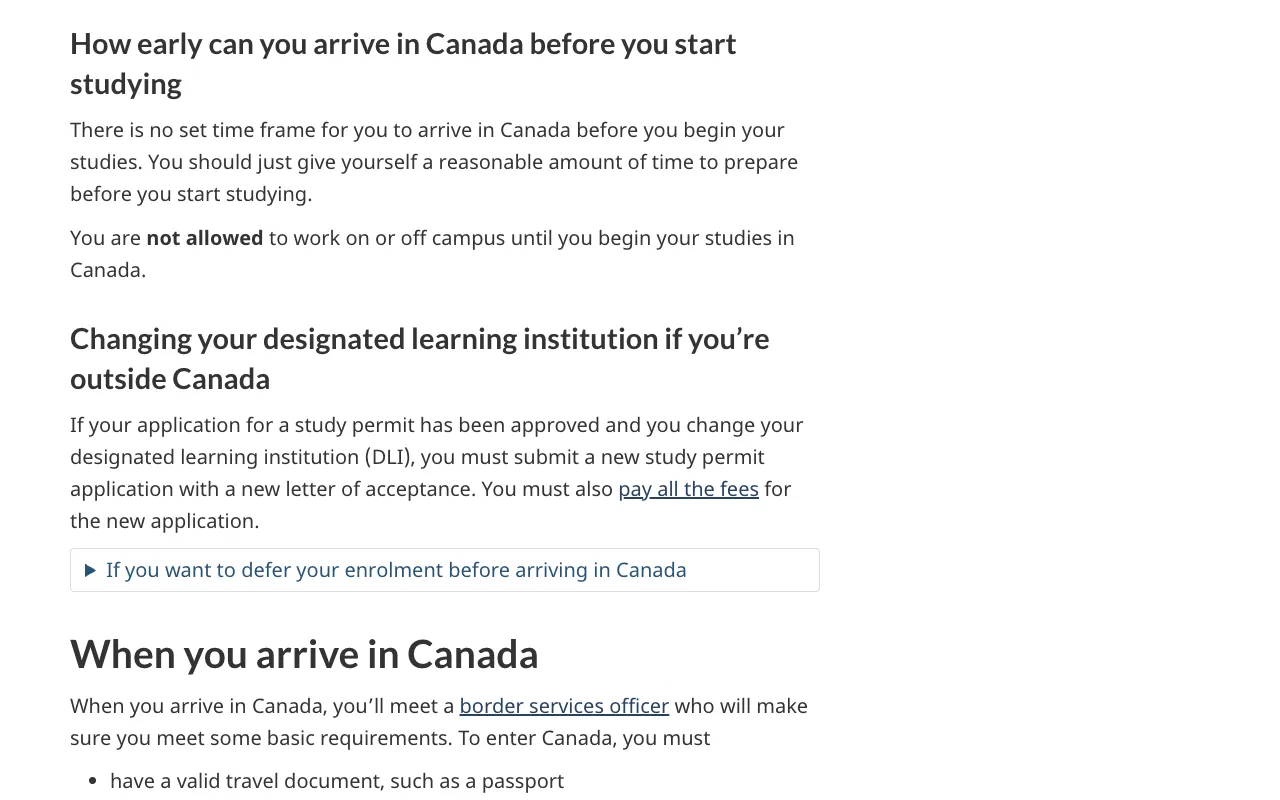
IRCC page · Study permit: Prepare for arrival · Whole page · Live page - You can't work on or off campus until your studies begin.
- Stay enrolled at a DLI and keep actively pursuing your studies. Some authorized leaves of up to 150 days are allowed.
- To change post-secondary schools, you must apply to extend your study permit.
- Your permit stops being valid 90 days after you complete your program, whatever expiry date is printed on it.
- If you'll need more time to finish, see our study permit extension walkthrough.
Documents checklist
Gather these before you apply. Your personalized checklist from IRCC is the final word on what your application needs.
- Letter of acceptance (LOA) from a designated learning institution (DLI)Each study permit applicant (except family members of someone whose study or work permit was approved in writing before they come to Canada)Issued by the school on official letterhead. It must show the exact tuition, the expected start and finish dates, and the registration deadline. Upload it only in the space meant for the LOA. For post-secondary students the school must confirm the LOA is valid. Official source for Letter of acceptance (LOA) from a designated learning institution (DLI)
- Provincial attestation letter or territorial attestation letter (PAL/TAL)Each study permit applicant, unless they meet an exceptionSigned by the province or territory. It includes your name, date of birth and address, and confirms you have a place in its allocation. It must be valid when you apply and can't come from a previous cap year. If you're exempt, upload proof of the exception in the 'Client information' field instead. Official source for Provincial attestation letter or territorial attestation letter (PAL/TAL)
- Attestation of issuance of your Quebec Acceptance Certificate (CAQ)Applicants who will study in Quebec (very few exceptions)In Quebec the CAQ takes the place of the PAL/TAL. It must contain the line confirming you have a place in Quebec's share of study permit applications or are exempt. When you apply online, upload it in both the PAL/TAL section and the CAQ section. Official source for Attestation of issuance of your Quebec Acceptance Certificate (CAQ)
- Proof of financial supportThe applicant, covering themselves and any family members who come with themMust cover tuition, living expenses and return transportation, with no work in Canada. Show enough for the first year and explain how you'll pay for the rest of a longer program. IRCC updates the required amounts every year. Official source for Proof of financial support
- Photocopy of the information page of your valid passport or travel documentThe applicant and each family member who comes with themMust show the passport number, the issue and expiry dates, and your photo, name, and date and place of birth. If you need a visitor visa and you're approved, you'll have to send the original passport. Official source for Photocopy of the information page of your valid passport or travel document
- Two photos meeting the Visa application photograph specificationsEach applicant, unless they are giving biometricsWrite your name and date of birth on the back of each photo. IRCC's checklist says you don't need paper photos if you're required to give biometrics. IRCC's 'Get the right documents' page still lists 2 photos, so follow your personalized checklist. Official source for Two photos meeting the Visa application photograph specifications
- Letter of explanationRecommended for each applicantExplain why you want to study in Canada and show that you understand your responsibilities as an international student. Official source for Letter of explanation
- Medical exam (if needed)Applicants who meet the medical exam criteria (length of stay, countries lived in, or type of work)You can have an upfront exam with a panel physician or wait for instructions. If you had an upfront exam, include proof with your application. Results are valid for 12 months and must be valid on the day you enter Canada. Official source for Medical exam (if needed)
- Police certificate (if requested)Applicants IRCC asks for oneApply for it as early as possible if you think you'll need one. Official source for Police certificate (if requested)
- Custodianship Declaration - Custodian for Minors Studying in Canada (IMM 5646)Minors under 17 coming to study without a parent or legal guardian (an officer may also ask for one for older minors)Notarized. Pages 1 and 2 are required: page 1 is signed by the custodian in Canada, and page 2 by the parents or legal guardians in their home country. The custodian must be a Canadian citizen or permanent resident aged 19 or older who lives in Canada. Official source for Custodianship Declaration - Custodian for Minors Studying in Canada (IMM 5646)
- Family Information (IMM 5707)Applicants aged 18 or older, or a minor travelling alone to CanadaListed on IRCC's study permit document checklist and in Guide 5269. Official source for Family Information (IMM 5707)
- Statutory Declaration of Common-law Union (IMM 5409), if applicableApplicants in a common-law relationshipRequired if you choose 'Common-Law' as your marital status on IMM 1294. Official source for Statutory Declaration of Common-law Union (IMM 5409), if applicable
- Photocopy of your Marriage license/Certificate, if applicableMarried applicantsIMM 1294's instructions say married applicants must send a copy. Official source for Photocopy of your Marriage license/Certificate, if applicable
- Proof of your legal status in the country or territory you apply fromApplicants who are not citizens of the country or territory they're applying fromLinked to the 'Country or territory where applying' question on IMM 1294. Official source for Proof of your legal status in the country or territory you apply from
- Proof of paymentEach applicationA receipt for the processing fee and, if it applies, the biometrics fee. Online applicants pay at the end of the application. Official source for Proof of payment
- English or French translation and translator's affidavit (for documents in other languages)Anyone submitting a document that isn't in English or FrenchTranslations must be done by someone fluent in both languages or by a Canadian certified translator, and never by you or a family member. A translator who isn't certified must provide a sworn affidavit. Official source for English or French translation and translator's affidavit (for documents in other languages)
- Any additional documents required by the responsible visa officeDepends on the country or territory you apply fromChoose your country on IRCC's How to apply page to see your visa office instructions. Official source for Any additional documents required by the responsible visa office
- Use of a Representative (IMM 5476) and Authority to Release Personal Information to a Designated Individual (IMM 5475), if applicableOnly applicants who use a representative or want IRCC to release information to someone elseYou don't have to hire a representative. IRCC says it treats everyone equally whether or not they use one. Official source for Use of a Representative (IMM 5476) and Authority to Release Personal Information to a Designated Individual (IMM 5475), if applicable
- Request for a Change of Sex or Gender Identifier (IRM 0002), if applicableApplicants choosing a sex or gender identifier different from the one on a previous Canadian temporary resident document or on their passportNo supporting documents are required. Official source for Request for a Change of Sex or Gender Identifier (IRM 0002), if applicable
What to write where
Field by field, in the order the form asks, with each one outlined on the form. Labels are as IRCC prints or documents them; the examples are made up.
IMM 1294 – Application for a Study Permit Made Outside of Canada (edition IMM 1294 (06-2026) E)
APPLICATION FOR STUDY PERMIT MADE OUTSIDE OF CANADA (top of page 1)
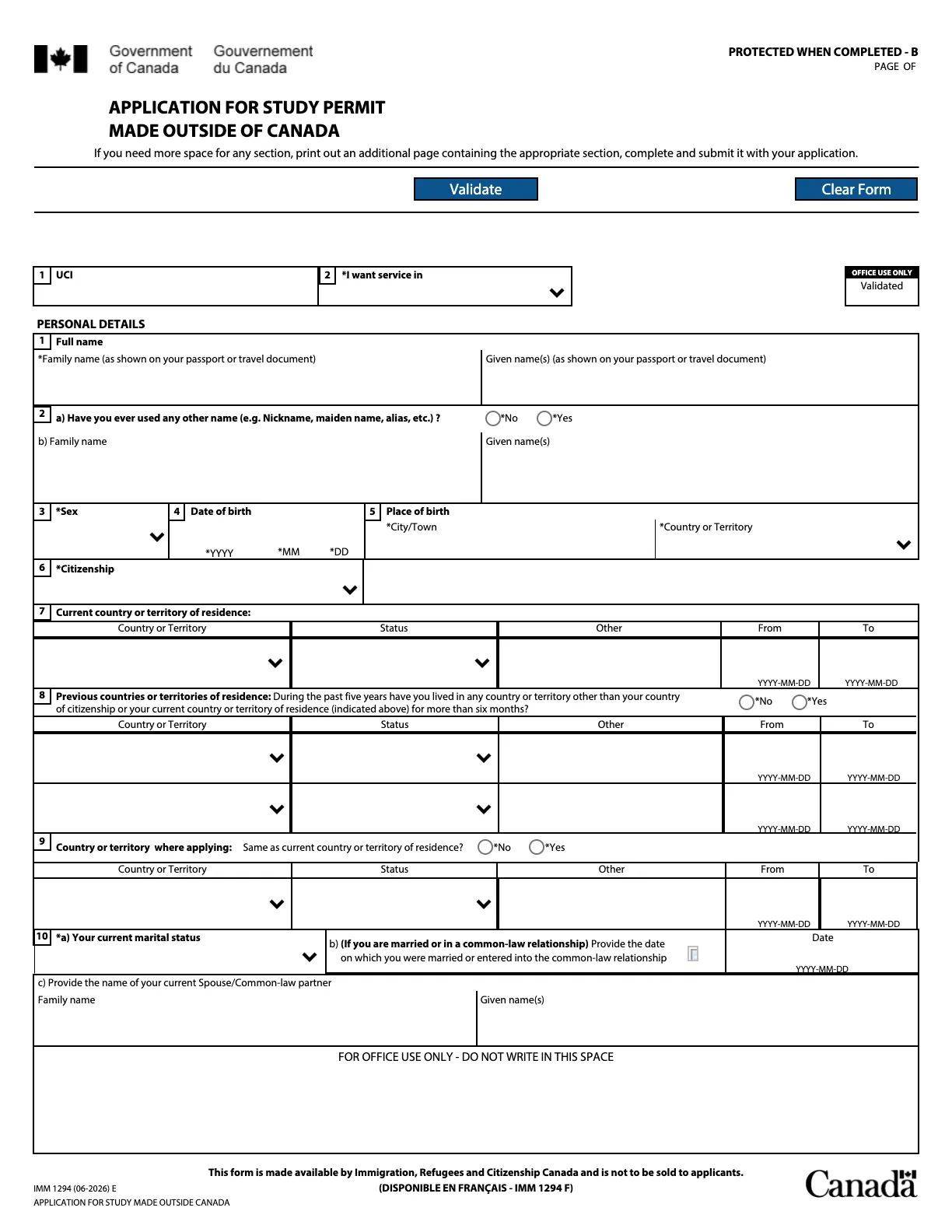 12
- 1 UCI
What they’re asking: Your IRCC client number (UCI), if IRCC has given you one before.
Your unique client identifier, if IRCC has given you one before. Leave it blank if this is your first time dealing with IRCC.
- 2 I want service in
What they’re asking: Which language, English or French, should IRCC use with you?
Choose English or French as the language IRCC uses with you.
e.g.
English
PERSONAL DETAILS
12345678910111213- 1 Family name (as shown on your passport or travel document)
What they’re asking: Your last name, exactly as your passport or travel document shows it.
Your surname exactly as printed in your passport, even if it's misspelled there. If your passport has no family name, put all your given names here and leave the given name box empty.
e.g.
SMITHWatch out: Using initials, or 'fixing' a spelling so it no longer matches the passport.
Official source for the field “Family name (as shown on your passport or travel document)”
- 2 Given name(s) (as shown on your passport or travel document)
What they’re asking: All your given names, exactly as printed in your passport.
All your given names, exactly as printed in your passport. If you have no given name, leave this blank.
e.g.
AlexWatch out: Typing '*', 'Not applicable' or 'NA' when you have no given name.
Official source for the field “Given name(s) (as shown on your passport or travel document)”
- 3 a) Have you ever used any other name (e.g. Nickname, maiden name, alias, etc.) ?
What they’re asking: Have you ever gone by another name, like a nickname or maiden name?
Answer Yes or No. If Yes, enter the other family name and given name(s) in the 'b) Family name' and 'Given name(s)' boxes. This includes a birth name, maiden name, married name or nickname.
- 4 Sex
What they’re asking: Your gender identifier: female, male, unknown or another gender.
Choose F (Female), M (Male), U (Unknown) or X (Another gender). The form prints 'Sex'. IRCC's instructions describe this as your gender identifier.
Watch out: Choosing an identifier that differs from your previous Canadian temporary resident document (or your passport, if you've never had one) without including form IRM 0002.
- 5 Date of birth
What they’re asking: When you were born: the year, month and day.
Enter the year (YYYY), month (MM) and day (DD). Use an asterisk (*) for any part of the date you don't know.
e.g.
1994-07-21- 6 Place of birth
What they’re asking: The city or town and country where you were born.
Fill in 'City/Town' and 'Country or Territory'. If your passport shows your place of birth, write it the same way.
e.g.
Lyon, France- 7 Citizenship
What they’re asking: Which country or territory are you a citizen of?
Your country or territory of citizenship. If you have more than one, choose the one that issued the passport you'll travel with.
- 8 Current country or territory of residence:
What they’re asking: Where you're legally allowed to live now, your status there, and since when.
Fill in the columns 'Country or Territory', 'Status', 'Other', 'From' and 'To': the country where you've been lawfully admitted to live, your status there (for example Citizen, Permanent resident, Student), and the dates you've lived there. If you choose 'Other' as your status, explain it in the 'Other' column.
e.g.
France, CitizenOfficial source for the field “Current country or territory of residence:”
- 9 Previous countries or territories of residence: During the past five years have you lived in any country or territory other than your country of citizenship or your current country or territory of residence (indicated above) for more than six months?
What they’re asking: In the past five years, have you lived over six months in any other country?
Answer Yes or No. If Yes, list each country, your status there and the dates.
- 10 Country or territory where applying:
What they’re asking: Are you applying from the same country you live in now?
Answer 'Same as current country or territory of residence?'. If No, give the country you're applying from, your status there and the dates.
Watch out: Not sending proof of your legal status when you apply from a country where you aren't a citizen.
Official source for the field “Country or territory where applying:”
- 11 a) Your current marital status
What they’re asking: Your relationship status right now, such as single, married or common-law.
Choose from the list: Annulled Marriage, Common-Law, Divorced, Married, Separated, Single or Widowed. IRCC's instructions define each one.
e.g.
SingleWatch out: Leaving out IMM 5409 if you're common-law, or a copy of your marriage certificate if you're married.
Official source for the field “a) Your current marital status”
- 12 b) (If you are married or in a common-law relationship) Provide the date on which you were married or entered into the common-law relationship
What they’re asking: The date you married, or when your common-law relationship began.
The date you married, or the date your current common-law relationship began.
- 13 c) Provide the name of your current Spouse/Common-law partner
What they’re asking: Your current spouse's or common-law partner's full name.
Your current spouse's or partner's 'Family name' and 'Given name(s)'.
Official source for the field “c) Provide the name of your current Spouse/Common-law partner”
PERSONAL DETAILS (CONTINUED)
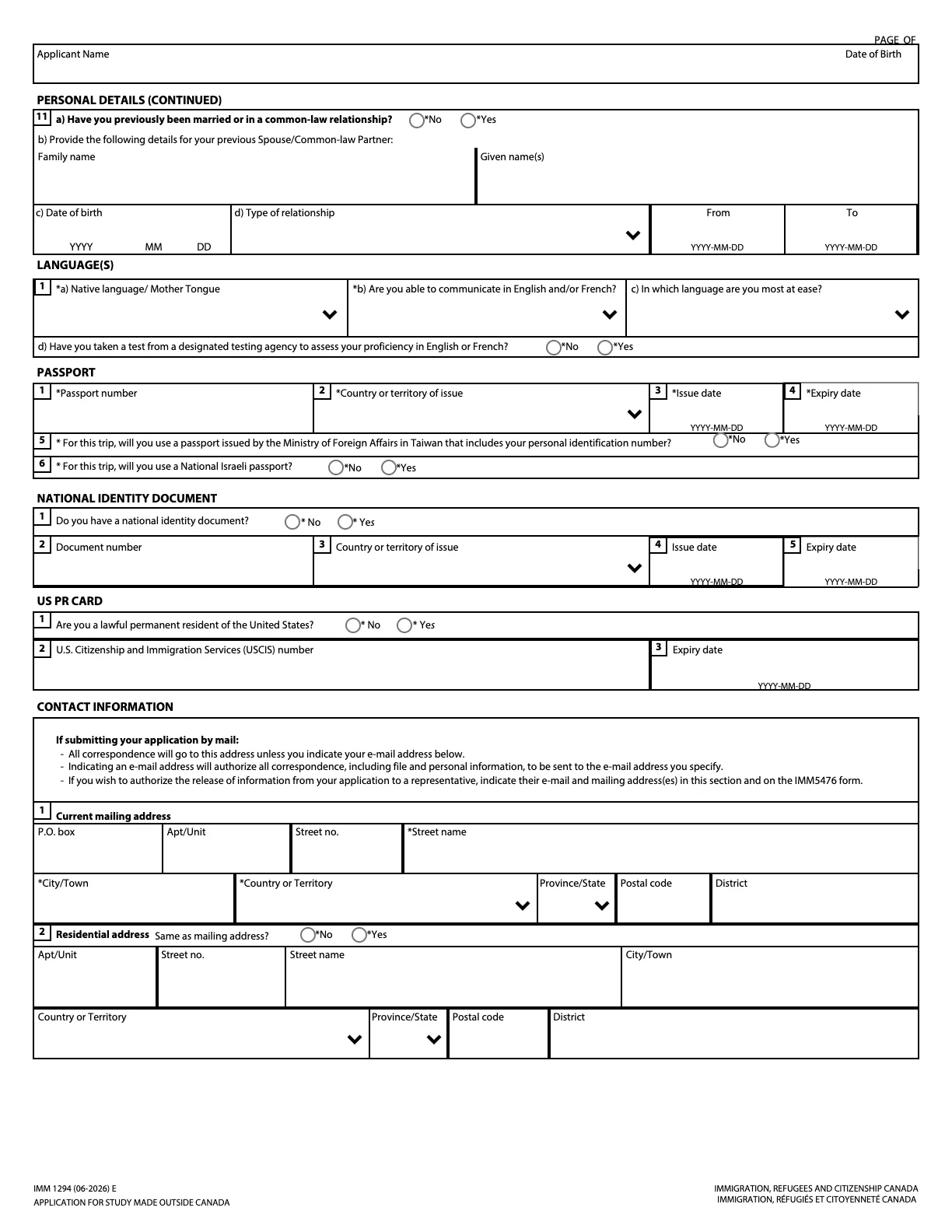 1
- 1 a) Have you previously been married or in a common-law relationship?
What they’re asking: Have you been married or in a common-law relationship before?
Answer Yes or No. If Yes, complete 'b) Provide the following details for your previous Spouse/Common-law Partner:' with their family name, given name(s), date of birth, the type of relationship (Common-law or Married) and the From–To dates.
Official source for the field “a) Have you previously been married or in a common-law relationship?”
LANGUAGE(S)
1234- 1 a) Native language/ Mother Tongue
What they’re asking: Your first language, the one you grew up with.
Your native language (mother tongue).
Official source for the field “a) Native language/ Mother Tongue”
- 2 b) Are you able to communicate in English and/or French?
What they’re asking: Can you communicate in English, French, both, or neither?
Choose English, French, Both or Neither.
Official source for the field “b) Are you able to communicate in English and/or French?”
- 3 c) In which language are you most at ease?
What they’re asking: Of English and French, which one would you most likely use?
If your native language isn't English or French, choose the one of the two you'd most likely use.
Official source for the field “c) In which language are you most at ease?”
- 4 d) Have you taken a test from a designated testing agency to assess your proficiency in English or French?
What they’re asking: Have you taken an English or French test from a designated testing agency?
Answer Yes or No.
PASSPORT
123456- 1 Passport number
What they’re asking: The number on your valid passport or travel document.
The number of your valid passport or travel document, exactly as printed, with no spaces.
- 2 Country or territory of issue
What they’re asking: Which country or territory issued your passport?
The country or territory that issued your passport or travel document.
Official source for the field “Country or territory of issue”
- 3 Issue date
What they’re asking: When your passport was issued.
The date your passport was issued.
- 4 Expiry date
What they’re asking: When your passport expires.
The date your passport expires. IRCC gives special instructions for Venezuelan passports whose printed expiry date has passed.
- 5 For this trip, will you use a passport issued by the Ministry of Foreign Affairs in Taiwan that includes your personal identification number?
What they’re asking: Will you travel on a Taiwan passport that includes your personal ID number?
Answer Yes or No.
- 6 For this trip, will you use a National Israeli passport?
What they’re asking: Will you be travelling on a National Israeli passport for this trip?
Answer Yes or No.
Official source for the field “For this trip, will you use a National Israeli passport?”
NATIONAL IDENTITY DOCUMENT
1- 1 Do you have a national identity document?
What they’re asking: Do you have a national ID document?
Answer Yes or No. If Yes, fill in 'Document number' (exactly as shown), 'Country or territory of issue', 'Issue date' and 'Expiry date'.
Official source for the field “Do you have a national identity document?”
US PR CARD
12- 1 Are you a lawful permanent resident of the United States?
What they’re asking: Are you a permanent resident of the United States, with a green card?
Answer Yes or No. If Yes, complete the next two fields.
Official source for the field “Are you a lawful permanent resident of the United States?”
- 2 U.S. Citizenship and Immigration Services (USCIS) number
What they’re asking: Your US green card number and when the card expires.
Your green card document number exactly as shown, then its 'Expiry date'.
Official source for the field “U.S. Citizenship and Immigration Services (USCIS) number”
CONTACT INFORMATION
12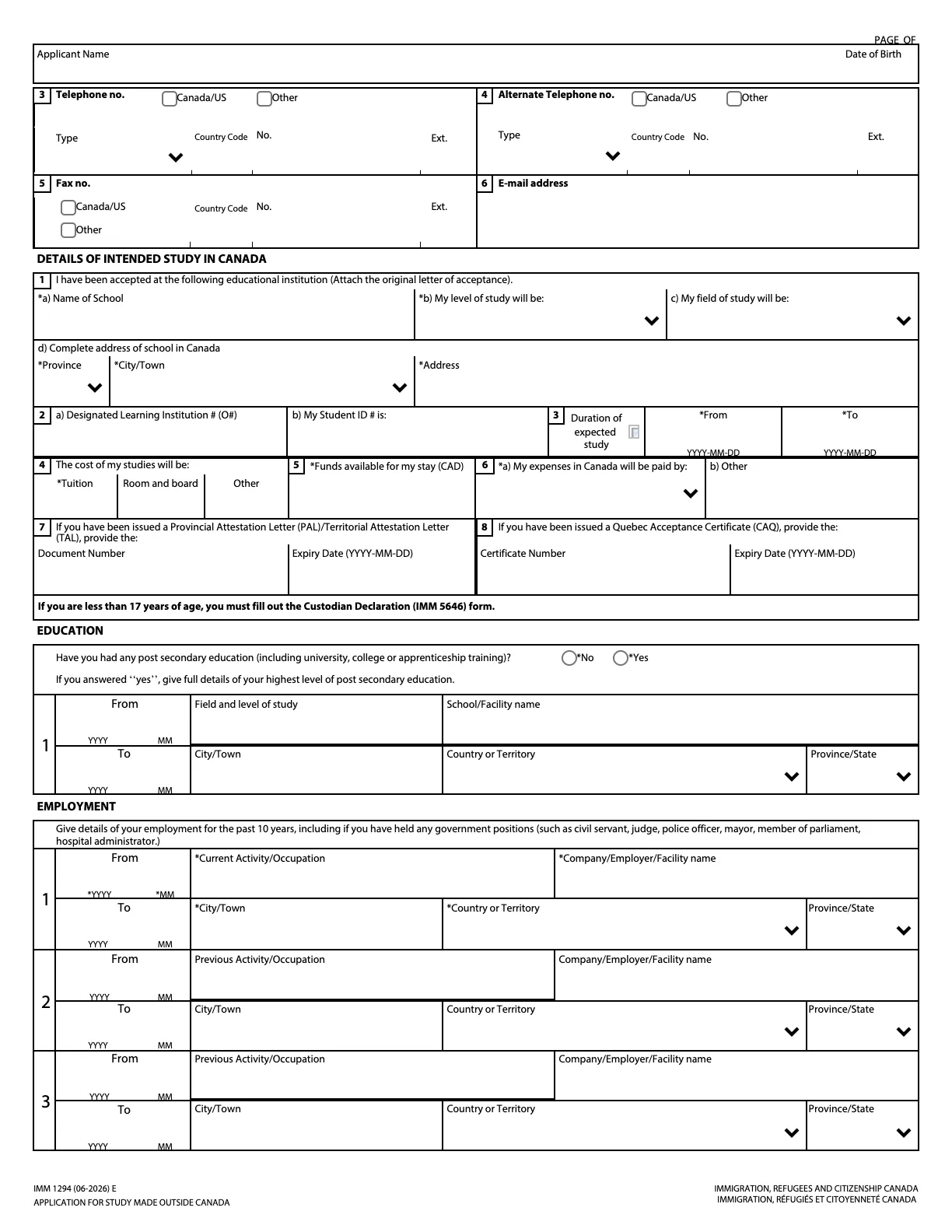 3456
- 1 Current mailing address
What they’re asking: Where IRCC should send your mail.
Where IRCC should mail you. The boxes are 'P.O. box', 'Apt/Unit', 'Street no.', 'Street name', 'City/Town', 'Country or Territory', 'Province/State', 'Postal code' and 'District'. If you don't give a P.O. box, the street number is required. If you use a representative, IRCC also asks for their email and mailing address here, plus form IMM 5476.
e.g.
123 Sample Street, TorontoWatch out: Abbreviating street words such as Street or Avenue. IRCC allows abbreviations only for directions (NW, SE, W, etc.).
- 2 Residential address
What they’re asking: Is the place you live the same as your mailing address?
Answer 'Same as mailing address?'. If No, enter the address where you actually live.
- 3 Telephone no.
What they’re asking: Your phone number, including the country and area codes.
Tick 'Canada/US' or 'Other', choose the 'Type' (residence, cellular or business), and enter the number with country and area codes. Put any extension under 'Ext.'.
- 4 Alternate Telephone no.
What they’re asking: A second phone number, entered the same way as the first.
Another phone number, entered the same way.
- 5 Fax no.
What they’re asking: A fax number, only if you have one.
Optional: a fax number with country and area codes, if you have one.
- 6 E-mail address
What they’re asking: An email address you check often.
An email address you check often. Giving one allows IRCC to send your correspondence, including personal information, by email. IRCC emails end in @cic.gc.ca, @canada.ca or @international.gc.ca.
e.g.
alex.smith@example.comWatch out: Missing IRCC emails that went to junk mail. IRCC asks you to add its addresses to your safe senders list.
DETAILS OF INTENDED STUDY IN CANADA
123456789101112- 1 a) Name of School
What they’re asking: The full name of the school that accepted you.
The full name of the school or institution that accepted you. The form asks you to attach the letter of acceptance.
e.g.
Sample Valley College- 2 b) My level of study will be:
What they’re asking: The level of the program you'll be studying.
Choose your level of study from the list.
Official source for the field “b) My level of study will be:”
- 3 c) My field of study will be:
What they’re asking: The subject area you'll be studying.
Choose your field of study from the list.
Official source for the field “c) My field of study will be:”
- 4 d) Complete address of school in Canada
What they’re asking: Where your school in Canada is located.
Fill in 'Province', 'City/Town' and 'Address' for the school.
e.g.
Ontario, Toronto, 123 Sample StreetOfficial source for the field “d) Complete address of school in Canada”
- 5 Duration of expected study
What they’re asking: When your program starts and ends.
The expected start ('From') and end ('To') dates of your program, matching your LOA.
- 6 a) Designated Learning Institution # (O#)
What they’re asking: Your school's designated learning institution (DLI) number, from IRCC's DLI list.
Your school's DLI number from IRCC's DLI list. Primary and secondary schools aren't on the list and don't need a DLI number.
Official source for the field “a) Designated Learning Institution # (O#)”
- 7 b) My Student ID # is:
What they’re asking: Your student number, if your school has given you one.
Your student ID number, if your school has given you one.
- 8 The cost of my studies will be:
What they’re asking: How much your tuition, room and board, and other costs will be.
Enter amounts for 'Tuition', 'Room and board' and 'Other' (for example books, transport and pocket money).
Official source for the field “The cost of my studies will be:”
- 9 Funds available for my stay (CAD)
What they’re asking: How much money you have for your stay, in Canadian dollars.
The total money available for your stay, in Canadian dollars. It should match your proof of funds.
Official source for the field “Funds available for my stay (CAD)”
- 10 a) My expenses in Canada will be paid by:
What they’re asking: Who will pay your expenses while you're in Canada?
Choose Myself, Parents or Other. If you choose Other, use 'b) Other' to say who will pay (for example a relative, a scholarship or a business).
e.g.
ParentsOfficial source for the field “a) My expenses in Canada will be paid by:”
- 11 If you have been issued a Provincial Attestation Letter (PAL)/Territorial Attestation Letter (TAL), provide the:
What they’re asking: Your attestation letter (PAL/TAL) number and expiry date, if you have one.
Enter the PAL/TAL 'Document Number' and 'Expiry Date (YYYY-MM-DD)' exactly as shown on the letter. (The form prints this field, but IRCC's step-by-step instructions don't describe it.)
e.g.
Expiry Date 2027-01-31- 12 If you have been issued a Quebec Acceptance Certificate (CAQ), provide the:
What they’re asking: For Quebec students: your Quebec Acceptance Certificate (CAQ) number and expiry date.
If you'll study in Quebec, enter the CAQ 'Certificate Number' and 'Expiry Date (YYYY-MM-DD)'.
e.g.
Expiry Date 2027-01-31
EDUCATION
1- 1 Have you had any post secondary education (including university, college or apprenticeship training)?
What they’re asking: Have you studied after high school, such as university, college or an apprenticeship?
Answer Yes or No. If Yes, give details of your highest post-secondary education: From and To dates (year and month), 'Field and level of study', 'School/Facility name', 'City/Town', 'Country or Territory' and 'Province/State'.
EMPLOYMENT
12- 1 Current Activity/Occupation
What they’re asking: What you do now, like your job or your studies.
Your current job or activity with From and To dates, 'Company/Employer/Facility name', 'City/Town', 'Country or Territory' and 'Province/State'. If you don't work, describe what you're doing, for example going to school.
e.g.
Student- 2 Previous Activity/Occupation
What they’re asking: Your past jobs and activities over the last 10 years.
Your previous jobs or activities covering the past 10 years, including any government positions. If you need more space, print another page.
Official source for the field “Previous Activity/Occupation”
BACKGROUND INFORMATION
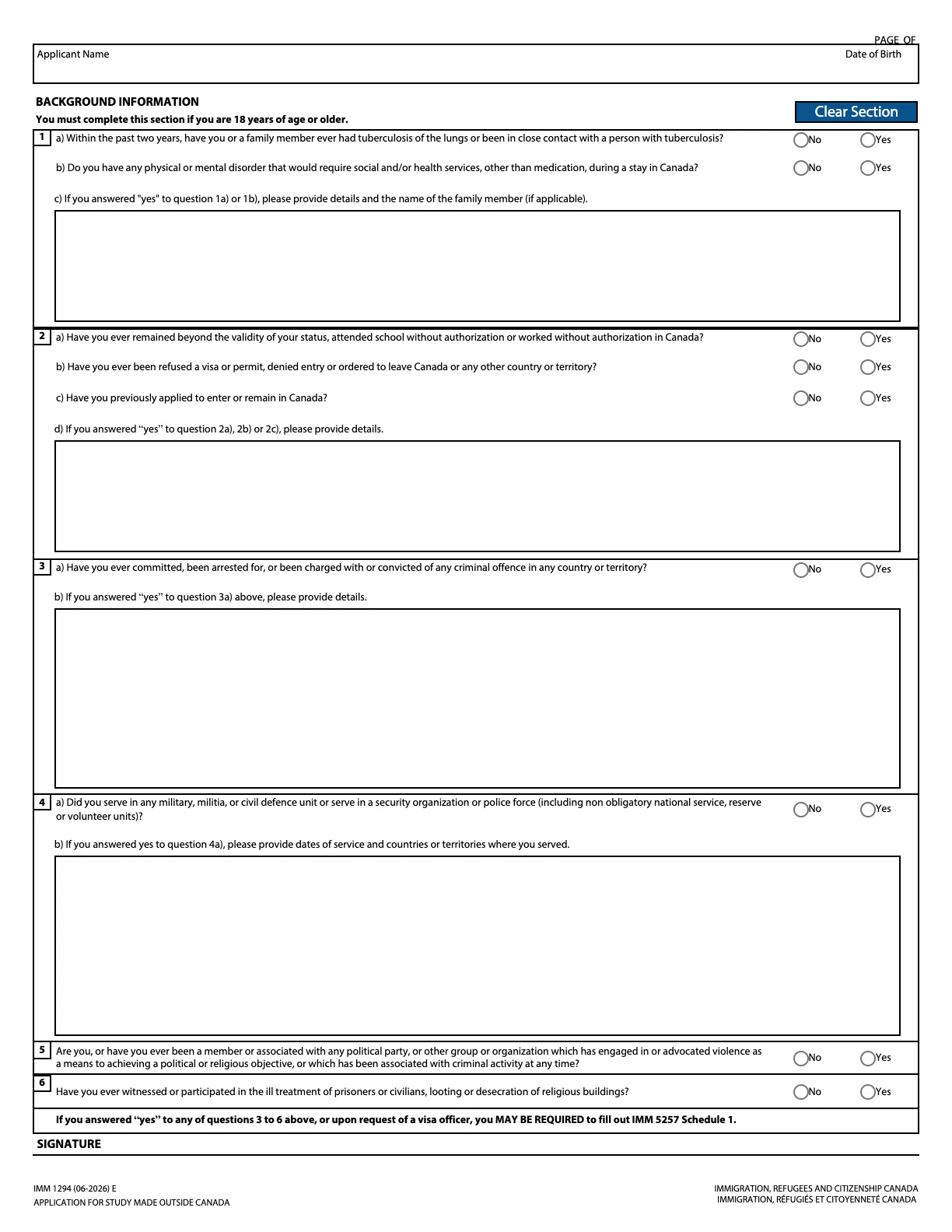 1234567891011
- 1 a) Within the past two years, have you or a family member ever had tuberculosis of the lungs or been in close contact with a person with tuberculosis?
What they’re asking: In the past two years, have you or family had lung tuberculosis or close contact?
Answer Yes or No. The form says applicants 18 or older must complete this section, and IRCC returns the application as incomplete if any question here is unanswered.
Watch out: Leaving any background question unanswered.
- 2 b) Do you have any physical or mental disorder that would require social and/or health services, other than medication, during a stay in Canada?
What they’re asking: Do you have a physical or mental disorder needing health or social services beyond medication?
Answer Yes or No.
- 3 c) If you answered "yes" to question 1a) or 1b), please provide details and the name of the family member (if applicable).
What they’re asking: If you said yes to 1a or 1b, the details and any family member's name.
Only if you answered Yes to 1a) or 1b): give the details and, if it applies, the family member's name.
- 4 a) Have you ever remained beyond the validity of your status, attended school without authorization or worked without authorization in Canada?
What they’re asking: Have you ever overstayed, studied or worked in Canada without permission?
Answer Yes or No.
- 5 b) Have you ever been refused a visa or permit, denied entry or ordered to leave Canada or any other country or territory?
What they’re asking: Ever refused a visa or permit, denied entry, or ordered to leave, in any country?
Answer Yes or No. This covers refusals by any country, not only Canada.
- 6 c) Have you previously applied to enter or remain in Canada?
What they’re asking: Have you applied to come to or stay in Canada before?
Answer Yes or No.
Official source for the field “c) Have you previously applied to enter or remain in Canada?”
- 7 d) If you answered “yes” to question 2a), 2b) or 2c), please provide details.
What they’re asking: Explain any yes answer to 2a, 2b or 2c.
Only if you answered Yes to any of 2a) to 2c): give the details.
- 8 a) Have you ever committed, been arrested for, or been charged with or convicted of any criminal offence in any country or territory?
What they’re asking: Have you ever committed, or been arrested, charged or convicted of, a criminal offence anywhere?
Answer Yes or No. If Yes, give details in 'b) If you answered “yes” to question 3a) above, please provide details.'
- 9 a) Did you serve in any military, militia, or civil defence unit or serve in a security organization or police force (including non obligatory national service, reserve or volunteer units)?
What they’re asking: Have you served in any military, militia, civil defence, security or police unit?
Answer Yes or No. If Yes, give your dates of service and the countries or territories where you served.
- 10 Are you, or have you ever been a member or associated with any political party, or other group or organization which has engaged in or advocated violence as a means to achieving a political or religious objective, or which has been associated with criminal activity at any time?
What they’re asking: Have you ever been part of a party or group linked to violence or crime?
Answer Yes or No.
- 11 Have you ever witnessed or participated in the ill treatment of prisoners or civilians, looting or desecration of religious buildings?
What they’re asking: Ever seen or taken part in mistreating prisoners or civilians, looting, or desecrating religious buildings?
Answer Yes or No. If you answer Yes to any of questions 3 to 6, or a visa officer asks, you may have to fill out IMM 5257 Schedule 1.
SIGNATURE
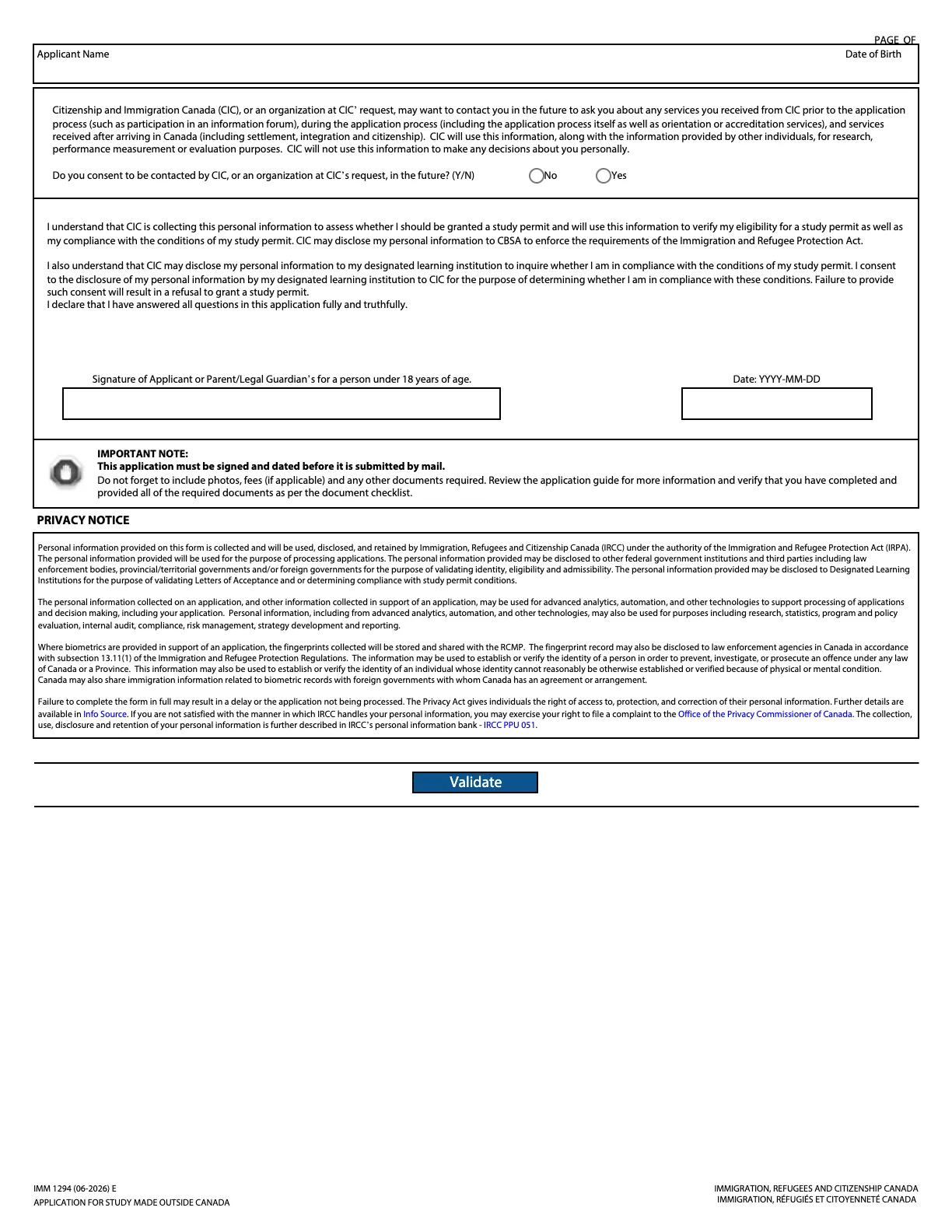 12
- 1 Do you consent to be contacted by CIC, or an organization at CIC’s request, in the future?
What they’re asking: Can CIC, or an organization it asks, contact you in future for research?
Answer Yes or No. This optional consent is for future research and evaluation contact. The form says it won't be used to make decisions about you.
- 2 Signature of Applicant or Parent/Legal Guardian’s for a person under 18 years of age.
What they’re asking: Your signature, or a parent's or guardian's if you're under 18.
Read the declaration above the signature line. Among other things, you consent to your DLI sharing information with IRCC about whether you're meeting your study permit conditions. If you apply online, leave the signature and 'Date: YYYY-MM-DD' empty. On paper, sign and date the form before you mail it.
Watch out: Refusing the consent in the declaration. The form says that will result in a refusal.
IRCC secure account: online study permit application (document upload fields IRCC names publicly)
Get your documents ready
12- 1 Provincial attestation letter (required)
What they’re asking: Your provincial or territorial attestation letter (PAL/TAL), uploaded here.
Upload your PAL/TAL here.
Watch out: Sending the PAL/TAL after you apply. IRCC says to submit it with the application.
Official source for the field “Provincial attestation letter (required)”
- 2 Client information
What they’re asking: Your PAL/TAL if its own field is missing, or proof you're exempt.
Upload your PAL/TAL here if the 'Provincial attestation letter (required)' field doesn't appear. If you're exempt from the PAL/TAL requirement, upload your proof of the exception here.
Do you intend to study in Quebec?
 12
- 1 Provincial/Territorial Attestation Letter
What they’re asking: Quebec students: your updated Quebec Acceptance Certificate (CAQ).
Quebec students: upload your updated CAQ here. Guide 5269 uses this name for the PAL/TAL upload section.
Official source for the field “Provincial/Territorial Attestation Letter”
- 2 CAQ
What they’re asking: Quebec students: the same updated CAQ, uploaded here too.
Quebec students: upload the same updated CAQ here as well.
Mistakes IRCC warns about
- Putting documents other than the LOA in the LOA upload space. IRCC treats this as your consent to share those documents with your school. Official source for this mistake
- Submitting an incomplete application. IRCC may return it, delay it or refuse it. Official source for this mistake
- Applying without a valid PAL/TAL (or CAQ), or without proof of an exception. IRCC won't accept the application for processing. Official source for this mistake
- Reusing a PAL/TAL after the application it was used for was approved or refused, or using an expired one. Official source for this mistake
- Giving false or misleading information. IRCC calls this a serious offence. Official source for this mistake
- Having documents translated by yourself or a relative. IRCC doesn't accept these translations. Official source for this mistake
- Not paying the biometrics fee with the application, or not giving biometrics within 30 days of the instruction letter. Official source for this mistake
- Having an upfront medical exam but not including proof of it with the application. Official source for this mistake
- Arriving after your immigration medical exam has expired. It must be valid on the day you enter Canada. Official source for this mistake
- Travelling with a different passport from the one you used to apply. Your eTA is linked to the original passport. Official source for this mistake
- Changing to a different DLI after approval while still outside Canada and expecting to keep the same approval. You must submit a new application with a new LOA and pay the fees again. Official source for this mistake
- Working before your studies begin. Official source for this mistake
- Not updating IRCC when your contact information changes after you apply. Official source for this mistake
- Writing 'NA' in a given-name box. Leave it empty if you have no given name. For other questions that don't apply, write 'Not Applicable' or 'NA'. Official source for this mistake
- Not checking PGWP rules (such as field-of-study requirements) before applying, if you might want to work in Canada after graduation. Official source for this mistake
After you apply
- Biometrics: book your appointment as soon as you get the biometric instruction letter. You have 30 days, and processing starts once IRCC has your biometrics (see the 'Give your biometrics' step).
- Processing: IRCC checks that your application is complete. It may ask for more documents, an interview, a medical exam or a police certificate. Send missing documents through your online account or the IRCC web form (see the 'Respond to IRCC' step).
- Keep your contact details current, and use the application status tracker with your UCI and application number.
- If approved from outside Canada: you get a port of entry letter of introduction (not the permit itself), plus an eTA or visitor visa if you need one. If you need a visa, IRCC asks for your original passport (see the 'Get the decision' step).
- If approved after applying from inside Canada (IMM 5709): IRCC mails the permit to your Canadian address and puts a letter of approval in your online account. IRCC says you can start studying once you get that letter.
- If refused: IRCC sends a letter explaining why. Contact the visa office that sent it if you have questions.
- At the port of entry: show your letter of introduction, passport, LOA and other documents. The officer issues your study permit if you still meet the requirements (see the 'Travel to Canada' step).
Not covered here
- Extending or changing the conditions of a study permit you already hold. See our study permit extension walkthrough (Official page)
- Restoring your status after a study permit expired (Official page)
- Faster processing for doctoral students and the graduate-student process (Official page)
- Post-graduation work permits (PGWP) (Official page)
- Work permits for spouses or common-law partners of students (Official page)
- Working while you study (on and off campus, co-op) (Official page)
- Minor children studying in Canada, including custodianship details (Official page)
- Francophone Minority Communities Student Pilot (Official page)
- Special measures for Ukrainian nationals (Official page)
- Paper applications (only for people who qualify) (Paper applications (only for eligible applicants) and visa office instructions)
- How Quebec issues the CAQ. Follow the Government of Quebec process that IRCC links from its PAL/TAL page (Provincial or territorial attestation letter (PAL/TAL))
Official IRCC pages
- Study permit: overview
- Study permit: Who can apply
- Who can study without a permit
- Study permit: Get the right documents
- Provincial or territorial attestation letter (PAL/TAL)
- Proof of financial support (current amounts)
- Designated learning institutions list
- Study permit: How to apply
- Guide 5269 – Applying for a Study Permit outside Canada
- IMM 1294 form and step-by-step field instructions
- IMM 5483 Document checklist for a study permit
- Paper applications (only for eligible applicants) and visa office instructions
- Study permit: After you apply
- Study permit: Prepare for your arrival
- Study permit conditions
- Biometrics: who needs to give them
- Biometrics: where to give them
- IRCC secure account
- Check processing times
- IRCC fee list