Steps
Check your permit's expiry date and whether you need to extend
Your study permit's expiry date is when you must stop studying and leave Canada. If you need more time, or you're changing schools or conditions, you must apply for an extension.
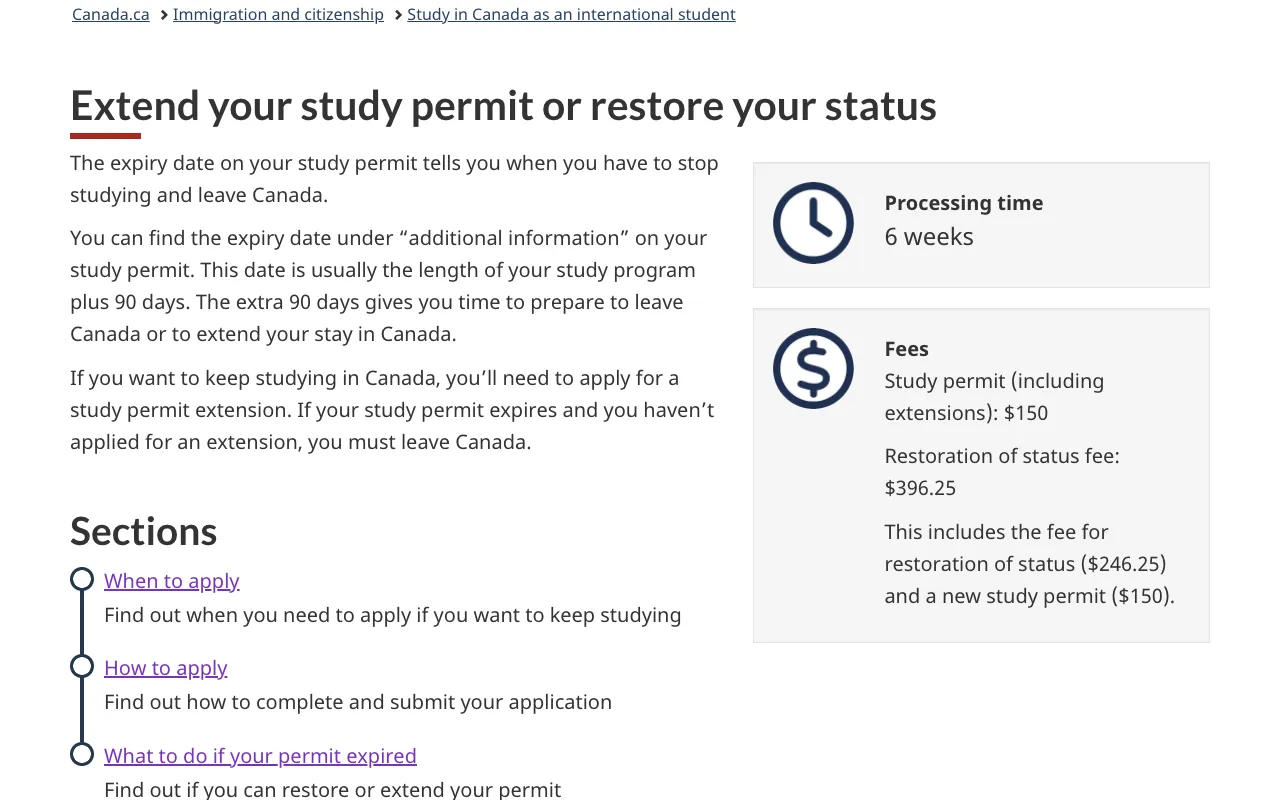
IRCC page · Extend your study permit or restore your status · Whole page · Live page - Find the expiry date under 'additional information' on your study permit. It's usually the length of your program plus 90 days.
- If you finish early, the permit expires on whichever comes first: the printed date, or 90 days after you complete your studies. The 90 days start from the first notice your school sends saying you've completed the program (such as an email, letter or transcript), or when you get your degree, diploma or certificate.
- If your studies will run past the expiry date, apply to extend. Otherwise you must stop studying and leave Canada.
- Changing post-secondary schools, or changing any condition on your permit, also requires a study permit extension application.
Apply on time: at least 30 days before your permit expires
Apply at least 30 days before your permit expires. IRCC recommends applying even earlier. Applying before expiry is what lets you keep studying while you wait.
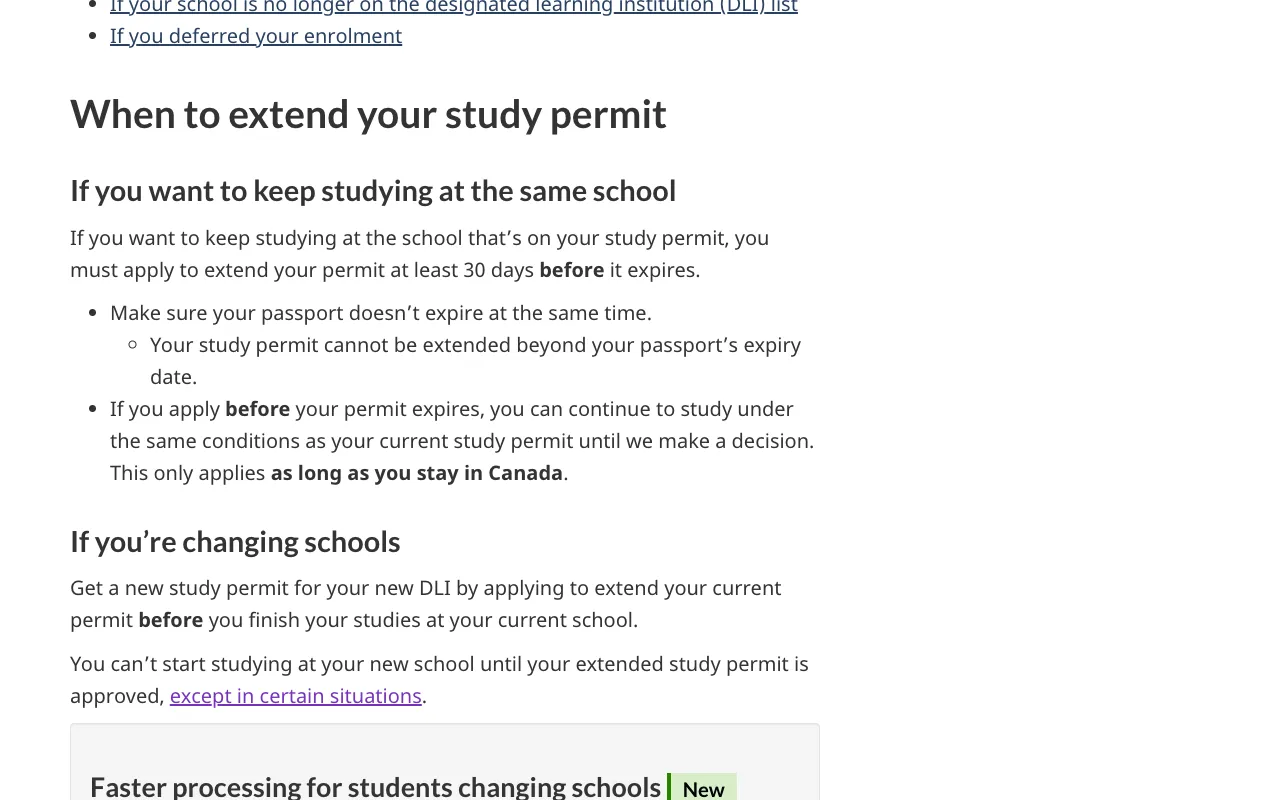
IRCC page · Extend your study permit or restore your status: When to apply · Whole page · Live page - Staying at the same school: apply at least 30 days before the permit expires. Processing times vary, so consider applying earlier.
- Check your passport. Your study permit can't be extended past your passport's expiry date.
- Changing schools: apply for an extension for the new DLI before you finish your studies at your current school.
- Faster processing: IRCC aims to process an extension in 60 days if you're changing to a new post-secondary DLI and say so in the online questions.
- If your school loses its DLI status, you can keep studying until your current permit expires, but to extend you'll need to enrol at a school that is a DLI.
Find out whether you need a new PAL/TAL (or CAQ)
If you're staying at the same DLI and the same level of study, you don't need a new PAL/TAL. If you're changing DLI or level, or restoring your status, you usually do.
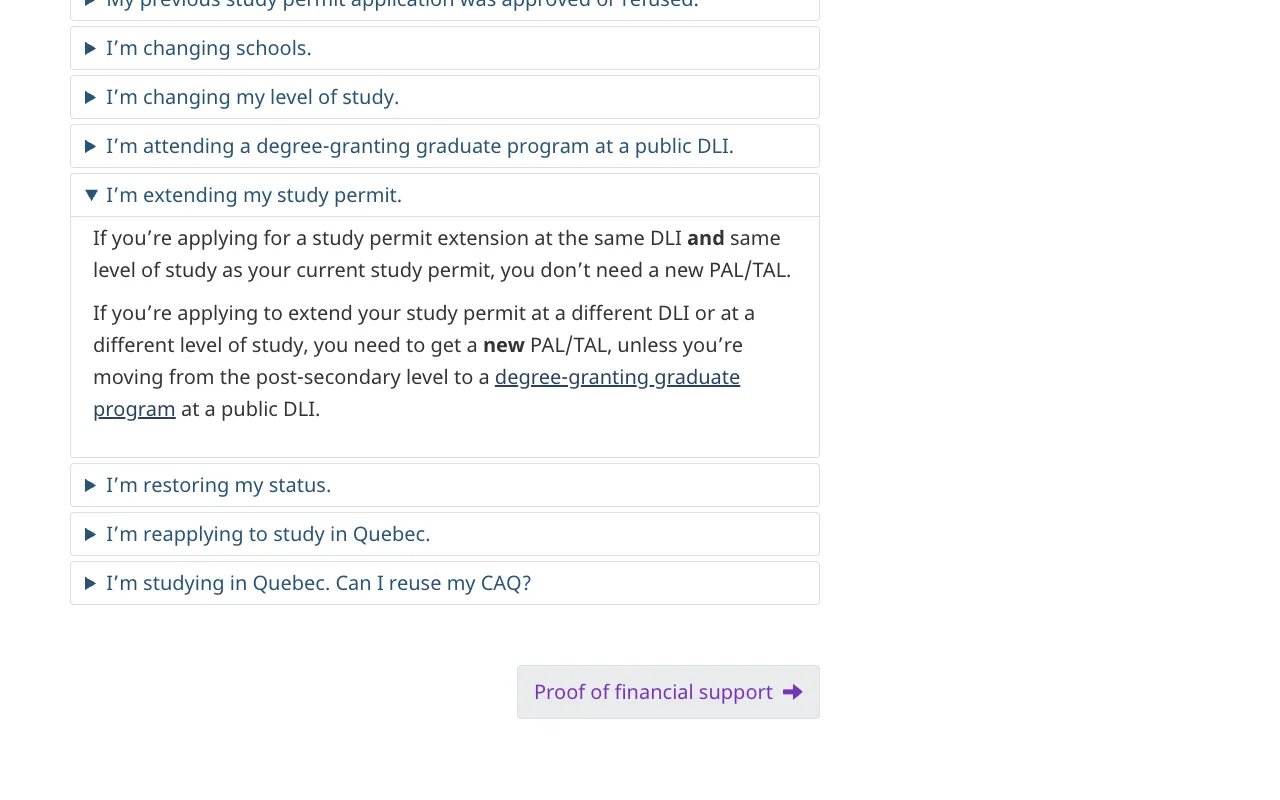
IRCC page · Study permit: Get the right documents Provincial attestation letter or territorial attestation letter · Whole page · Live page - Same DLI and same level of study: no new PAL/TAL is needed.
- Different DLI or different level of study: get a new PAL/TAL before you apply. An exception: moving from post-secondary studies to a degree-granting graduate program at a public DLI.
- Restoring your status: you need a new PAL/TAL, even if you're staying at the same DLI and level.
- IRCC's guide says that in most cases an application without a required PAL/TAL is returned, along with the fees.
- Quebec: you need a valid CAQ, whether you're renewing or applying for a first permit.
Get a letter of acceptance or letter of enrolment from your DLI
Post-secondary DLIs send new students a letter of acceptance and current students a letter of enrolment. You upload it in the space for the LOA in your online application.
IRCC page · Extend your study permit or restore your status: How to apply · Whole page · Live page - The letter must be current and show you're accepted or registered, your program, your expected start and finish dates, and any conditions on your acceptance.
- Your DLI must verify the letter. If it doesn't do so by IRCC's deadline, IRCC returns your application and refunds the processing fee. Before you resubmit, ask your DLI to confirm it will validate the letter in time.
- Include proof of academic standing too. If you've studied for two consecutive periods, give transcripts (official or unofficial) from your last two periods of study, or a letter from the registrar.
Gather proof of funds and your other documents
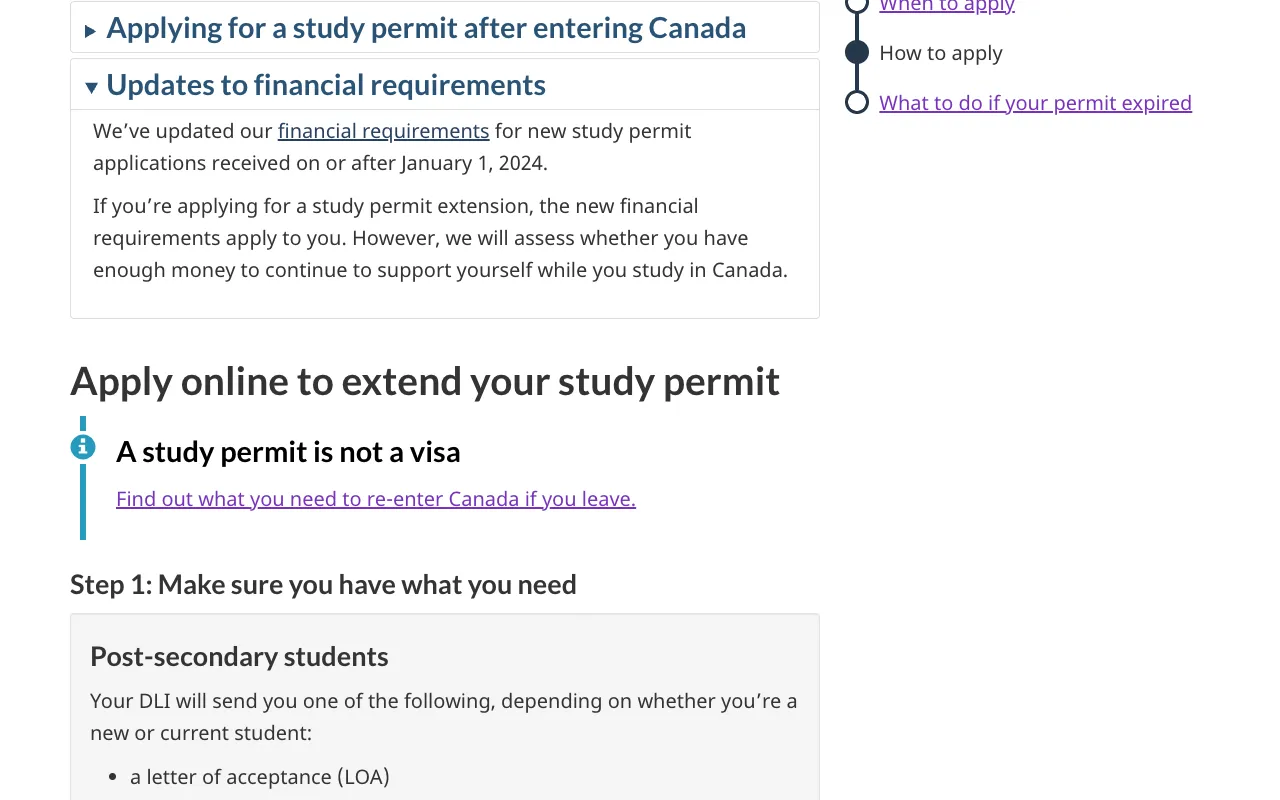
Show you can still support yourself, and collect passport copies, your current immigration document and any situation-specific documents.
IRCC page · Extend your study permit or restore your status: How to apply · Whole page · Live page - Proof of funds: the current financial requirements apply to extensions too. IRCC assesses whether you have enough money to keep supporting yourself while you study.
- Passport copies: pages showing the number, issue and expiry dates, your name and date of birth, the stamp from your most recent entry to Canada, and any other marked page.
- A copy of your current immigration document (for example, your study permit).
- If you're changing schools: a letter explaining why, plus a new PAL/TAL unless you're exempt.
- Translations: any document not in English or French must be translated. Include a copy of the original along with the translation.
- Your online personalized checklist lists the exact documents for your case.
Apply online in the IRCC secure account
Extensions must be submitted online through the IRCC secure account, even if you used a different account for your first study permit. Paper is allowed only in limited cases.
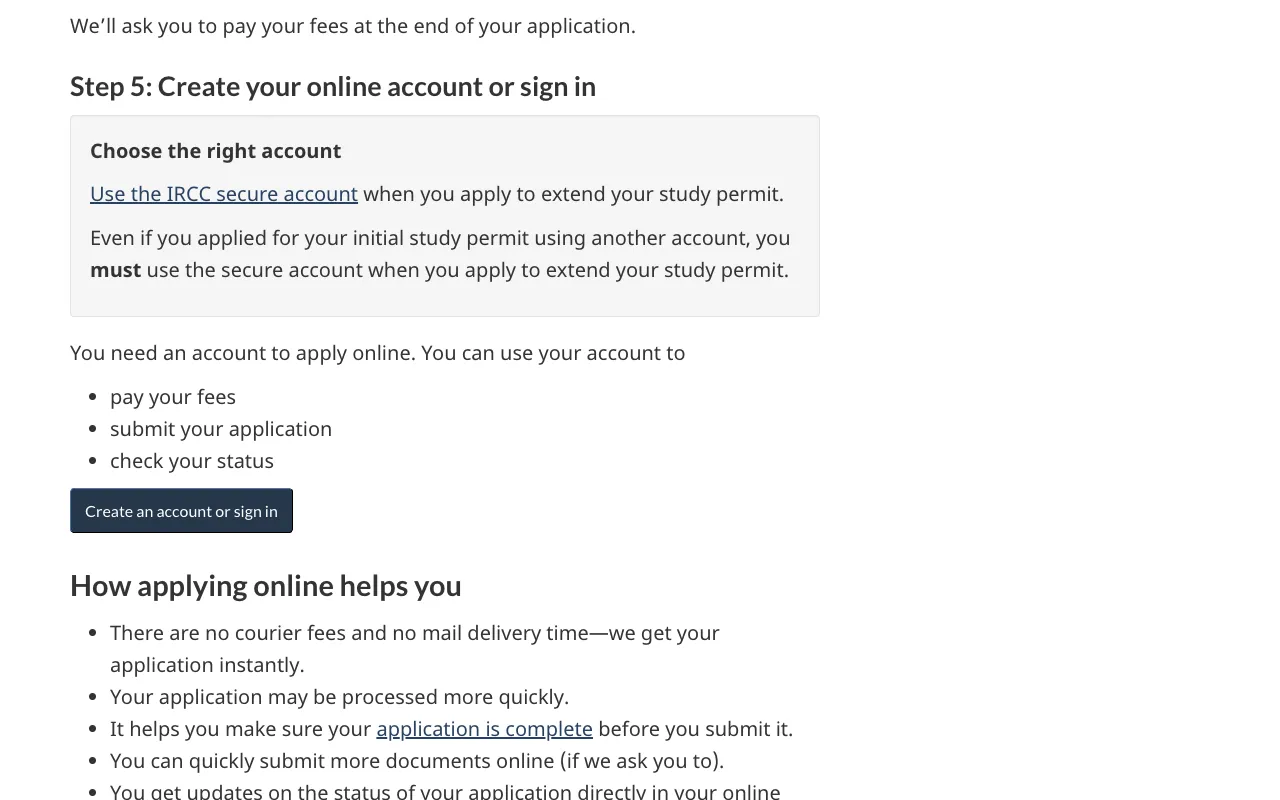
IRCC page · Extend your study permit or restore your status: How to apply · Whole page · Live page - Use the IRCC secure account even if you applied for your original permit in another account.
- You need a scanner or camera to make electronic copies, and a valid credit or debit card.
- Answer the online questions. IRCC uses them to build your personalized document checklist.
- If you're changing to a new post-secondary DLI, answer 'Yes' to the question about changing your designated learning institution so you're considered for faster processing.
- You can apply on paper only if a disability prevents you from applying online, or a barrier makes applying online impossible or unreliable.
Fill out the IMM 5709 form
Each person fills out their own IMM 5709 (Application to Change Conditions, Extend my Stay or Remain in Canada as a Student) and uploads it. Only the current version of the form is accepted.
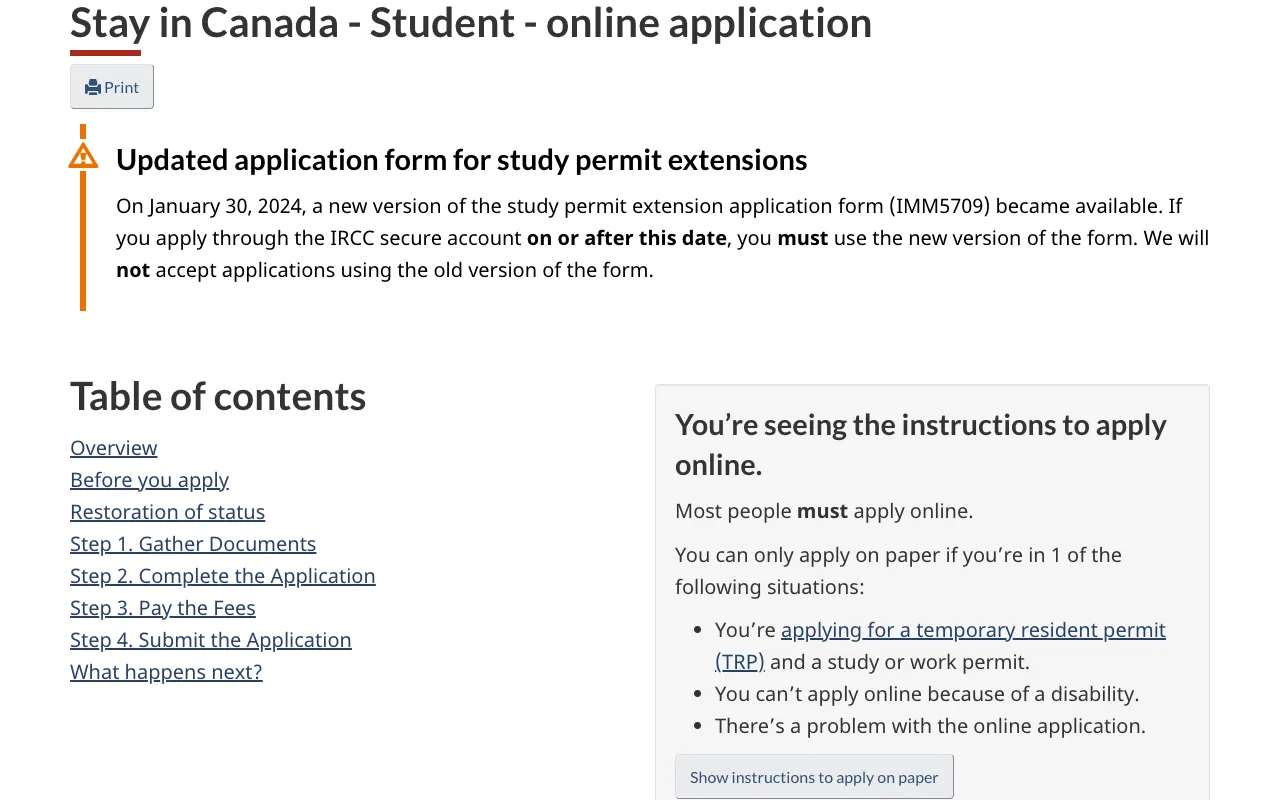
IRCC page · Guide 5552 - Applying to Change Conditions or Extend Your Stay in Canada - Student - online application · Whole page · Live page - Download the latest version of the PDF and fill it out in Adobe Reader on a computer. IRCC stopped accepting old versions when a new form came out on January 30, 2024. The current edition is dated June 2026.
- At the top, tick 'Apply for a study permit for the first time or extend my study permit'. If your permit has already expired, also tick 'Restore my status as a student'.
- Answer every question. Unanswered background questions make the application incomplete.
- Validate a form you completed on a computer so it generates a barcode page.
- Add IMM 5409 (common-law), IMM 5646 (custodian for a minor), IMM 5476 (representative) and IMM 5475 (release of information) if they apply to you.
Pay the fees
Pay the study permit processing fee (it covers extensions), plus the restoration fee if you've lost status and the biometrics fee if you need to give biometrics.
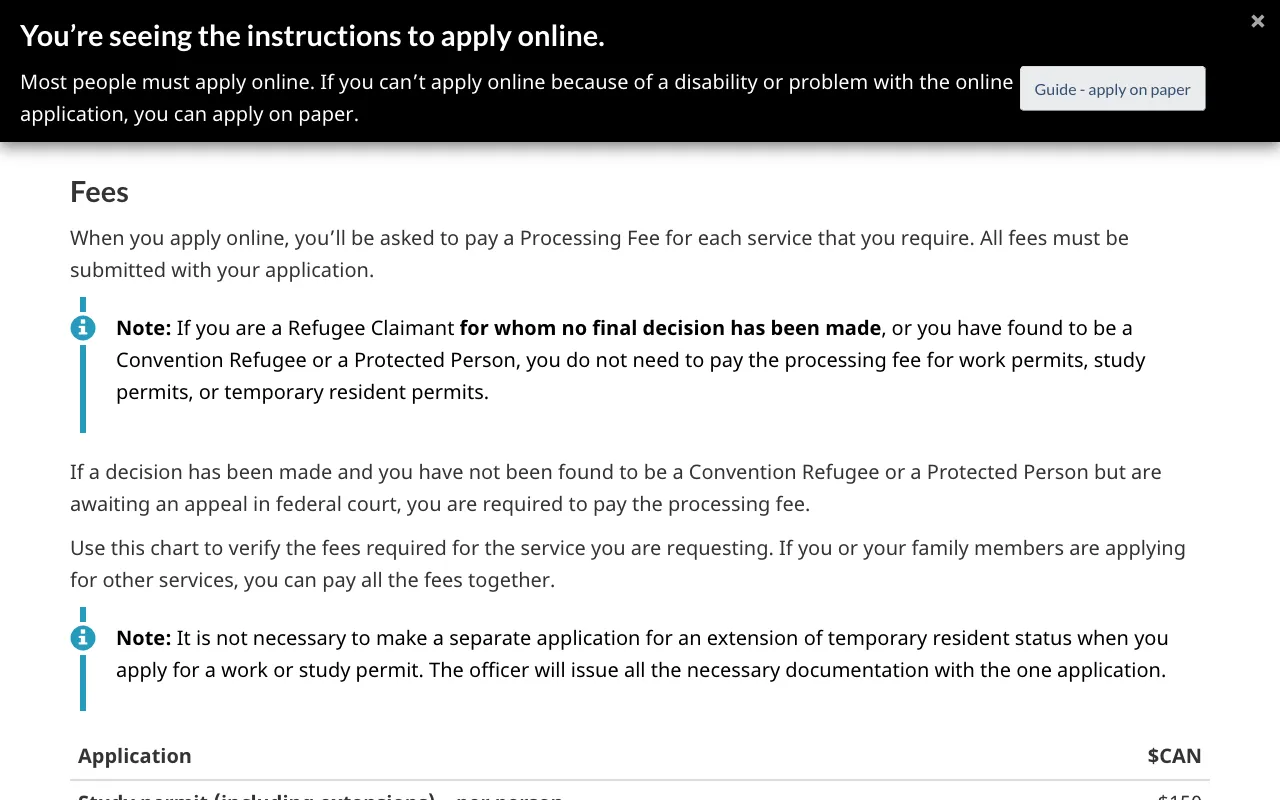
IRCC page · Guide 5552 - Applying to Change Conditions or Extend Your Stay in Canada - Student - online application · Whole page · Live page - Check current amounts on IRCC's fee list. They change.
- If you're out of status, pay both the study permit fee and the restoration fee.
- Once IRCC starts processing, the fee isn't refunded, whatever the decision. If your permit has expired and you wrongly apply for an extension instead of restoration, you won't get the extension fee back and will have to pay the restoration fee as well.
- If you also apply for a work permit with IMM 5709, pay that fee too.
Give biometrics if required
Biometrics are generally required for a study permit extension (US nationals excluded), unless you're exempt or your earlier biometrics are still valid.
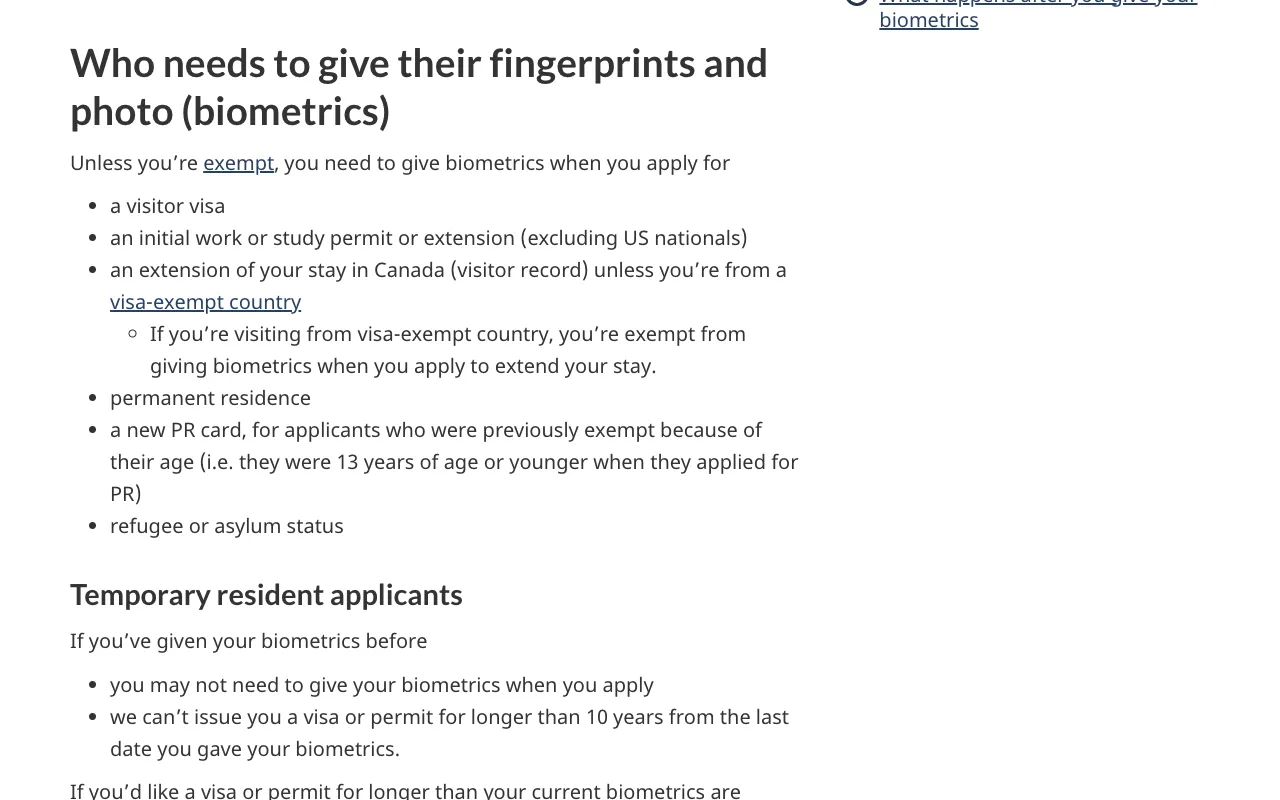
IRCC page · Biometrics Who needs to give their fingerprints and photo · Whole page · Live page - Biometrics are valid for 10 years. IRCC's biometric status check tool shows when yours expire.
- If you need to give biometrics, pay the biometrics fee when you apply, then wait for your biometric instruction letter.
- In Canada, give biometrics at a designated Service Canada office, by appointment only.
While you wait: maintained status
If you applied before your permit expired, you have maintained status. You can stay in Canada and keep studying under your current permit's conditions until IRCC decides, as long as you stay in Canada.
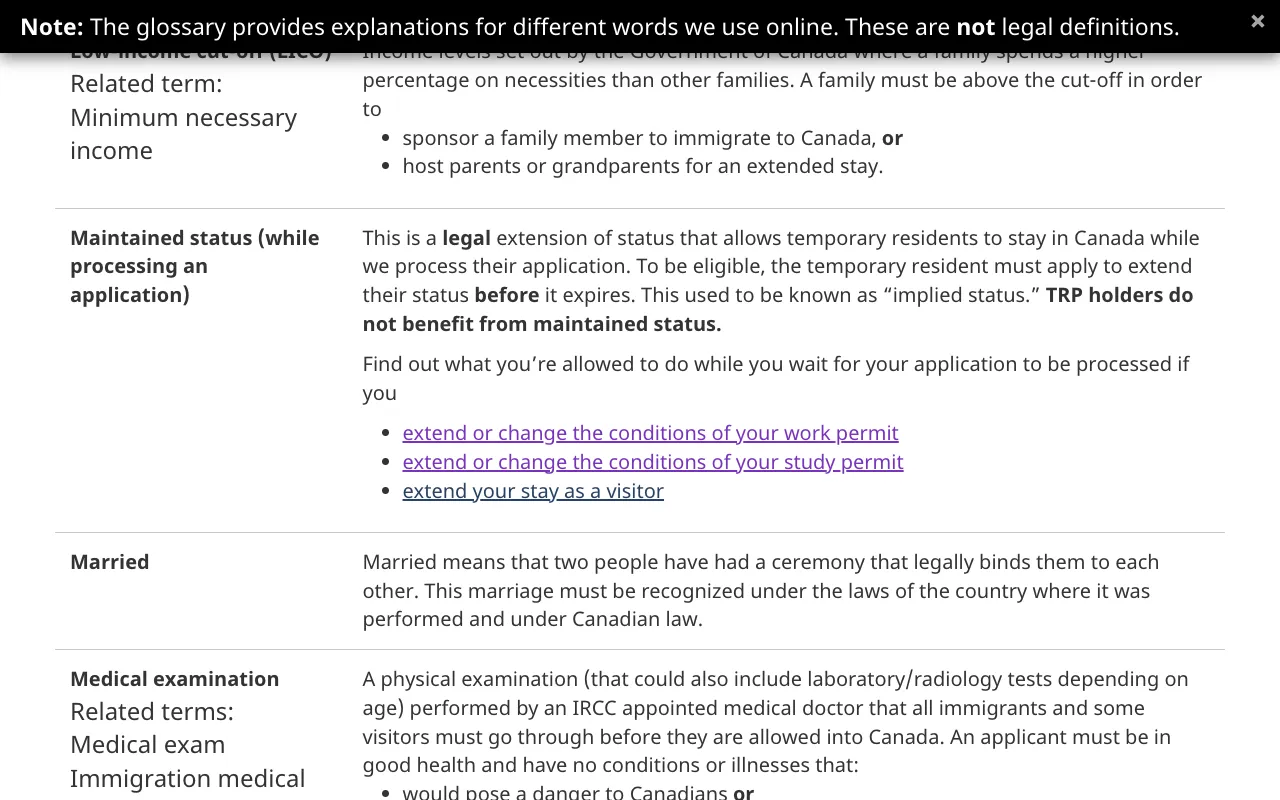
IRCC page · Glossary · Whole page · Live page - Maintained status (formerly called 'implied status') is a legal extension of your status while IRCC processes an application you made before your status expired.
- You can keep studying under the conditions of your current permit, but only while you remain in Canada.
- Off-campus work: one of the eligibility requirements is having a valid study permit or having applied to extend before it expired. You must still meet all the other requirements.
- On maintained status you can't renew provincial or territorial documents such as a driver's licence or health card, and you can't get a social insurance number (SIN) card. Renew them before your permit expires.
- If IRCC rejects your application as incomplete, it's treated as never submitted, and you don't get maintained status.
- Keep your contact information up to date and answer any IRCC requests.
If you travel outside Canada while you wait
You can leave Canada while your extension is pending, but when you come back you can't study until the extension is approved, and you may not be allowed back in.
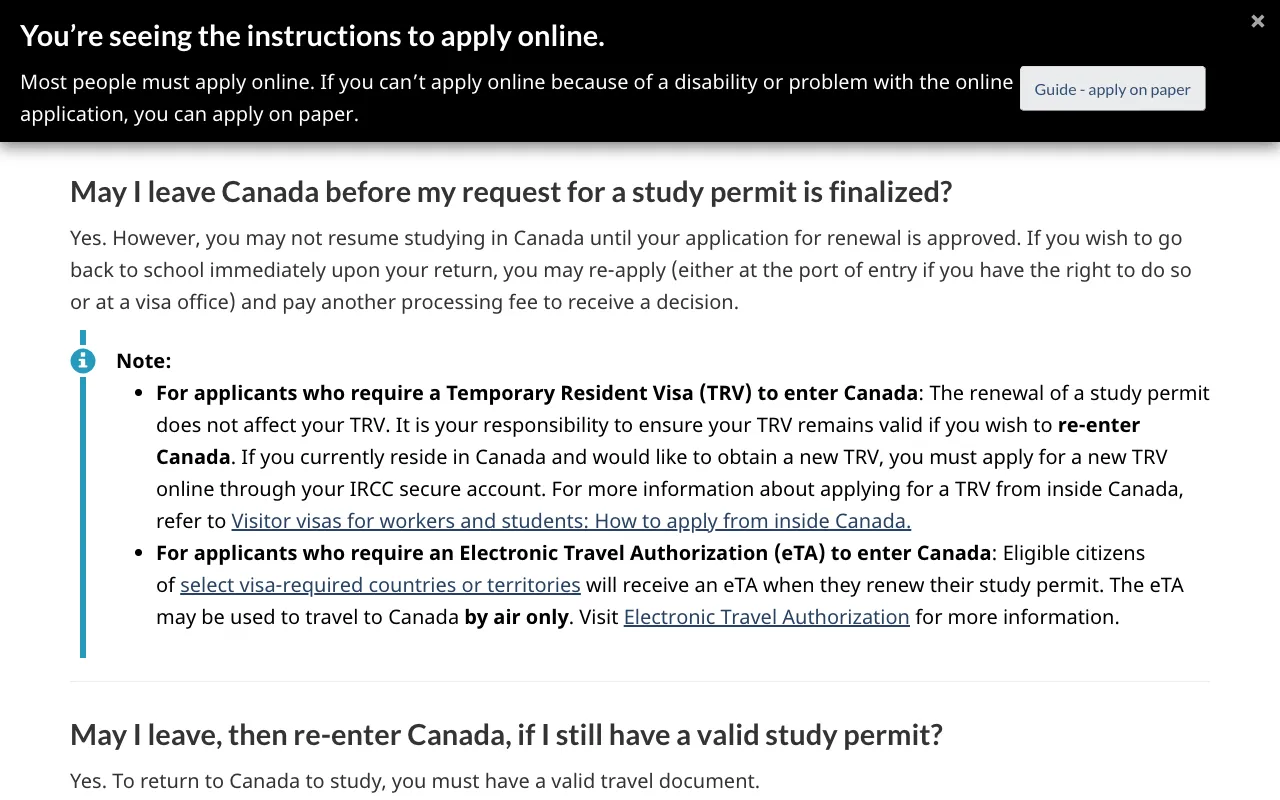
IRCC page · Guide 5552 - Applying to Change Conditions or Extend Your Stay in Canada - Student - online application · Whole page · Live page - If IRCC hasn't decided by the time you return, you may be let in as a visitor, and you can't study until you get the new permit. The officer may ask you to prove you can support yourself.
- A study permit isn't a travel document. You also need a valid visitor visa or eTA (or proof of US permanent residence, if that applies to you).
- Renewing a study permit doesn't renew your visitor visa. If you need a new one, apply separately from inside Canada.
- The border services officer always makes the final decision about entry.
If you're changing schools: when you can start at the new DLI
In most cases you must wait for the extension to be approved before you start at a new post-secondary DLI. You can start earlier only if you meet all of IRCC's criteria.
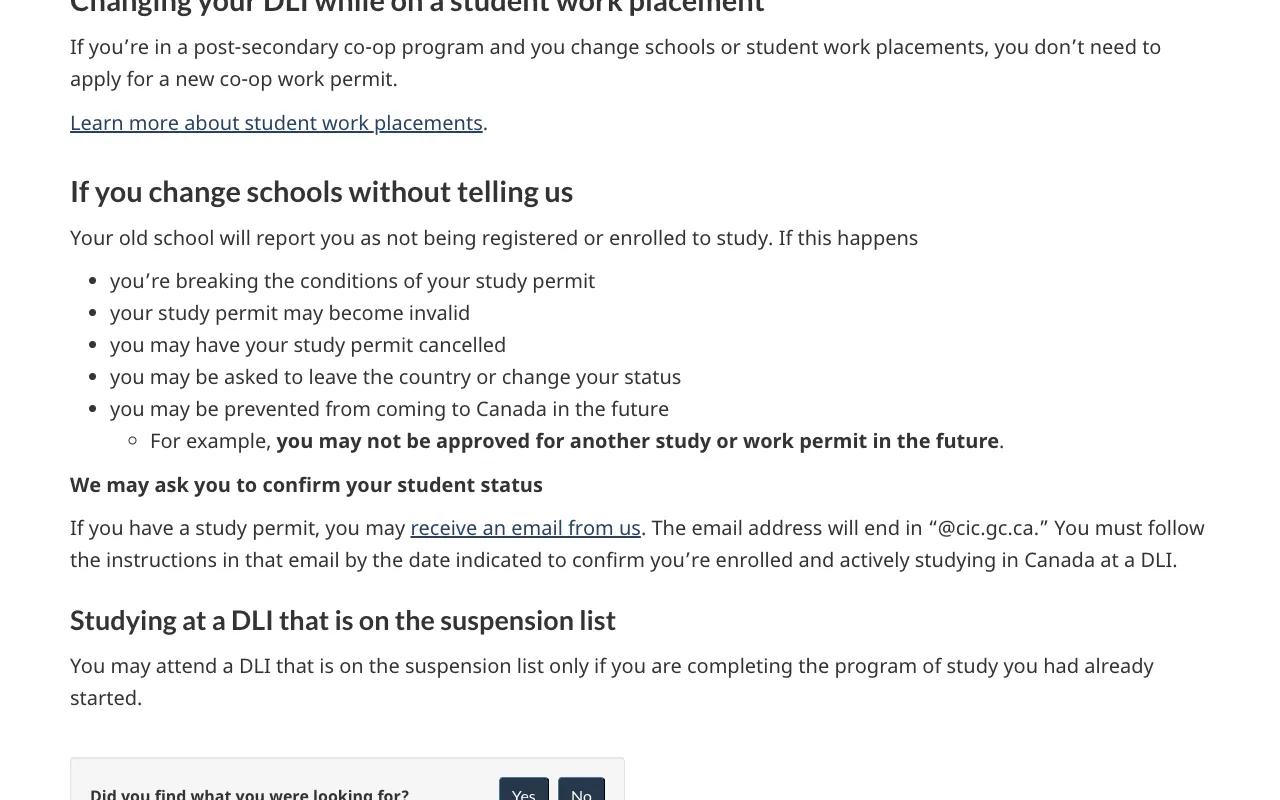
IRCC page · Changing your school or program · Whole page · Live page - You can start at the new school while waiting only if all of these are true: you haven't left Canada since you got the new LOA; you still meet your current permit's conditions; and before you finished your program, your previous DLI closed, discontinued your program, was put on the suspension list, or lost its designated status.
- Otherwise, apply for and get the extension for your new DLI before you finish studying at your current one.
- If you change schools without telling IRCC, your old school reports that you're not enrolled. Your permit may become invalid or be cancelled.
Get the decision
IRCC's Case Processing Centre sends a new study permit or a refusal letter, or refers your file to a local IRCC office. Approved permits are mailed to your Canadian address.
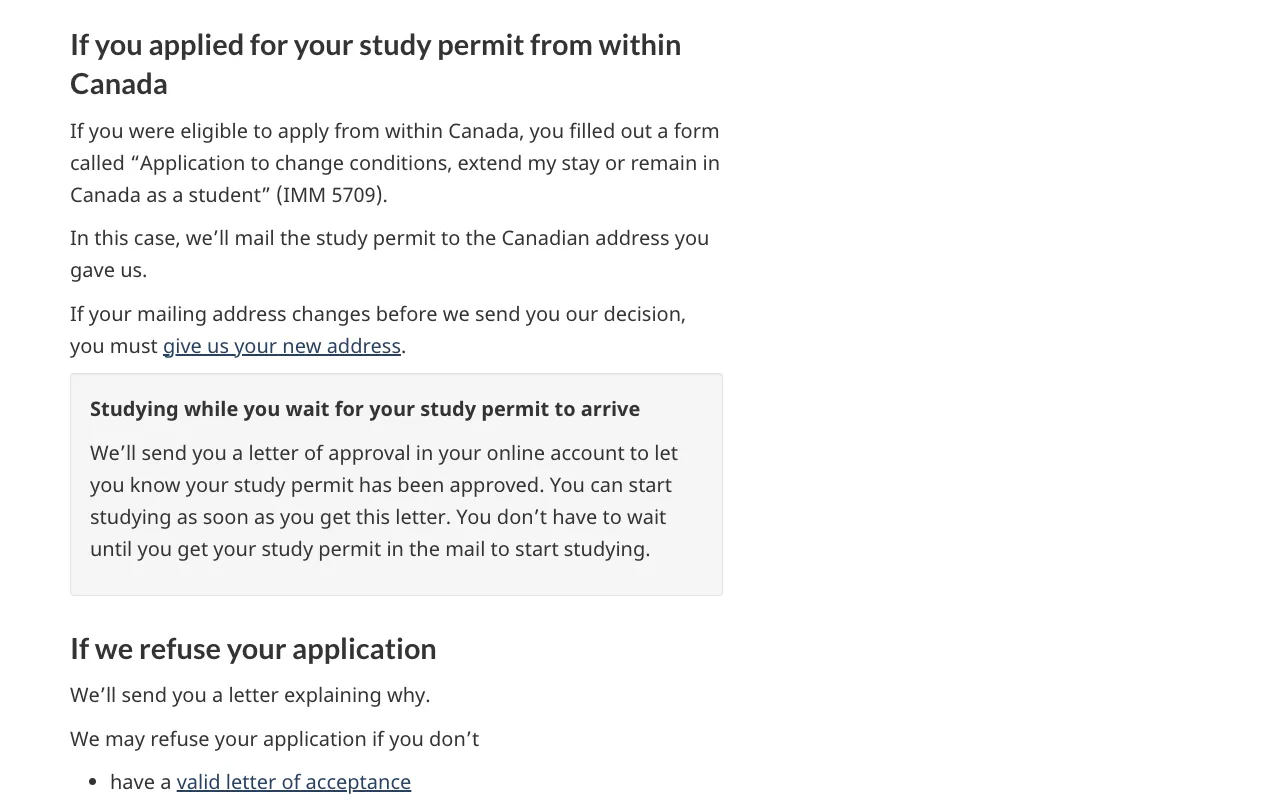
IRCC page · Study permit: After you apply · Whole page · Live page - If approved, IRCC mails the new study permit to the Canadian address you gave. If your mailing address changes before the decision, tell IRCC.
- For in-Canada applications, IRCC also puts a letter of approval in your online account.
- If your file goes to a local office, that office may ask for more information or an interview. It can take up to three months for them to contact you.
- If you're refused, you must stop studying when your current permit expires. You can then apply to stay as a visitor or worker, apply to restore your status as a student, or leave Canada. If you started a new program at the same school while waiting and are refused, stop studying immediately.
If your permit already expired: apply to restore your status (within 90 days)
If your permit expired before you applied, you've lost student status. You may be able to restore it within 90 days by applying for restoration together with a new study permit, but you can't study until it's restored.
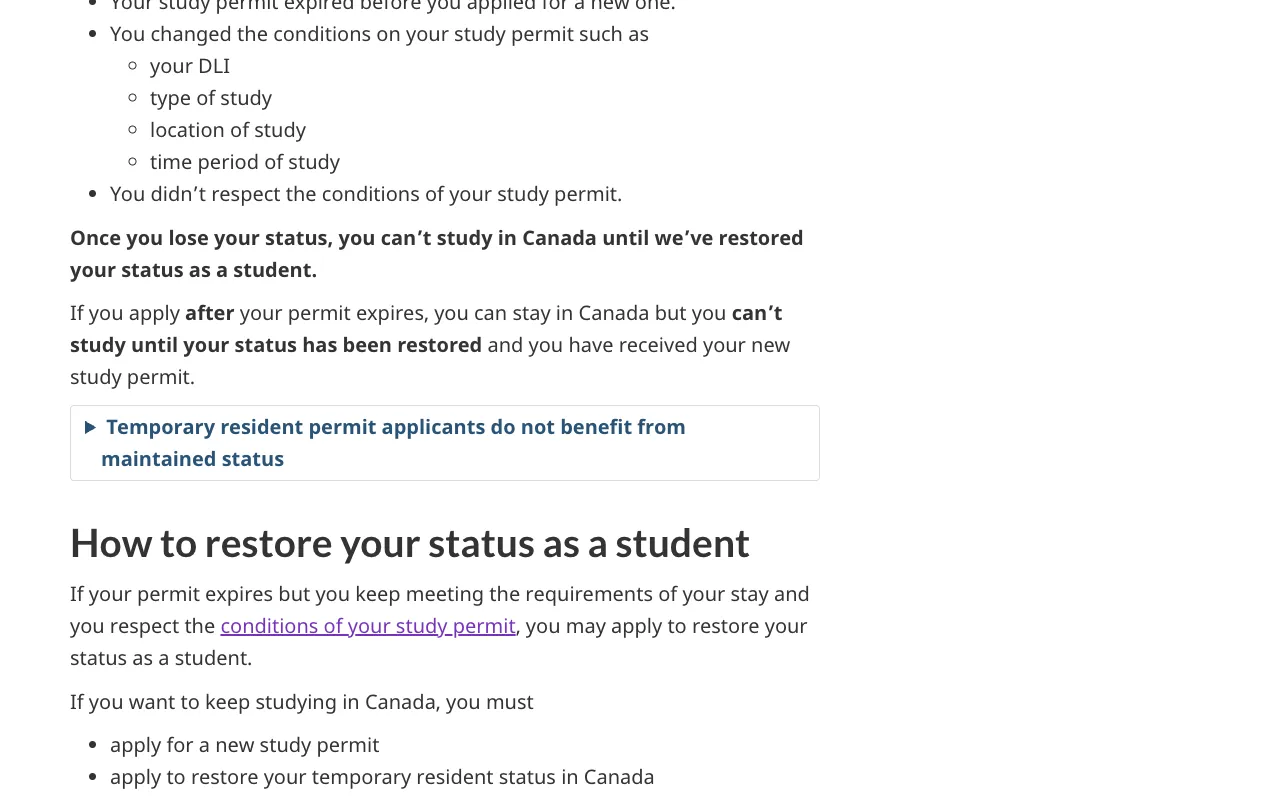
IRCC page · Extend your study permit or restore your status: What to do if your permit expires · Whole page · Live page - You also lose status if you change permit conditions (such as your DLI, type, location or period of study) without approval, or don't respect your permit's conditions.
- Apply within 90 days of losing status. Explain what happened, keep meeting the requirements for your stay, and pay both the restoration fee and the study permit fee.
- On IMM 5709, tick 'Restore my status as a student' as well as the study permit box.
- You need a new PAL/TAL for restoration.
- You can stay in Canada while IRCC processes the application, but you can't study until your status is restored and you have the new permit. Approval isn't guaranteed.
- Family members who also lost status must each apply and pay separately. Temporary resident permit (TRP) holders can't restore their status.
Documents checklist
Gather these before you apply. Your personalized checklist from IRCC is the final word on what your application needs.
- Proof of PaymentEach person included in the applicationA receipt for the processing fee (and the restoration and biometrics fees, if they apply). Online applicants pay in the account. Official source for Proof of Payment
- PHOTOCOPIES of passport pagesEach person included in the applicationMust clearly show the passport number, the issue and expiry dates, your name and date of birth, the stamp from your most recent entry to Canada, and any other marked page. Your permit can't run past your passport's expiry date. Official source for PHOTOCOPIES of passport pages
- PHOTOCOPIES of your travel or identity documentOnly if you didn't use a passport to enter CanadaFor example a citizenship certificate, birth certificate or alien registration card. Official source for PHOTOCOPIES of your travel or identity document
- PHOTOCOPY of your current immigration document (if you have one)Each person included in the applicationFor example, your current study permit. Don't send originals unless IRCC asks. Official source for PHOTOCOPY of your current immigration document (if you have one)
- Proof of acceptance or enrolment (letter of acceptance or letter of enrolment)The student applicantA current letter from the DLI on official letterhead. Post-secondary DLIs must verify it, so upload it in the space for the LOA. A letter of acceptance must show the exact tuition, the start and finish dates, and the registration deadline. Official source for Proof of acceptance or enrolment (letter of acceptance or letter of enrolment)
- Proof of academic standing (transcripts or registrar's letter)Students renewing a permit after studying for at least two consecutive periodsTranscripts (official or unofficial) from your last two periods of study, or a registrar's letter. Primary and secondary students have their own versions of this, listed in Guide 5552. Official source for Proof of academic standing (transcripts or registrar's letter)
- Provincial Attestation Letter / Territorial Attestation Letter (PAL/TAL)Only applicants who need one, for example when changing DLI or level of study, or restoring statusNot needed if you're staying at the same DLI and level of study. Without a required PAL/TAL (or proof of an exception), the application won't be accepted for processing. Official source for Provincial Attestation Letter / Territorial Attestation Letter (PAL/TAL)
- Québec Acceptance Certificate (CAQ) approval letter from MIFI (if studying in Québec)Students studying or planning to study in Quebec (very few exceptions)The CAQ must contain the line confirming you have a place in Quebec's share of study permit applications or are exempt. For the IMM 5709, IRCC asks for the certificate number and expiry date. Official source for Québec Acceptance Certificate (CAQ) approval letter from MIFI (if studying in Québec)
- Proof of funds available or means of supportThe student applicant, covering any accompanying family membersMust cover tuition, living expenses and transportation, without working in Canada. IRCC applies the current financial requirements to extensions. Official source for Proof of funds available or means of support
- PHOTOCOPY of your Marriage License or Certificate (if applicable)Married applicantsIMM 5709's instructions say married applicants must provide a copy. Official source for PHOTOCOPY of your Marriage License or Certificate (if applicable)
- Statutory Declaration of Common-law Union (IMM 5409), if applicableApplicants in a common-law relationshipRequired if your marital status on IMM 5709 is Common-Law. Official source for Statutory Declaration of Common-law Union (IMM 5409), if applicable
- Custodianship Declaration - Custodian for Minors Studying in Canada (IMM 5646), if applicableMinors under 17 studying without a parent or legal guardianPages 1 and 2, notarized. The custodian must live in Canada. The IMM 5709 PDF itself says to fill it out if you're under the age of majority in your province or territory (18 or 19), and IRCC says an officer may ask for a custodian for 17-year-olds up to that age. Official source for Custodianship Declaration - Custodian for Minors Studying in Canada (IMM 5646), if applicable
- Letter explaining why you're changing schoolsApplicants who are changing DLIsInclude documents showing you meet the criteria if you believe you can start at the new DLI before a decision. Official source for Letter explaining why you're changing schools
- Explanation of why you need restoration (letter)Only applicants restoring their status after the permit expiredExplain how you lost your status and why you stayed longer than allowed. Official source for Explanation of why you need restoration (letter)
- Medical exam results (if required)For example medical students, people working in health care or in close contact with children or the elderly, and some agricultural workersIf you had an upfront medical exam, include proof with your application. Official source for Medical exam results (if required)
- Translations into English or FrenchAnyone submitting a document in another languageProvide a copy of the original document and its English or French translation. Official source for Translations into English or French
- Use of a Representative (IMM 5476) / Authority to Release Personal Information to a Designated Individual (IMM 5475), if applicableOnly if you use a representative, or want IRCC to release information to someone elseOptional forms listed on IMM 5555. Official source for Use of a Representative (IMM 5476) / Authority to Release Personal Information to a Designated Individual (IMM 5475), if applicable
- Request for a Change of Sex or Gender Identifier (IRM 0002), if applicableApplicants choosing an identifier different from the one on their previous Canadian temporary resident documentNo supporting documents are required. Official source for Request for a Change of Sex or Gender Identifier (IRM 0002), if applicable
What to write where
Field by field, in the order the form asks, with each one outlined on the form. Labels are as IRCC prints or documents them; the examples are made up.
IMM 5709 – Application to Change Conditions, Extend my Stay or Remain in Canada as a Student (edition IMM 5709 (06-2026) E)
APPLICATION TO CHANGE CONDITIONS, EXTEND MY STAY OR REMAIN IN CANADA AS A STUDENT (top of page 1)
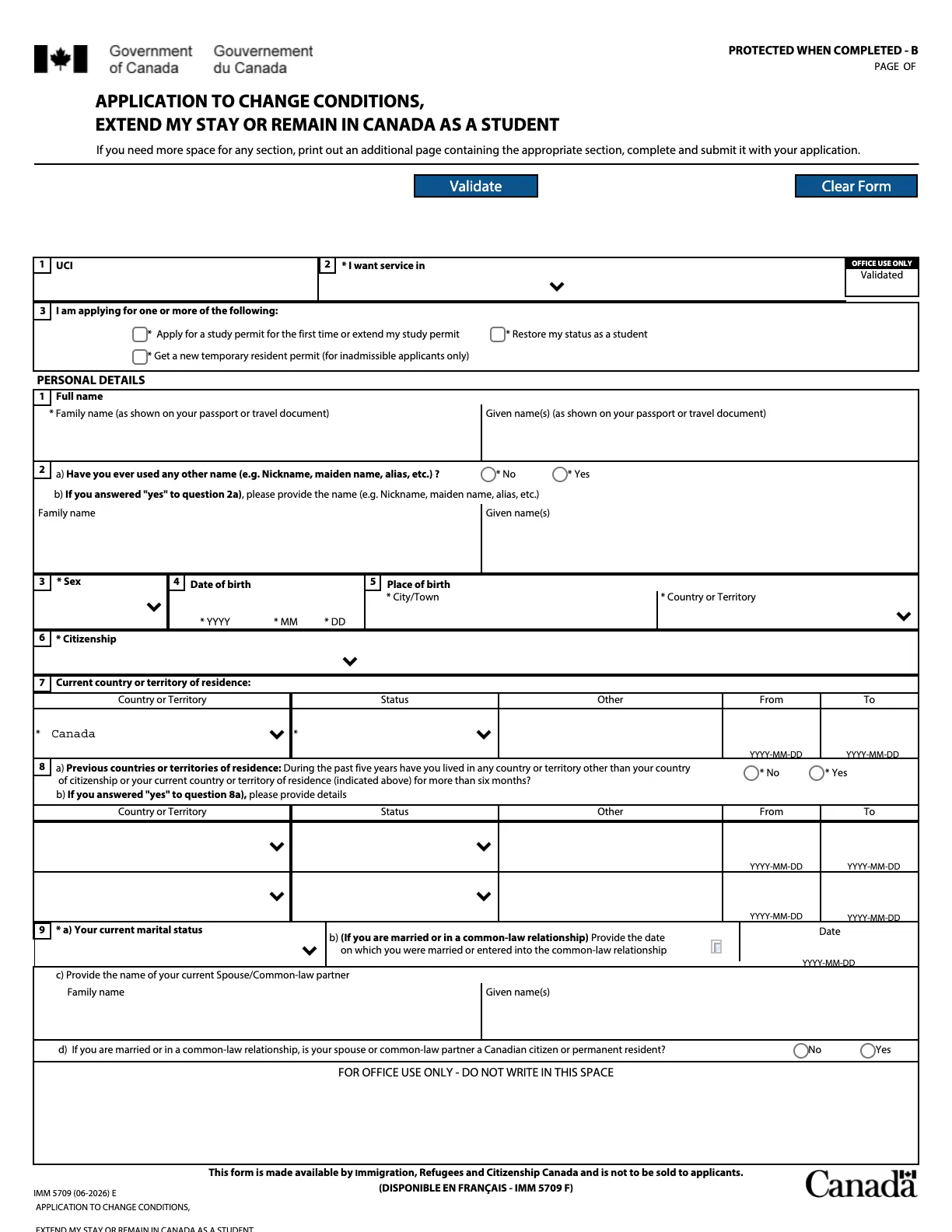 12345
- 1 UCI
What they’re asking: Your unique client identifier, or UCI, printed on your study or work permit.
Your unique client identifier. IRCC says it's printed on your study or work permit, under 'Country of Citizenship'.
- 2 I want service in
What they’re asking: Which language, English or French, you want IRCC to serve you in.
Choose English or French.
- 3 Apply for a study permit for the first time or extend my study permit
What they’re asking: Are you extending your study permit, or applying for your first one from inside Canada?
One of three boxes under 'I am applying for one or more of the following:'. Tick it to extend your study permit, or to get a first study permit from inside Canada.
- 4 Restore my status as a student
What they’re asking: Are you applying to restore your student status after losing it?
Tick this as well as the study permit box only if your permit has already expired (or you otherwise lost status) and you're applying within 90 days to restore it. IRCC's web instructions call this 'Restoration of temporary resident status as a student'.
Watch out: Applying for a plain extension after the permit expired. IRCC keeps the fee and asks for a restoration fee as well.
Official source for the field “Restore my status as a student”
- 5 Get a new temporary resident permit (for inadmissible applicants only)
What they’re asking: Are you inadmissible and applying for a temporary resident permit?
Leave this unticked unless you're inadmissible and applying for a temporary resident permit. That case is outside this guide.
PERSONAL DETAILS
12345678910111213- 1 Family name (as shown on your passport or travel document)
What they’re asking: Your last name, exactly as your passport shows it.
Your surname exactly as it appears in your passport, even if misspelled. No initials. If your passport has no family name, put all your given names here.
e.g.
SMITHOfficial source for the field “Family name (as shown on your passport or travel document)”
- 2 Given name(s) (as shown on your passport or travel document)
What they’re asking: Your first and any middle names, as your passport shows them.
All your given names, as they appear in your passport. If you have none, leave it blank.
e.g.
AlexWatch out: Entering '*', 'Not applicable' or 'NA' when you have no given name.
Official source for the field “Given name(s) (as shown on your passport or travel document)”
- 3 a) Have you ever used any other name (e.g. Nickname, maiden name, alias, etc.) ?
What they’re asking: Have you ever gone by another name, like a nickname or maiden name?
Answer Yes or No. If Yes, enter the other names under 'b) If you answered "yes" to question 2a), please provide the name (e.g. Nickname, maiden name, alias, etc.)'.
- 4 Sex
What they’re asking: Your gender: female, male, unknown or another gender.
Choose F, M, U or X. The form prints 'Sex'. IRCC's instructions call it gender.
Watch out: Changing the identifier from your previous Canadian document without including IRM 0002.
- 5 Date of birth
What they’re asking: When you were born: day, month and year.
Fill in the DD, MM and YYYY boxes. Use an asterisk (*) for any unknown part.
- 6 Place of birth
What they’re asking: The city or town and country where you were born.
Your 'City/Town' and 'Country or Territory' of birth.
e.g.
Lyon, France- 7 Citizenship
What they’re asking: Your country of citizenship, or for dual citizens, the passport you're using.
Your country of citizenship. If you have more than one, choose the one whose passport you're using.
- 8 Current country or territory of residence:
What they’re asking: Your status in Canada right now, and the dates you've held it.
The country is Canada. Under 'Status', choose your current status in Canada (for example Student) and give the From–To dates you've held it. If you're out of status, choose 'Other', type 'Out of status, restoration' under 'Other', and leave the From and To boxes blank.
Watch out: Out-of-status applicants entering dates or a student status. IRCC asks for 'Other' and 'Out of status, restoration'.
Official source for the field “Current country or territory of residence:”
- 9 a) Previous countries or territories of residence: During the past five years have you lived in any country or territory other than your country of citizenship or your current country or territory of residence (indicated above) for more than six months?
What they’re asking: In the last five years, lived over six months outside Canada and your home country?
Answer Yes or No. If Yes, give each country, your status there and the dates.
- 10 a) Your current marital status
What they’re asking: Your marital status today, for example single, married or common-law.
Choose from the list (Annulled Marriage, Common-Law, Divorced, Legally Separated, Married, Single or Widowed).
Watch out: Leaving out IMM 5409 if you're common-law, or a marriage certificate copy if you're married.
Official source for the field “a) Your current marital status”
- 11 b) (If you are married or in a common-law relationship) Provide the date on which you were married or entered into the common-law relationship
What they’re asking: When you married, or when your current common-law relationship began.
The date of the marriage, or the start date of your current common-law relationship.
- 12 c) Provide the name of your current Spouse/Common-law partner
What they’re asking: Your current spouse or common-law partner's full name.
Their 'Family name' and 'Given name(s)'.
e.g.
Family name SMITH, given name TaylorOfficial source for the field “c) Provide the name of your current Spouse/Common-law partner”
- 13 d) If you are married or in a common-law relationship, is your spouse or common-law partner a Canadian citizen or permanent resident?
What they’re asking: Is your spouse or partner a Canadian citizen or permanent resident?
Answer Yes or No.
PERSONAL DETAILS (CONTINUED)
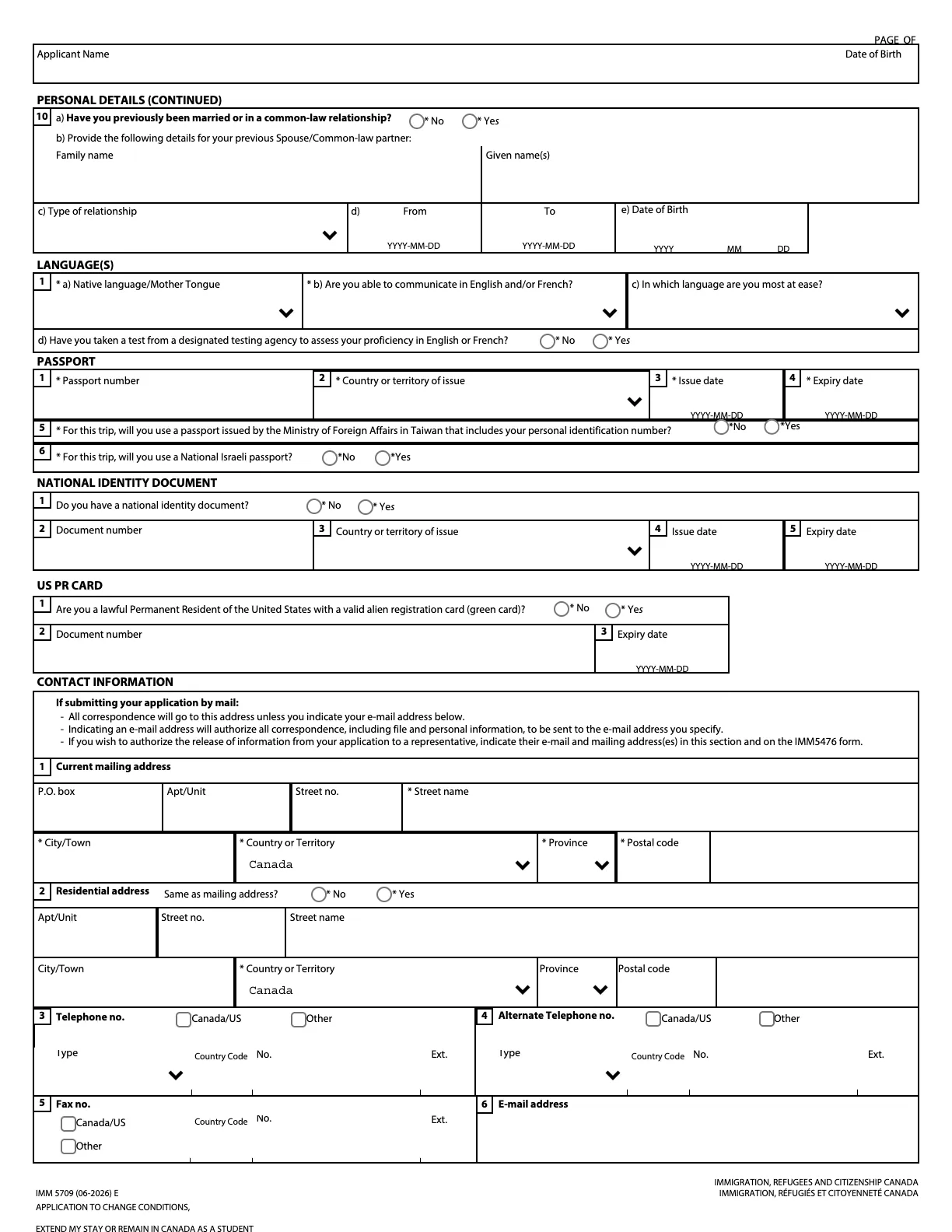 1
- 1 a) Have you previously been married or in a common-law relationship?
What they’re asking: Have you been married or in a common-law relationship before?
Answer Yes or No. If Yes, give the previous partner's family name, given name(s), type of relationship, From–To dates and date of birth.
Official source for the field “a) Have you previously been married or in a common-law relationship?”
LANGUAGE(S)
1234- 1 a) Native language/Mother Tongue
What they’re asking: The language you learned at home as a child and still understand.
The language you learned at home as a child and still understand. If it isn't in the list, choose 'Other'.
Official source for the field “a) Native language/Mother Tongue”
- 2 b) Are you able to communicate in English and/or French?
What they’re asking: Can you communicate in English, French, both, or neither?
Choose English, French, Both or Neither.
Official source for the field “b) Are you able to communicate in English and/or French?”
- 3 c) In which language are you most at ease?
What they’re asking: Between English and French, which one do you use most?
If your native language isn't English or French, choose the one of the two you use most.
Official source for the field “c) In which language are you most at ease?”
- 4 d) Have you taken a test from a designated testing agency to assess your proficiency in English or French?
What they’re asking: Have you taken an English or French test from a designated testing agency?
Answer Yes or No. You don't have to submit language test results with this application, though IRCC may ask for them later.
PASSPORT
123456- 1 Passport number
What they’re asking: Your passport number, exactly as printed.
Exactly as printed, with no spaces.
- 2 Country or territory of issue
What they’re asking: Which country issued your passport?
The country that issued the passport.
Official source for the field “Country or territory of issue”
- 3 Issue date
What they’re asking: The date your passport was issued.
The date the passport was issued.
- 4 Expiry date
What they’re asking: The date your passport expires.
The passport's expiry date. Your new permit can't run past it, so renew your passport first if it expires soon.
- 5 For this trip, will you use a passport issued by the Ministry of Foreign Affairs in Taiwan that includes your personal identification number?
What they’re asking: Is your passport a Taiwan passport that includes your personal identification number?
Answer Yes or No.
- 6 For this trip, will you use a National Israeli passport?
What they’re asking: Are you using a National Israeli passport?
Answer Yes or No.
Official source for the field “For this trip, will you use a National Israeli passport?”
NATIONAL IDENTITY DOCUMENT
1- 1 Do you have a national identity document?
What they’re asking: Do you have a national ID document, and if so, its details?
Answer Yes or No. If Yes, fill in 'Document number', 'Country or territory of issue', 'Issue date' and 'Expiry date'.
Official source for the field “Do you have a national identity document?”
US PR CARD
1- 1 Are you a lawful Permanent Resident of the United States with a valid alien registration card (green card)?
What they’re asking: Are you a US permanent resident with a valid green card?
Answer Yes or No. If Yes, fill in the 'Document number' and 'Expiry date' of your green card.
CONTACT INFORMATION
123456- 1 Current mailing address
What they’re asking: Your Canadian mailing address, where IRCC will mail your new permit.
Your mailing address in Canada. Boxes: 'P.O. box', 'Apt/Unit', 'Street no.', 'Street name', 'City/Town', 'Country or Territory', 'Province' and 'Postal code'. If you don't give a P.O. box, the street number is required. IRCC mails your new permit to the Canadian address you give.
e.g.
123 Sample Street, TorontoWatch out: Abbreviating street words such as Street or Avenue. Only directions (NW, SE, W) may be abbreviated.
- 2 Residential address
What they’re asking: Is the place you live the same as your mailing address?
Answer 'Same as mailing address?'. If No, enter where you live.
- 3 Telephone no.
What they’re asking: Your main phone number, with the country and area codes.
Tick 'Canada/US' or 'Other', choose the 'Type', and enter the full number. Put any extension under 'Ext.'.
- 4 Alternate Telephone no.
What they’re asking: A second phone number, entered the same way as the first.
Another number, entered the same way.
- 5 Fax no.
What they’re asking: Your fax number, if you have one.
Optional.
- 6 E-mail address
What they’re asking: An email address you check often, for IRCC's messages.
An email address you check regularly. Giving one allows IRCC to send your correspondence, including personal information, by email.
e.g.
alex.smith@example.comWatch out: Missing IRCC emails in junk mail. IRCC emails end in @cic.gc.ca, @canada.ca or @international.gc.ca.
COMING INTO CANADA
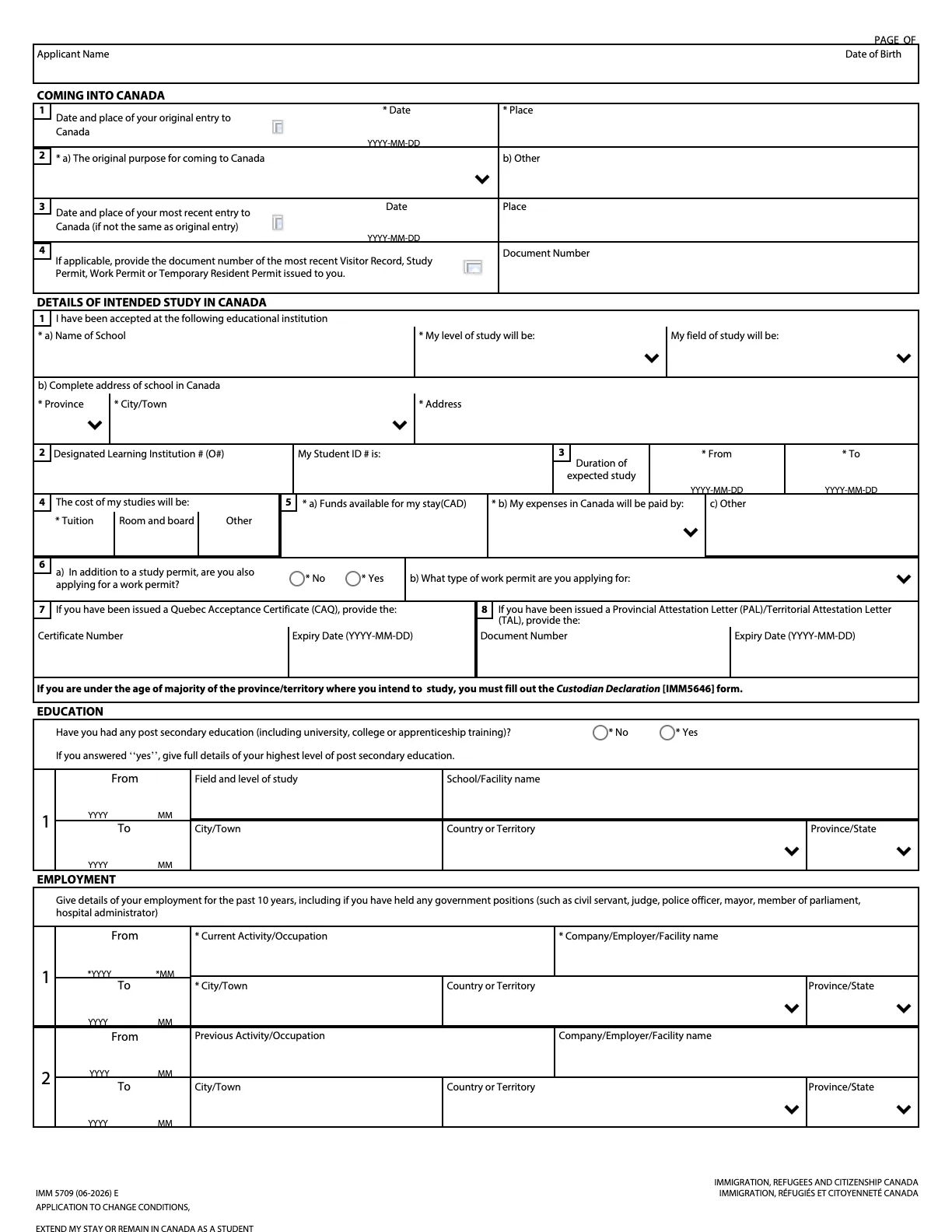 1234
- 1 Date and place of your original entry to Canada
What they’re asking: When and where you first came into Canada.
The 'Date' and 'Place' (for example the airport or border crossing) where you first entered Canada.
e.g.
Place: Vancouver airportOfficial source for the field “Date and place of your original entry to Canada”
- 2 a) The original purpose for coming to Canada
What they’re asking: Why you first came to Canada, such as study or work.
Choose Business, Tourism, Study, Work or Other. If Other, explain in 'b) Other'.
Official source for the field “a) The original purpose for coming to Canada”
- 3 Date and place of your most recent entry to Canada (if not the same as original entry)
What they’re asking: When and where you last came into Canada, if different from your first entry.
Your latest entry date and place, if it's different from your first entry.
- 4 Document Number
What they’re asking: The number on your most recent visitor record, study, work or temporary resident permit.
If it applies, the document number of the most recent visitor record, study permit, work permit or temporary resident permit issued to you.
DETAILS OF INTENDED STUDY IN CANADA
12345678910111213- 1 a) Name of School
What they’re asking: The full name of your school, or your new school if changing.
The full name of the school that accepted or enrolled you. If you're changing schools, use the new one.
e.g.
Sample Lakeview College- 2 My level of study will be:
What they’re asking: The level of study you'll be doing, chosen from the list.
Choose from the list.
- 3 My field of study will be:
What they’re asking: What subject area you'll study, chosen from the list.
Choose from the list.
- 4 b) Complete address of school in Canada
What they’re asking: Your school's full address in Canada.
The school's 'Province', 'City/Town' and 'Address'.
e.g.
456 Campus Road, TorontoOfficial source for the field “b) Complete address of school in Canada”
- 5 Designated Learning Institution # (O#)
What they’re asking: Your school's DLI number, from IRCC's list of designated learning institutions.
The DLI number from IRCC's DLI list (post-secondary schools).
Official source for the field “Designated Learning Institution # (O#)”
- 6 My Student ID # is:
What they’re asking: Your student number at your school.
Your student ID number.
- 7 Duration of expected study
What they’re asking: The start and end dates of the studies this extension covers.
The 'From' and 'To' dates of the studies the extension is for, matching your DLI letter.
- 8 The cost of my studies will be:
What they’re asking: How much your tuition, room and board, and other costs will be.
Amounts for 'Tuition', 'Room and board' and 'Other' (for example books, transport and pocket money).
Official source for the field “The cost of my studies will be:”
- 9 a) Funds available for my stay(CAD)
What they’re asking: How much money, in Canadian dollars, you have for your studies.
The money available for your studies, in Canadian dollars. It should match your proof of funds. (The form prints the label with no space before '(CAD)'.)
Official source for the field “a) Funds available for my stay(CAD)”
- 10 b) My expenses in Canada will be paid by:
What they’re asking: Who will pay for your expenses in Canada?
Choose Myself, Parents or Other. If Other, say who in 'c) Other' (for example a relative, a scholarship or a business).
Official source for the field “b) My expenses in Canada will be paid by:”
- 11 a) In addition to a study permit, are you also applying for a work permit?
What they’re asking: Are you also applying for a work permit with this application?
Answer Yes or No. If Yes, choose the type in 'b) What type of work permit are you applying for:' (Co-op Work Permit, Open Work Permit or Post-Graduation Work Permit), pay that fee too, and follow the work permit checklist IMM 5583. Note that since April 1, 2026, post-secondary students don't need a co-op work permit for work placements.
- 12 If you have been issued a Quebec Acceptance Certificate (CAQ), provide the:
What they’re asking: If you study in Quebec, your Quebec Acceptance Certificate number and expiry date.
Quebec students: the CAQ 'Certificate Number' and 'Expiry Date (YYYY-MM-DD)'.
e.g.
Expiry date 2027-08-31- 13 If you have been issued a Provincial Attestation Letter (PAL)/Territorial Attestation Letter (TAL), provide the:
What they’re asking: Your provincial or territorial attestation letter's number and expiry date, if you have one.
If you have a PAL/TAL for this application, enter its 'Document Number' and 'Expiry Date (YYYY-MM-DD)' exactly as shown on the letter. (The form prints this field, but IRCC's step-by-step instructions don't describe it.)
e.g.
Expiry date 2027-08-31
EDUCATION
1- 1 Have you had any post secondary education (including university, college or apprenticeship training)?
What they’re asking: Have you had any university, college or apprenticeship training?
Answer Yes or No. If Yes, give details of your highest post-secondary education: From and To (year and month), 'Field and level of study', 'School/Facility name', 'City/Town', 'Country or Territory' and 'Province/State'.
EMPLOYMENT
12- 1 Current Activity/Occupation
What they’re asking: What you're doing now, such as studying, and where.
Your current activity (for example, student) with From and To dates, 'Company/Employer/Facility name', 'City/Town', 'Country or Territory' and 'Province/State'.
- 2 Previous Activity/Occupation
What they’re asking: What you've done over the past ten years, including any government jobs.
Previous activities covering the past 10 years, including any government positions. Use an extra page if needed.
Official source for the field “Previous Activity/Occupation”
BACKGROUND INFORMATION
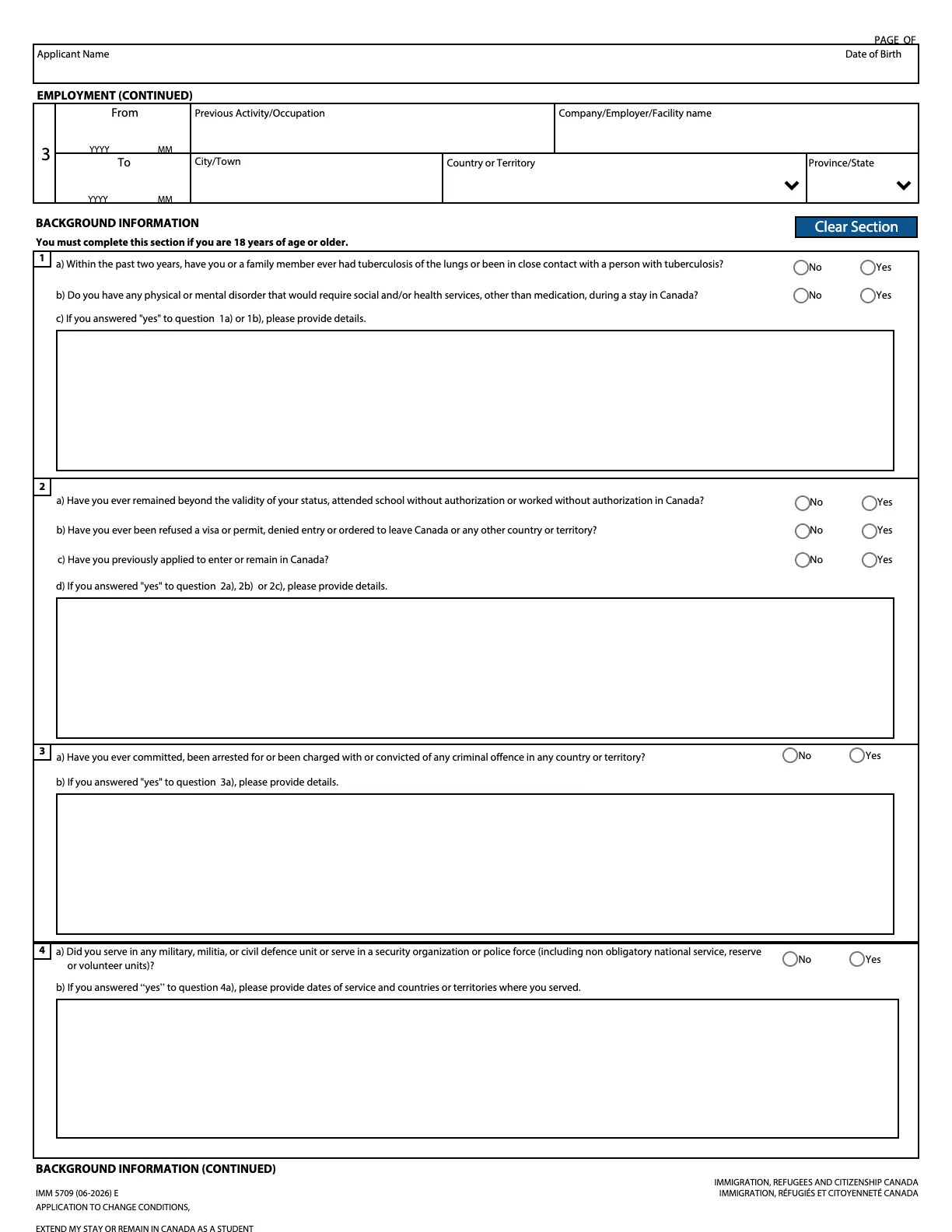 123456789
 1011
- 1 a) Within the past two years, have you or a family member ever had tuberculosis of the lungs or been in close contact with a person with tuberculosis?
What they’re asking: Past two years: have you or family had lung tuberculosis, or close contact with it?
Answer Yes or No. The form says this section is for applicants 18 or older, and unanswered questions make the application incomplete.
Watch out: Leaving any background question unanswered.
- 2 b) Do you have any physical or mental disorder that would require social and/or health services, other than medication, during a stay in Canada?
What they’re asking: Do you have a physical or mental disorder needing health or social services beyond medication?
Answer Yes or No.
- 3 c) If you answered "yes" to question 1a) or 1b), please provide details.
What they’re asking: Details about a yes answer to the tuberculosis or health questions.
Only if you answered Yes to 1a) or 1b). IRCC's instructions also ask for the family member's name, if it applies.
- 4 a) Have you ever remained beyond the validity of your status, attended school without authorization or worked without authorization in Canada?
What they’re asking: Have you ever overstayed, or studied or worked in Canada without permission?
Answer Yes or No.
- 5 b) Have you ever been refused a visa or permit, denied entry or ordered to leave Canada or any other country or territory?
What they’re asking: Ever refused a visa or permit, denied entry, or ordered to leave any country?
Answer Yes or No.
- 6 c) Have you previously applied to enter or remain in Canada?
What they’re asking: Have you applied before to come to or stay in Canada?
Answer Yes or No. Your earlier study permit application counts as a previous application.
Official source for the field “c) Have you previously applied to enter or remain in Canada?”
- 7 d) If you answered "yes" to question 2a), 2b) or 2c), please provide details.
What they’re asking: Details for any yes to the overstay, refusal or previous-application questions.
Details for any Yes answer to 2a) to 2c).
- 8 a) Have you ever committed, been arrested for or been charged with or convicted of any criminal offence in any country or territory?
What they’re asking: Have you ever committed a crime, or been arrested, charged or convicted, anywhere?
Answer Yes or No. If Yes, give details in 'b) If you answered "yes" to question 3a), please provide details.'
- 9 a) Did you serve in any military, militia, or civil defence unit or serve in a security organization or police force (including non obligatory national service, reserve or volunteer units)?
What they’re asking: Ever served in any military, militia, civil defence, security or police unit?
Answer Yes or No. If Yes, give your dates of service and the countries or territories where you served.
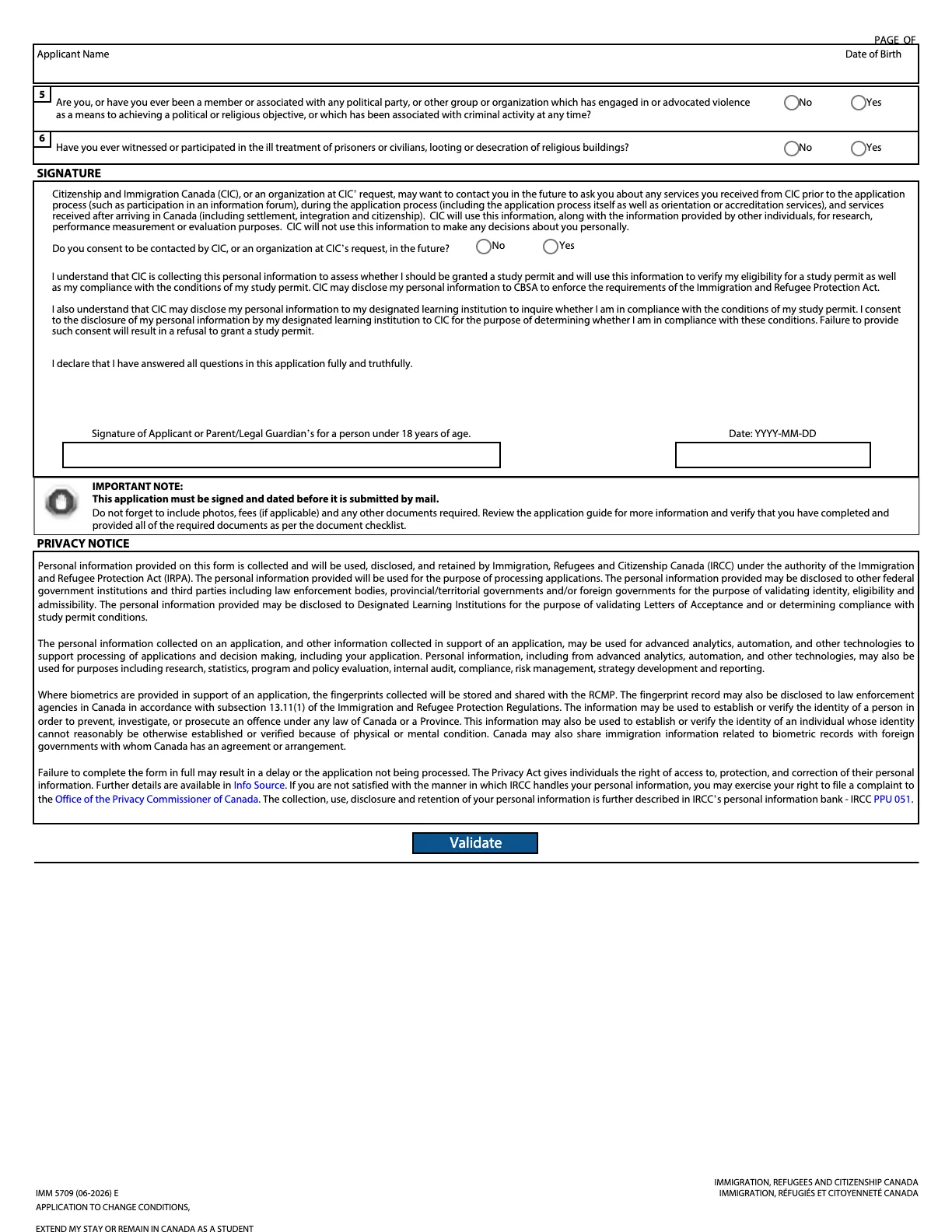
- 10 Are you, or have you ever been a member or associated with any political party, or other group or organization which has engaged in or advocated violence as a means to achieving a political or religious objective, or which has been associated with criminal activity at any time?
What they’re asking: Ever in or linked to a group tied to political or religious violence, or crime?
Answer Yes or No.
- 11 Have you ever witnessed or participated in the ill treatment of prisoners or civilians, looting or desecration of religious buildings?
What they’re asking: Ever witnessed or taken part in mistreating prisoners or civilians, looting, or desecrating religious buildings?
Answer Yes or No.
SIGNATURE
12- 1 Do you consent to be contacted by CIC, or an organization at CIC’s request, in the future?
What they’re asking: Would you agree to be contacted later for research or evaluation?
Optional Yes or No consent to future research or evaluation contact. The form says it isn't used to make decisions about you.
- 2 Signature of Applicant or Parent/Legal Guardian’s for a person under 18 years of age.
What they’re asking: Your signature, or a parent's or legal guardian's if you're under 18.
Read the declaration. It includes your consent for your DLI to share information with IRCC about whether you're meeting your permit conditions. The form says paper applications must be signed and dated ('Date: YYYY-MM-DD') before mailing. For online applications, follow the instructions in your account.
Watch out: Withholding the consent in the declaration. The form says that will result in a refusal.
IRCC secure account: study permit extension (online questions IRCC names publicly)
Step 3: Prepare your answers for the online tool
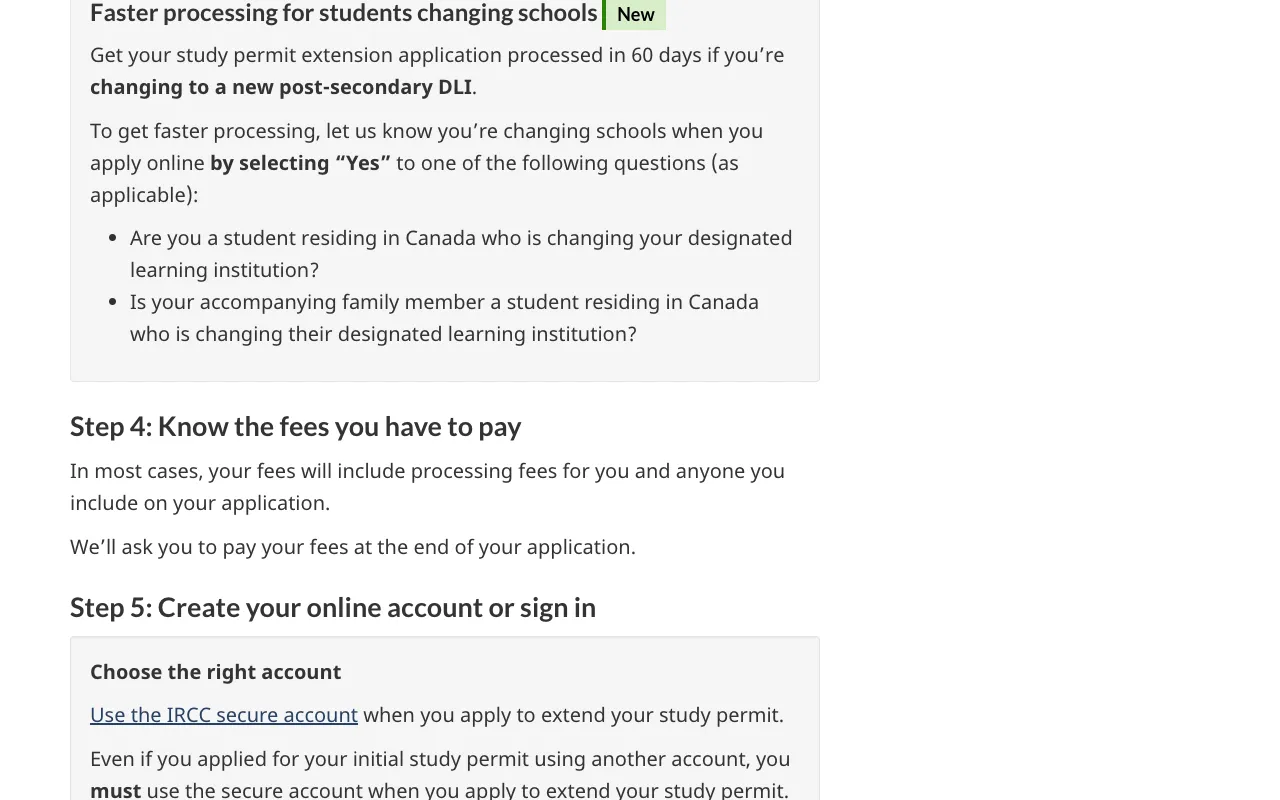 12
- 1 Are you a student residing in Canada who is changing your designated learning institution?
What they’re asking: Are you a student in Canada switching to a new post-secondary DLI?
Answer 'Yes' if you're changing to a new post-secondary DLI. This flags your application for the 60-day faster processing.
- 2 Is your accompanying family member a student residing in Canada who is changing their designated learning institution?
What they’re asking: Is a family member on your application switching to a new post-secondary DLI?
Answer 'Yes' if an accompanying family member included in the application is the one changing to a new post-secondary DLI.
Mistakes IRCC warns about
- Letting your permit expire before you apply. You lose student status, can't study, and must apply for restoration within 90 days. Official source for this mistake
- Applying for a plain extension when your permit has already expired. IRCC keeps the extension fee and asks for a second fee for restoration. Official source for this mistake
- Submitting an incomplete application. If IRCC rejects it as incomplete, you don't get maintained status. Official source for this mistake
- Using an old version of IMM 5709. Official source for this mistake
- Applying before your DLI is ready to verify your letter. If it isn't verified by the deadline, IRCC returns the application. Official source for this mistake
- Leaving out a new PAL/TAL when you're changing schools or levels of study (unless you're exempt). Official source for this mistake
- Starting at a new DLI before your extension is approved when you don't meet IRCC's criteria, or changing schools without telling IRCC. Official source for this mistake
- Leaving Canada while the extension is pending and then studying after you come back before it's approved. Official source for this mistake
- Waiting too long, so your health card, driver's licence or SIN lapses. You can't renew provincial documents or get a SIN card while on maintained status. Official source for this mistake
- Letting your passport get close to expiry. Your extended permit can't run past it. Official source for this mistake
- Applying for a work permit instead of a study permit extension and then continuing to study. You can't keep studying while that application is pending. Official source for this mistake
- Assuming maintained status protects you if you're a temporary resident permit (TRP) applicant. It doesn't. Official source for this mistake
- Not meeting your permit's conditions (for example, not being enrolled during each academic semester). You can lose your status, and future applications may be affected. Official source for this mistake
- Giving false or misleading information. Official source for this mistake
After you apply
- If you applied before your permit expired, you're on maintained status: you can stay and keep studying under your current conditions while you remain in Canada (see the 'maintained status' step).
- Give biometrics if IRCC sends you a biometric instruction letter. In Canada, book an appointment at a designated Service Canada office (see the 'Give biometrics' step).
- Answer any IRCC requests and keep your contact information current. Upload any missing documents through your account or the web form.
- The Case Processing Centre either sends a new study permit (mailed to your Canadian address), sends a refusal letter, or refers your file to a local office, which may contact you within about three months (see the 'Get the decision' step).
- If you're refused, stop studying when your permit expires. Then apply to stay as a visitor or worker, apply for restoration, or leave Canada.
- If you travel while waiting, you can't study after you come back until the extension is approved (see the travel step).
Not covered here
- Applying for a first study permit from outside Canada. See our study permit walkthrough (Official page)
- Post-graduation work permits and other work permits for students (Official page)
- Getting a new visitor visa (TRV) from inside Canada (Official page)
- Temporary resident permits for inadmissible applicants (Official page)
- Extending your stay as a visitor (visitor record), including restoring visitor status (Official page)
- Fixing errors IRCC made on your permit, or adding off-campus work conditions (an amendment, not an extension) (Official page)
- Paper applications (only if a disability or barrier prevents applying online) (Extend your study permit: If you can't apply online)
- Refugee claimants and the extra documents for refused claimants applying to the Federal Court (listed on IMM 5555) (IMM 5555 Document checklist: Student (in Canada applicant))
- Renewing Quebec authorizations (CAQ) for Quebec students. Start from IRCC's PAL/TAL page, which links to Quebec's process (Provincial or territorial attestation letter (PAL/TAL))
Official IRCC pages
- Extend your study permit or restore your status (overview)
- Extend your study permit: When to apply
- Extend your study permit: How to apply
- What to do if your permit expired (restoration and maintained status)
- Guide 5552 – Applying to Change Conditions or Extend Your Stay in Canada – Student (online)
- IMM 5709 form and step-by-step field instructions
- IMM 5555 Document checklist: Student (in Canada applicant)
- Provincial or territorial attestation letter (PAL/TAL)
- Proof of financial support
- Changing schools or programs
- Help Centre: How can I extend my stay as a student?
- Help Centre: Can I stay in Canada after my study permit expires if I applied for a new permit?
- Travelling outside Canada and re-entering as a student
- Study permit conditions
- Extend your study permit: If you can't apply online
- Biometrics: who needs to give them
- IRCC secure account
- Check processing times
- IRCC fee list