Steps
Confirm an employer-specific permit is the right type
An employer-specific work permit lets you work only under the conditions printed on it: one employer, one occupation, and sometimes one location. You need a job offer from an employer that isn't on IRCC's non-compliant list.
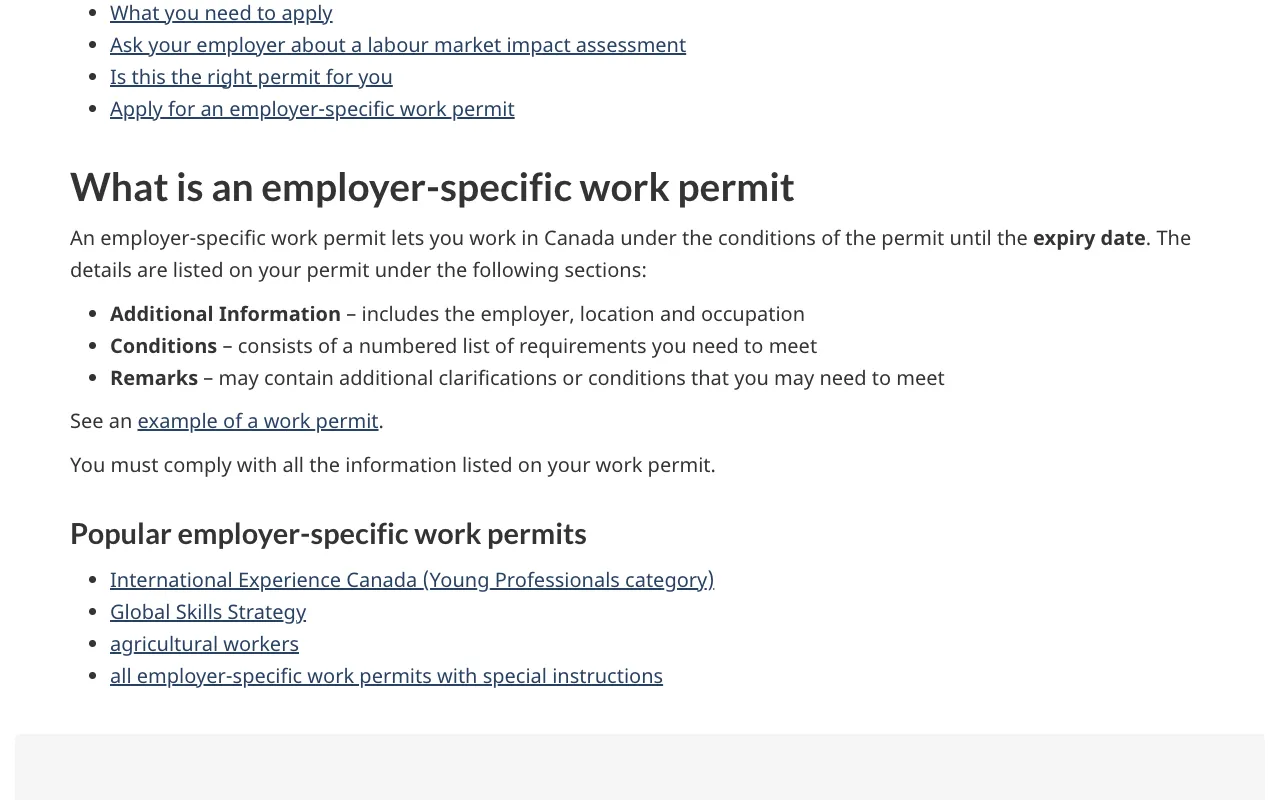
IRCC page · Employer-specific work permits: eligibility, LMIA, and application steps · Whole page · Live page - The permit shows the employer, location and occupation under “Additional Information”, a numbered list under “Conditions”, and any extra conditions under “Remarks”.
- You can't pick the permit type yourself; it depends on your situation. IRCC's “Find out what type of work permit you need” tool helps you check.
- If you need a work permit and don't have one yet, you can't work in Canada or state on a job application that you are legally allowed to work.
- Some programs (for example Global Skills Strategy, agricultural workers, IEC Young Professionals) have their own special instructions. Check the special-instructions list before you apply.
Your employer's part: an LMIA or an offer of employment number
Before you can apply, your employer must work out whether your job needs a labour market impact assessment (LMIA). Depending on the answer, they give you either LMIA documents or an offer of employment number.
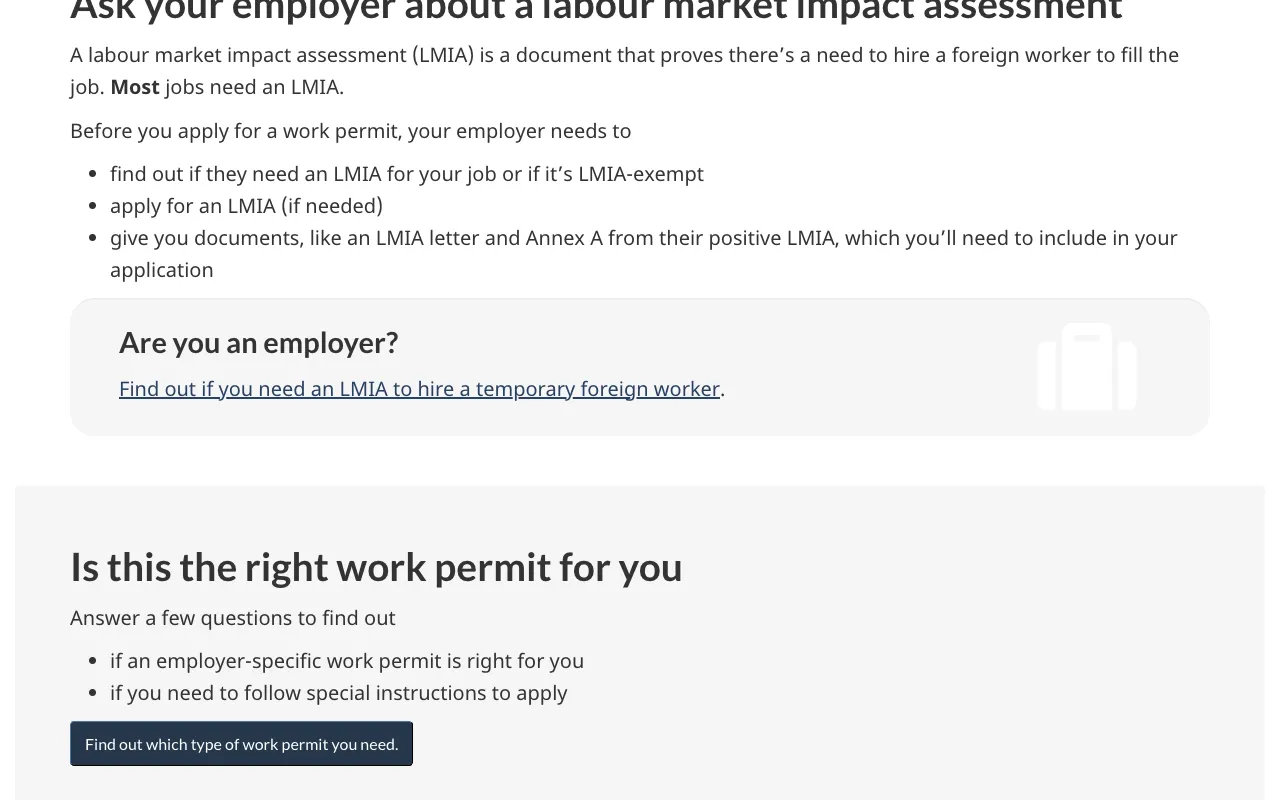
IRCC page · Employer-specific work permits: eligibility, LMIA, and application steps · Whole page · Live page - An LMIA shows that a foreign worker is needed for the job. IRCC says most jobs need one. The employer applies for it through Employment and Social Development Canada; this guide does not cover that process.
- LMIA-required job: once the LMIA is positive, the employer gives you a copy of the LMIA decision letter, its Annex A (employment details) and the LMIA file number, plus an employment contract and a job offer letter.
- LMIA-exempt job: the employer submits an offer of employment in IRCC's Employer Portal and pays the employer compliance fee. The portal generates an offer of employment number (the letter A followed by 7 digits), which the employer gives to you.
- Each offer of employment number can be used for only one application. A later application needs a new number from the employer.
- Some LMIA-exempt employers, such as foreign missions and international organizations, don't submit offers and won't have a number for you.
- Paid work in Quebec for more than 30 days in an LMIA-required job also needs a Quebec Acceptance Certificate (CAQ). The employer handles that with Quebec. If you don't need an LMIA, you usually don't need a CAQ.
Check where you are allowed to apply from
Most people apply from outside Canada, using form IMM 1295. You can apply from inside Canada, using form IMM 5710, only if you fit one of IRCC's listed situations.
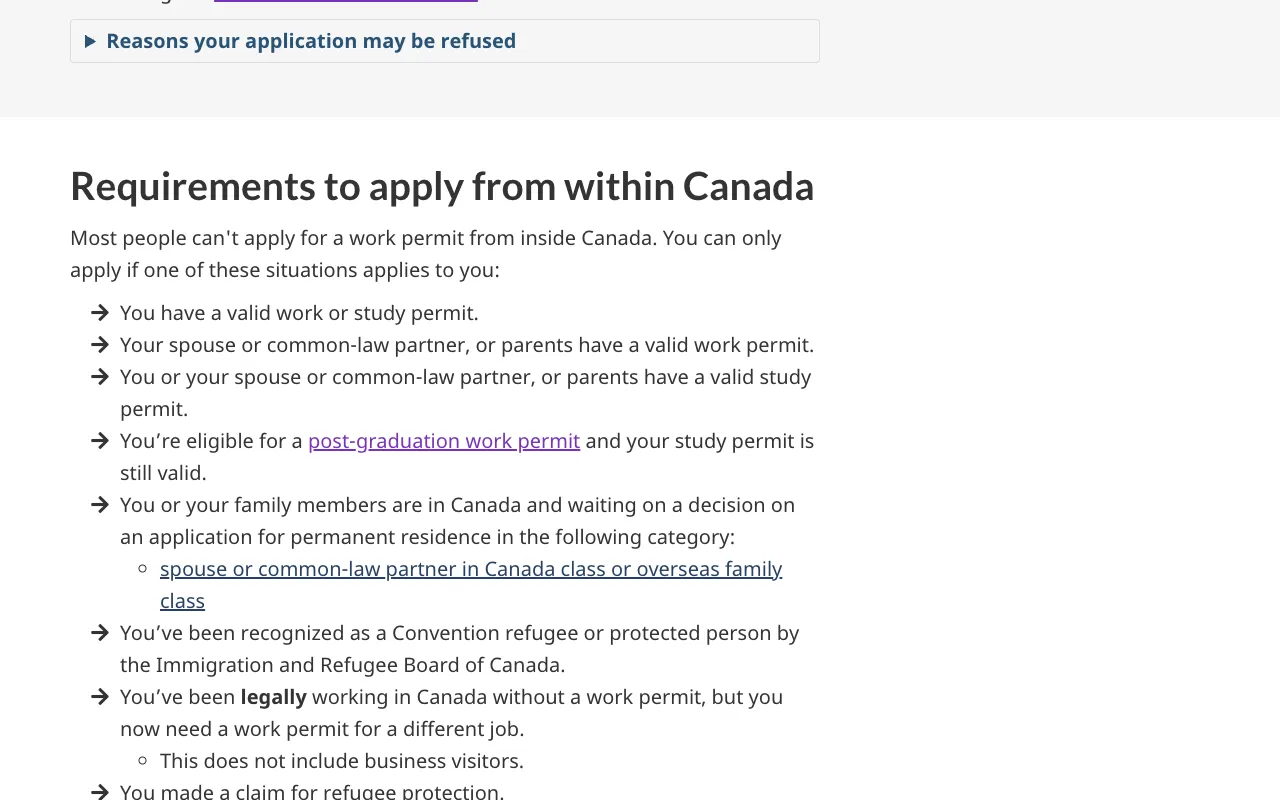
IRCC page · Work permit: Apply from inside Canada – Eligibility and requirements · Whole page · Live page - Inside-Canada situations include: you already hold a valid work or study permit; your spouse, common-law partner or parent holds a valid work permit; you have been working legally without a permit but now need one for a different job (not business visitors); you hold a temporary resident permit valid for 6 months or more; and a few others listed by IRCC.
- Outside Canada, you must also show you will leave Canada before your permit expires.
- Everyone must show enough money for themselves and their family during the stay and to return home, and must include all required documents.
- IRCC lists reasons for refusal, including medical inadmissibility, criminality, security concerns, misrepresentation, and planning to work for an ineligible employer.
- Applying at a port of entry (the border) has separate eligibility rules and isn't covered here.
Gather your documents
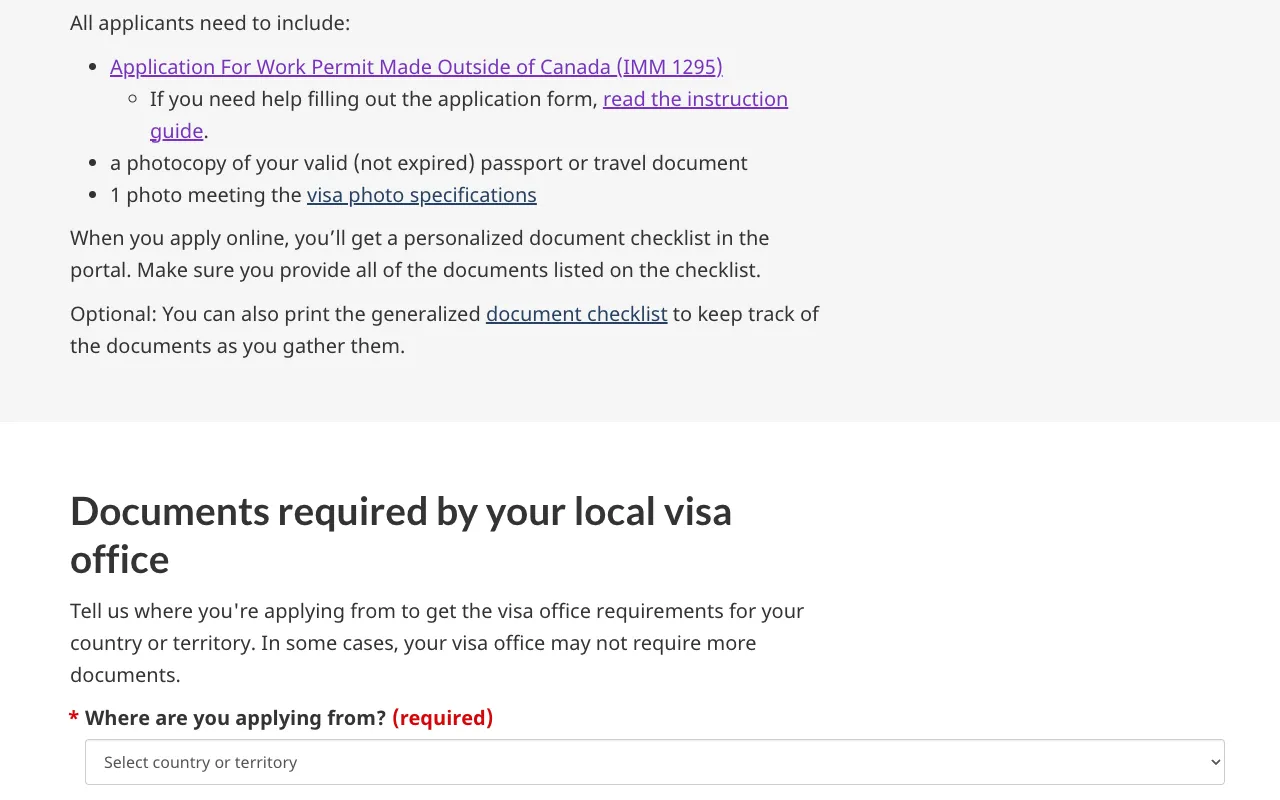
Everyone includes the application form, a copy of their passport and a photo. Employer-specific applicants add employment documents, some of which come from the employer. The personalized checklist in your account is the final list.
IRCC page · Work permit: Forms and document requirements for applications outside Canada · Whole page · Live page - Asked of every employer-specific applicant: a letter from your current employer, a reference letter from past employers, proof of past work experience (for example pay stubs), proof that you meet the job's requirements (such as a licence for a regulated job), and a résumé.
- If your job needs no licence or certification, IRCC says to upload a blank page with “Not applicable” written on it in that slot.
- Then add the LMIA documents or the offer of employment number described in the previous step.
- If you apply from outside Canada and aren't a citizen of the country you're applying from, include proof of your immigration status there. Your local visa office may require extra documents.
- Any document not in English or French needs a translation, plus an affidavit from the translator if they aren't a certified translator. You and your family members may not do the translation.
Get a medical exam if your job or travel history needs one
Some jobs, and some recent travel histories, need an immigration medical exam. You can have an upfront exam with an IRCC panel physician before applying, or wait for instructions from IRCC.
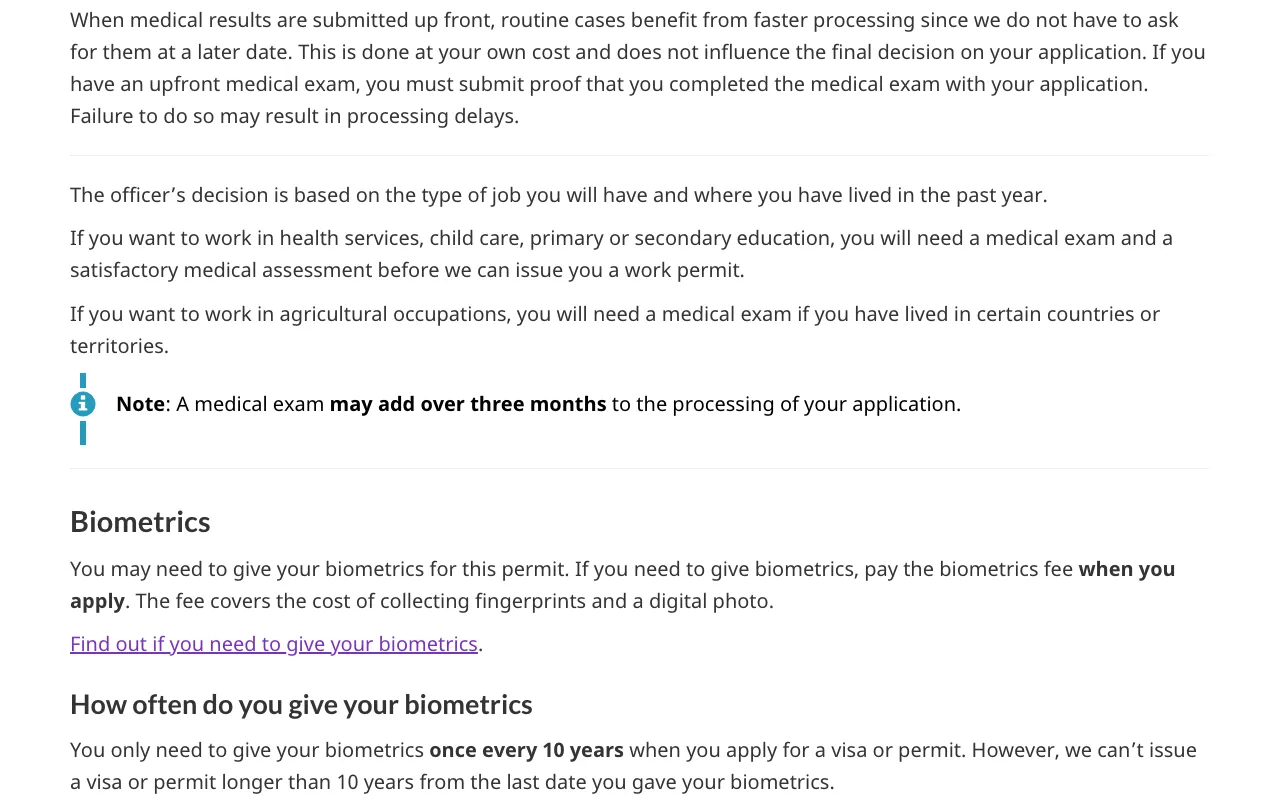
IRCC page · Guide 5487 - Applying for a Work Permit outside Canada · Whole page · Live page - Working in health services, child care, or primary or secondary education requires a medical exam and a satisfactory assessment before IRCC can issue the permit.
- Agricultural work needs an exam if you have lived in certain countries or territories.
- If you have an upfront exam, include proof of it with your application. Leaving the proof out can delay processing.
- If you need a medical exam but didn't have one before arriving, your permit may restrict which jobs you can do. You can ask later to have the restriction removed (see the work permit extension walkthrough).
Fill out the application form
From outside Canada, fill out IMM 1295 (Application for Work Permit Made Outside of Canada). From inside Canada, fill out IMM 5710. The section that matters most for an employer-specific permit is “Details of intended work in Canada”.
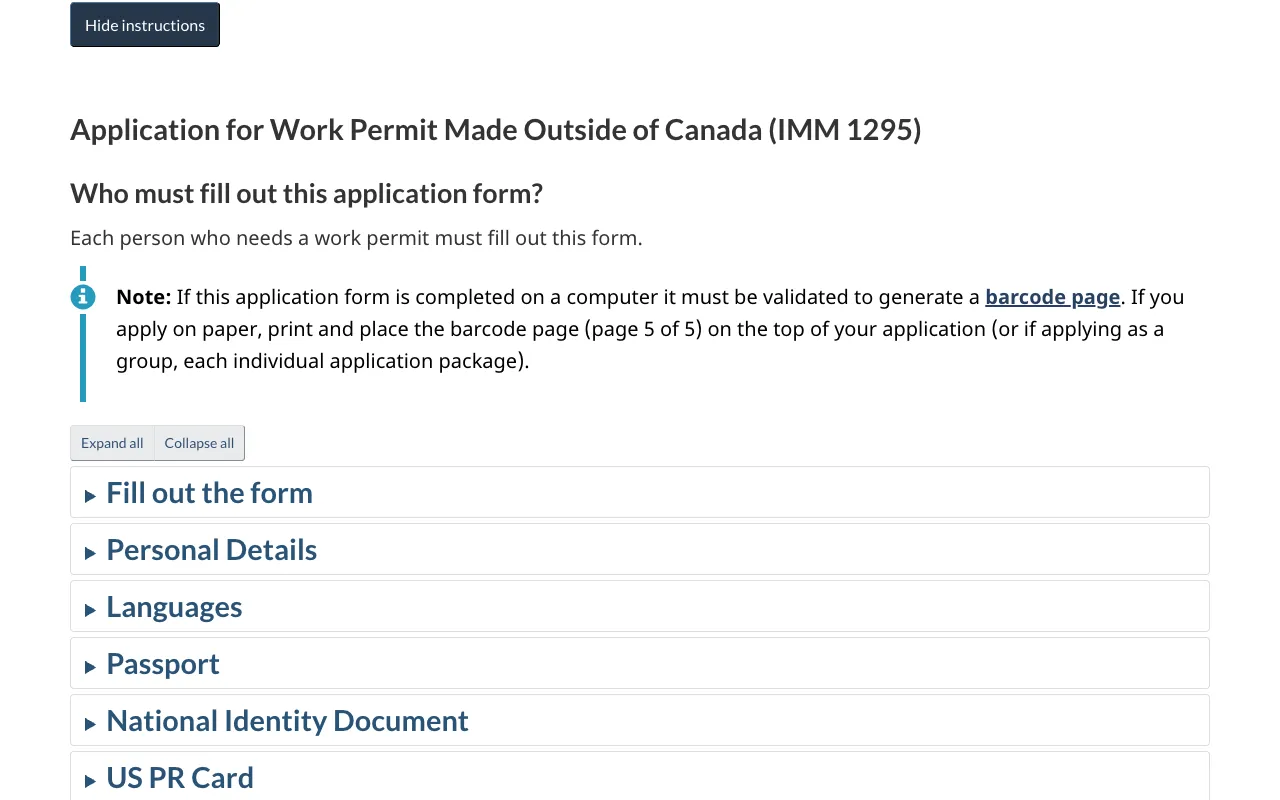
IRCC page · Application for a Work Permit Made Outside of Canada (IMM 1295) · Whole page · Live page - Download the PDF to a computer and open it in Adobe Acrobat Reader. IRCC says the forms may not open on tablets or phones.
- Question 1 (type of permit): choose “Labour Market Impact Assessment Stream” or “Exemption from Labour Market Impact Assessment”. Ask your employer if you're not sure.
- Your employment dates should match the dates in the LMIA or the offer of employment.
- Enter the 7-digit LMIA number or the offer of employment number (A plus 7 digits) in the LMIA / Offer of Employment number box.
- Priority processing for certain occupations: IRCC asks you to enter only the NOC number from your offer or LMIA in the Job title box. Use it only if your occupation is on IRCC's current list.
- Answer every background question truthfully. Untruthful answers to these statutory questions are a listed refusal reason.
Apply online in your IRCC secure account
Sign in or create an IRCC secure account, answer the questionnaire to get your personalized document checklist, then upload your forms and documents.
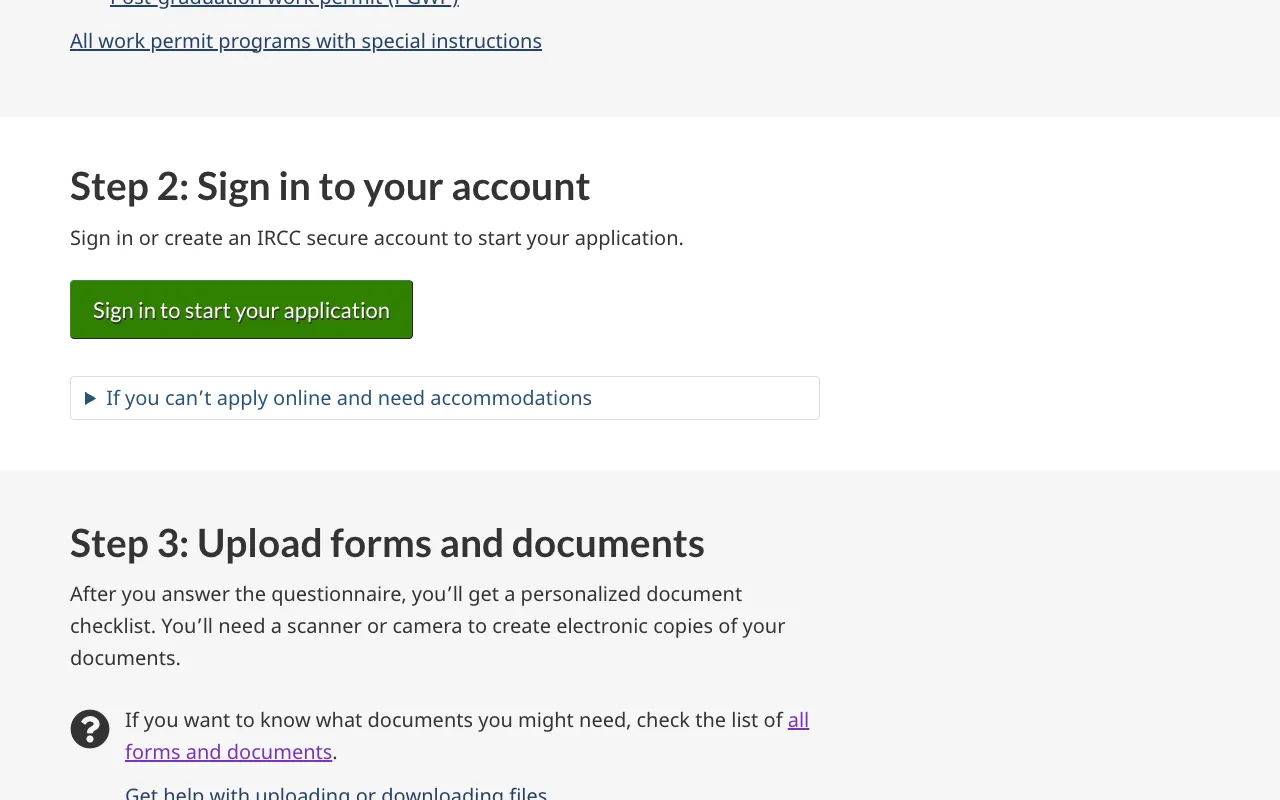
IRCC page · Work permit: Submit your application from outside Canada – Steps and priority processing · Whole page · Live page - You'll need a scanner or camera to make electronic copies of your documents.
- Read IRCC's special-instructions list first; some permit types tell you how to answer the questionnaire.
- Paper applications are allowed only if a disability prevents you from applying online, you're applying under the Seasonal Agricultural Worker Program, or you hold an identity or travel document for non-national residents, refugees or stateless persons.
Pay the fees
You pay at the end of the online application, by credit or debit card. Most applicants pay the work permit processing fee and, if required, the biometrics fee. Check current amounts on IRCC's fee list.
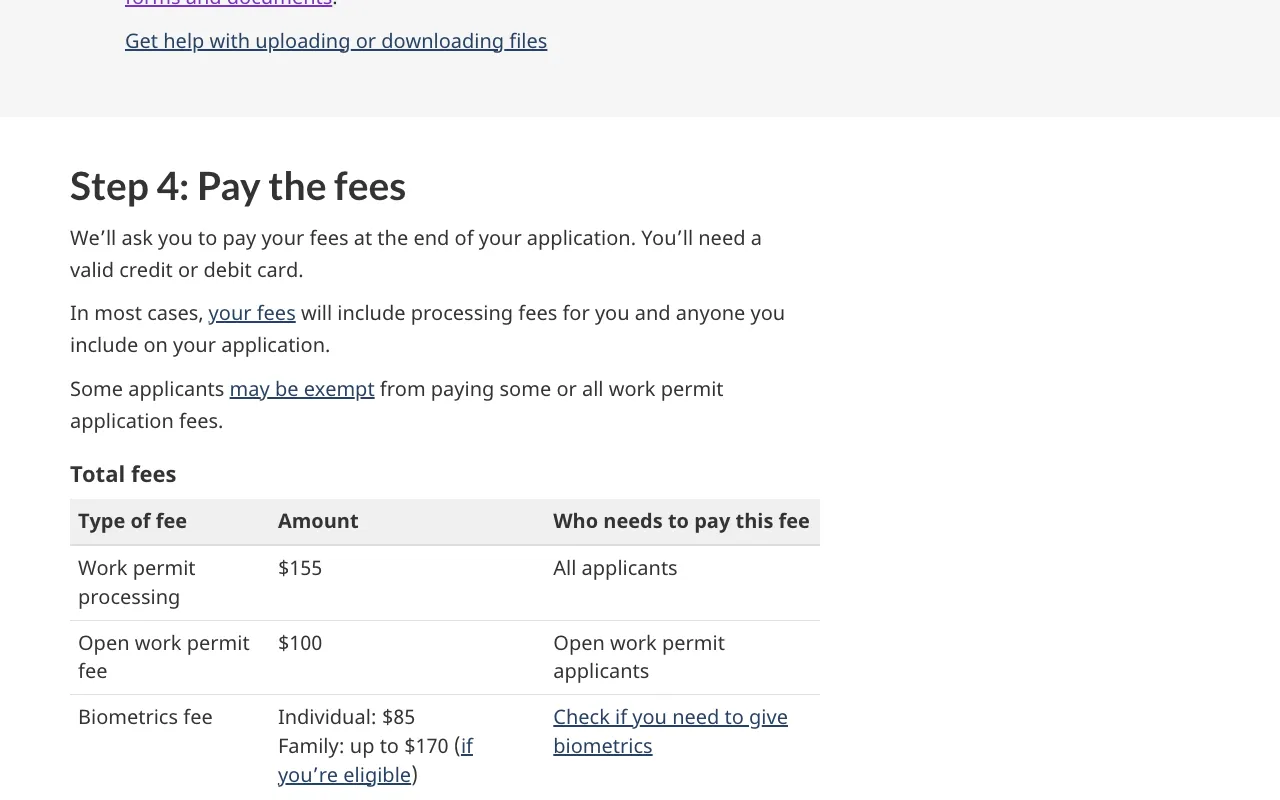
IRCC page · Work permit: Submit your application from outside Canada – Steps and priority processing · Whole page · Live page - Some applicants are exempt from some or all work permit fees; IRCC has a fee-exemptions page.
- If you need to give biometrics, pay the biometrics fee when you apply to avoid delays.
- The employer compliance fee for LMIA-exempt jobs is the employer's to pay, not yours.
- Fees change. This guide doesn't state amounts; use IRCC's fee list.
Submit a complete application
Before you submit, make sure everything on your checklist is uploaded. IRCC may refuse an incomplete application without processing it.
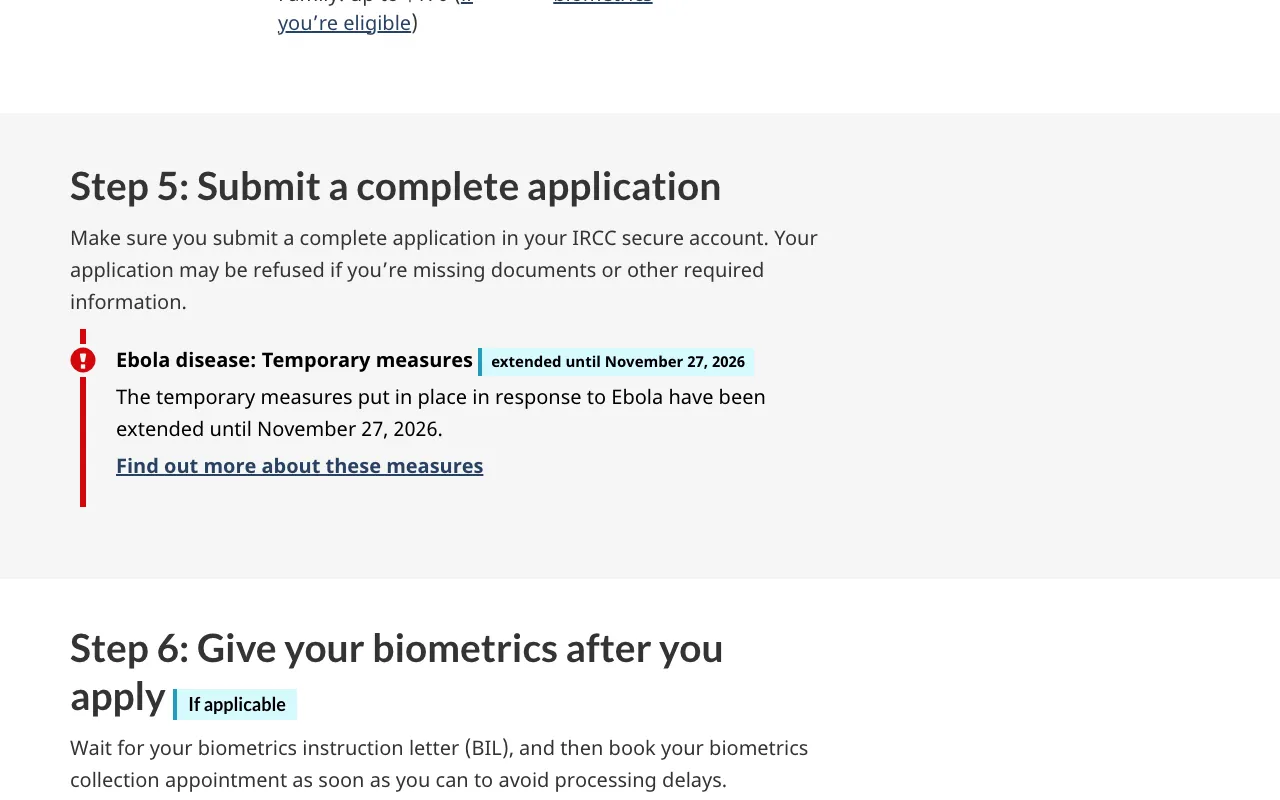
IRCC page · Work permit: Submit your application from outside Canada – Steps and priority processing · Whole page · Live page - Outside Canada, IRCC says it will refuse an incomplete application without processing it, and biometrics count toward completeness.
- Inside Canada, IRCC says it may refuse an incomplete application.
Give your biometrics (fingerprints and photo) if required
If you need biometrics, IRCC sends a biometric instruction letter (BIL) after you pay. Book an appointment at an official collection site as soon as possible.
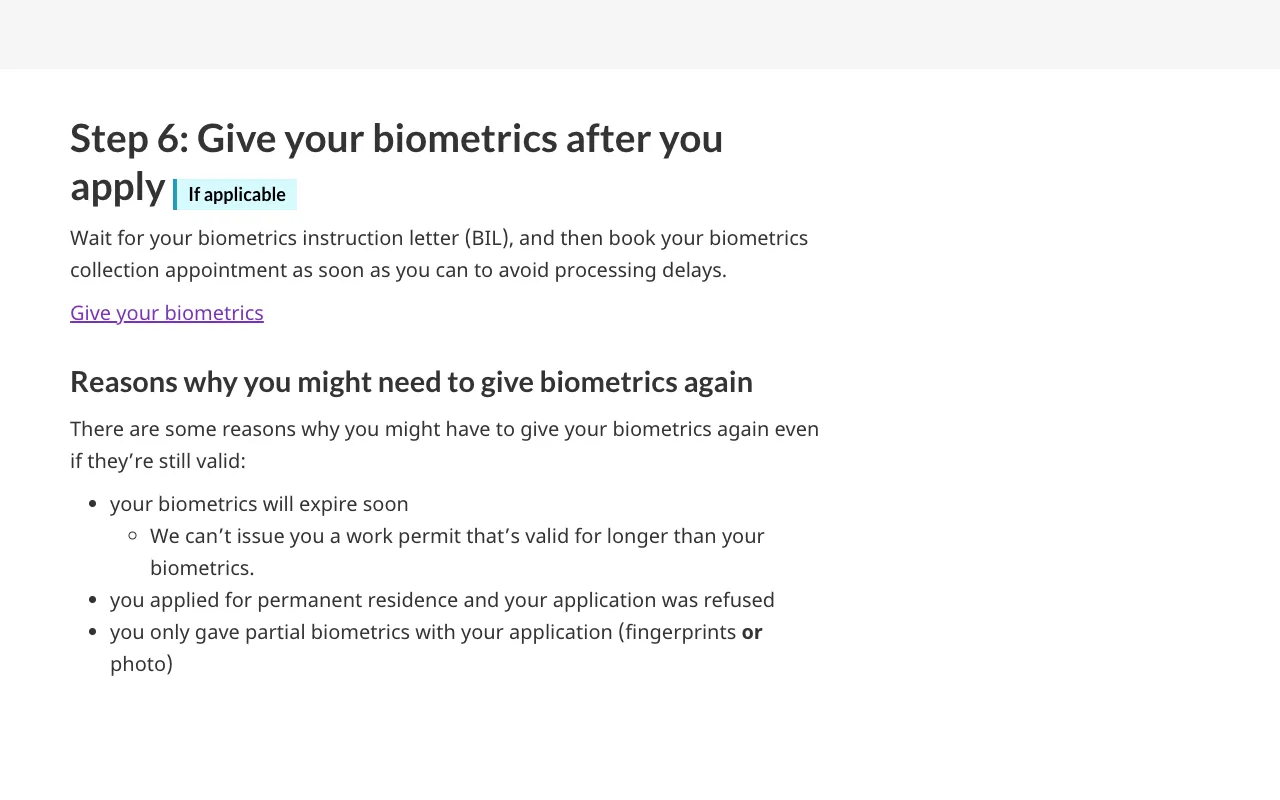
IRCC page · Work permit: Submit your application from outside Canada – Steps and priority processing · Whole page · Live page - Most temporary-residence applicants need biometrics. Exemptions include children aged 13 and under and applicants aged 80 and over (with exceptions). IRCC has a tool to check your case.
- Biometrics generally last 10 years, but IRCC can't issue a work permit valid longer than your biometrics.
- IRCC says you have 30 days from the date on the letter to give biometrics.
- Use the BIL issued for this application. A BIL from an earlier application may delay processing or lead to refusal.
- Outside Canada, IRCC starts processing after it receives your biometrics.
Wait for a decision
An officer checks that the application is complete, that the employer is allowed to hire you, and that you qualify. You may be asked for an interview, a medical exam or more documents.
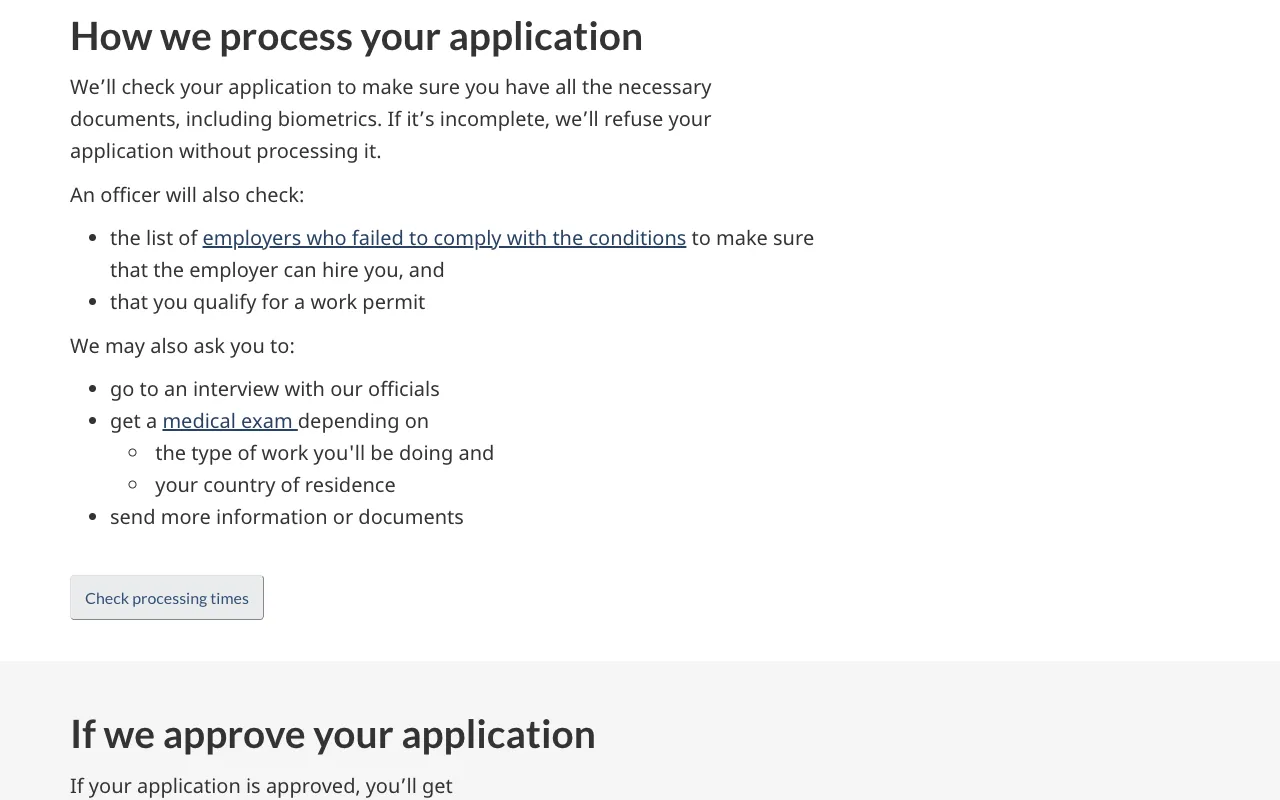
IRCC page · Work permit: Wait for a decision after applying outside Canada – Status and next steps · Whole page · Live page - Officers check the list of employers who failed to comply with the conditions.
- Listed refusal reasons include not meeting the permit's requirements, weak ties to your home country (outside Canada), an incomplete application, insufficient funds, a job offer that isn't genuine, not enough proof of skills or education, and untruthful answers.
- If refused, you can apply again unless your letter says you can't. IRCC suggests reapplying only if you can add information you didn't include before.
- Processing times change; check IRCC's processing-times tool.
If you applied from outside Canada: travel and get your permit at the border
Approval from outside Canada gives you a port of entry letter of introduction, which is not the work permit itself. The border services officer decides whether to issue the permit when you arrive.
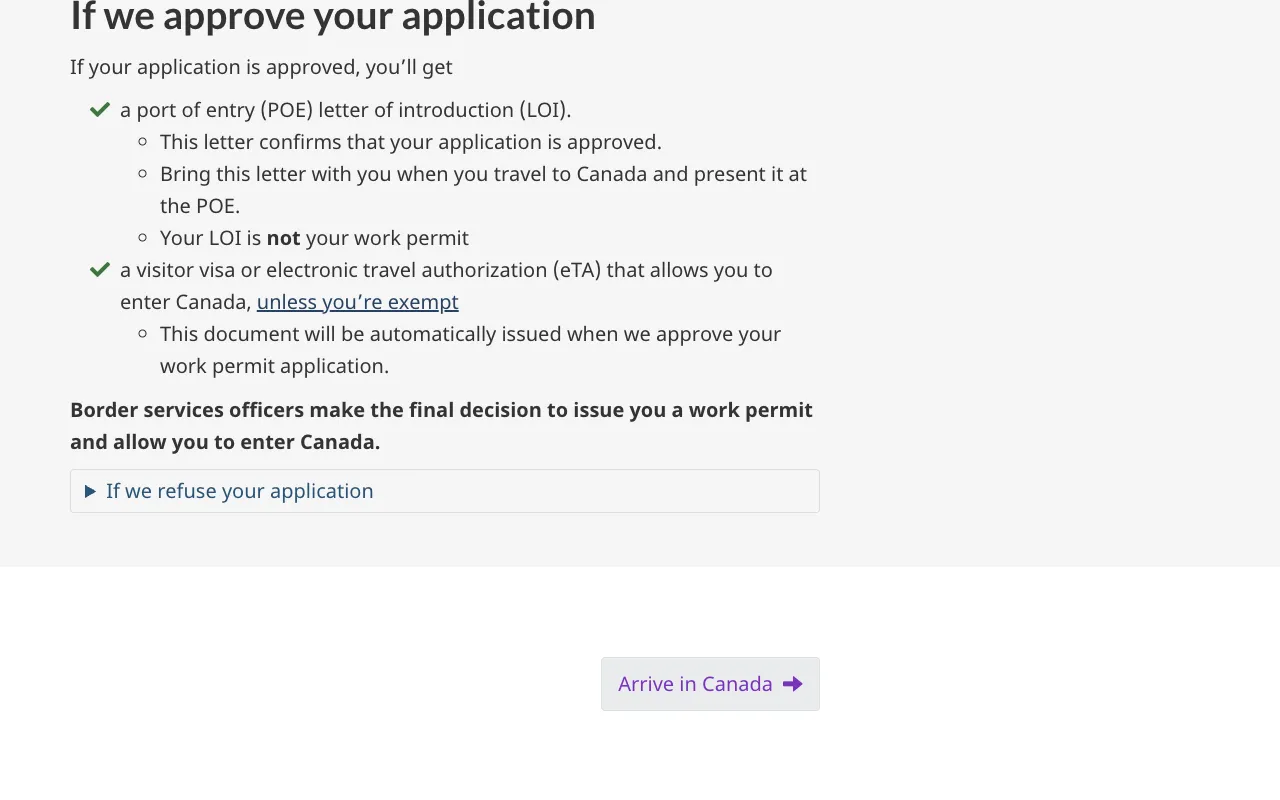
IRCC page · Work permit: Wait for a decision after applying outside Canada – Status and next steps · Whole page · Live page - Unless you're exempt, a visitor visa or eTA is issued automatically with the approval.
- Bring a passport valid longer than your planned stay, your visitor visa (if needed), valid medical exam results (if you needed an exam), and the letter of introduction (printed or electronic).
- Also bring supporting documents: proof you meet the job requirements, a copy of the positive LMIA (and CAQ attestation for Quebec) or the offer of employment number.
- Tell the officer you have come to work and give accurate information. False or incomplete information can lead to refusal of entry or removal.
- If something on the printed permit is wrong, ask the officer before you leave the border.
If you applied from inside Canada: decision letter and mailed permit
If approved, IRCC sends a decision letter to your IRCC secure account and mails the permit to your Canadian address.
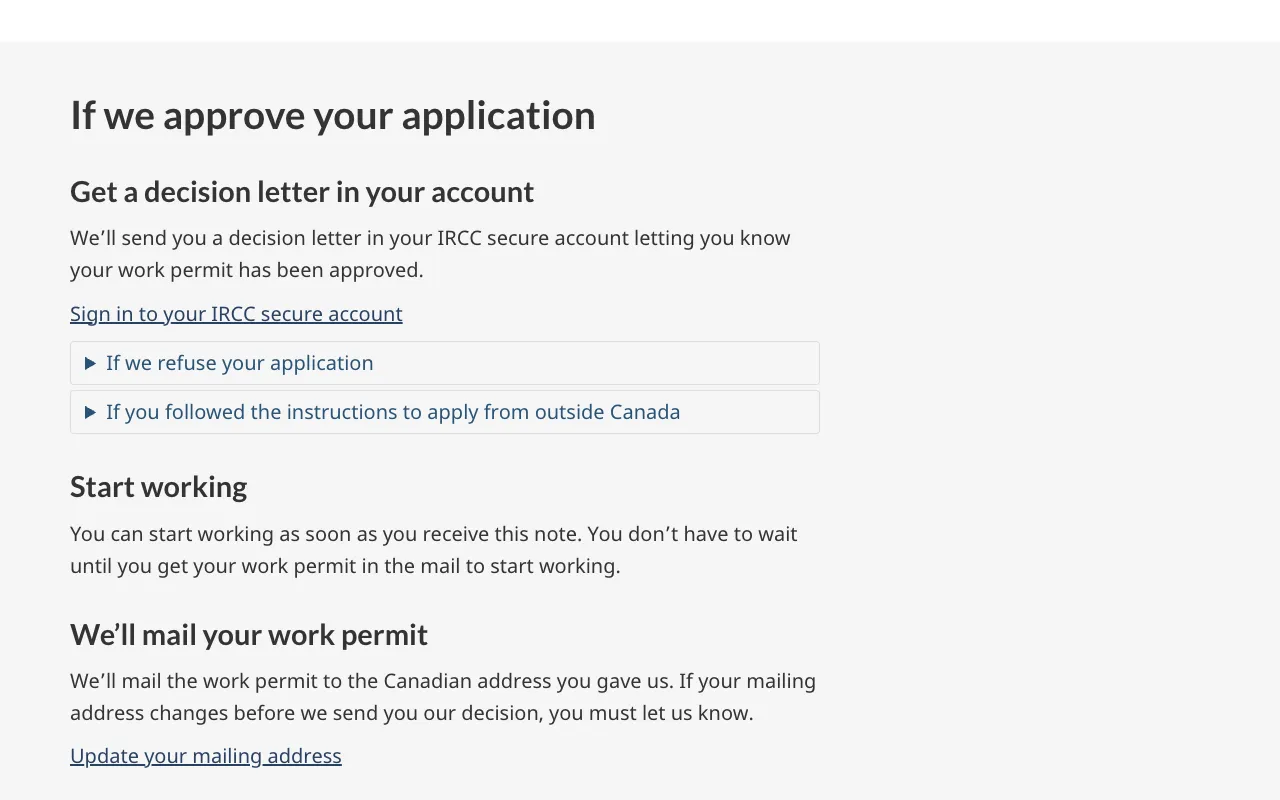
IRCC page · Work permit: After applying in Canada – Check status and next steps · Whole page · Live page - IRCC says you can start working as soon as you receive the approval note. You don't have to wait for the permit to arrive by mail.
- Keep your mailing address up to date. IRCC says the permit should arrive within about 6 weeks of the decision letter; contact IRCC if it doesn't.
- If you followed the outside-Canada instructions (IMM 1295) while in Canada, you get a letter of introduction and must leave and re-enter Canada to activate the permit. Re-entering from the U.S. or Saint-Pierre-et-Miquelon doesn't activate it.
After you get the permit: follow its conditions
Work only for the employer, in the occupation and at the location your permit names, until it expires. Changing employer or job, or extending, means applying again.
IRCC page · Employer-specific work permits: eligibility, LMIA, and application steps · Whole page · Live page - Most work permits are valid for 1 to 2 years, but never longer than your passport or biometrics.
- Get a social insurance number (SIN) to work, and arrange provincial or territorial health insurance, or enough money for medical care.
- To change employer or job, you must first get a permit with the new conditions (see the work permit extension walkthrough).
- Breaking permit conditions can lead to enforcement action and hurt future applications.
Documents checklist
Gather these before you apply. Your personalized checklist from IRCC is the final word on what your application needs.
- Application For Work Permit Made Outside of Canada (IMM 1295)Each person applying from outside CanadaPDF form, filled out on a computer. Instruction guide: IMM 1295 page and Guide 5487. Official source for Application For Work Permit Made Outside of Canada (IMM 1295)
- Application to Change Conditions, Extend my Stay or Remain in Canada as a Worker (IMM 5710)Each person eligible to apply from inside CanadaUsed for initial in-Canada permits as well as extensions. Instruction guide: IMM 5710 page and Guide 5553. Official source for Application to Change Conditions, Extend my Stay or Remain in Canada as a Worker (IMM 5710)
- a photocopy of your valid (not expired) passport or travel documentAll applicantsIRCC can't issue a permit valid past your passport's expiry date. Official source for a photocopy of your valid (not expired) passport or travel document
- 1 photo meeting the visa photo specificationsAll applicantsMust meet IRCC's visa photo specifications. Guide 5487 says that if you give biometrics, you shouldn't include paper photos. Follow your personalized checklist. Official source for 1 photo meeting the visa photo specifications
- a letter from your current employerEmployer-specific applicantsAlways requested for employer-specific permits. Official source for a letter from your current employer
- a reference letter from past employersEmployer-specific applicantsAlways requested for employer-specific permits. Official source for a reference letter from past employers
- proof of past work experience (for example, pay stubs)Employer-specific applicantsAlways requested for employer-specific permits. Official source for proof of past work experience (for example, pay stubs)
- proof that you meet the requirements of the job (for example, the license or certification if your job is regulated)Employer-specific applicantsIf no licence or certification is needed, upload a blank page saying “Not applicable”. Guide 5487 also mentions trade certificates, education requirements, or experience shown in a résumé. Official source for proof that you meet the requirements of the job (for example, the license or certification if your job is regulated)
- a résuméEmployer-specific applicantsAlways requested for employer-specific permits. Official source for a résumé
- a copy of the positive LMIA and LMIA file numberLMIA-required applicants (provided by the employer)Also called a confirmation letter. The employer should also give you the letter's Annex A (employment details). Official source for a copy of the positive LMIA and LMIA file number
- a job offer letterLMIA-required applicants (provided by the employer)Sets out pay and deductions, duties, and conditions such as hours. Usually less detailed than a contract. Official source for a job offer letter
- an employment contractLMIA-required and LMIA-exempt applicants (provided by the employer)Required in both streams. The inside-Canada page also calls it the employment agreement. Official source for an employment contract
- an offer of employment numberLMIA-exempt applicants (provided by the employer)Format: the letter A followed by 7 digits. Single use. Some exempt employers, such as foreign missions, won't have one. Official source for an offer of employment number
- a Quebec Acceptance Certificate (CAQ) (if you plan to work a paid job in Quebec for more than 30 days)LMIA-required applicants working in QuebecGuide 5487 asks for a copy of the attestation of issuance of the CAQ. Usually not needed if you don't need an LMIA. Official source for a Quebec Acceptance Certificate (CAQ) (if you plan to work a paid job in Quebec for more than 30 days)
- proof of a medical examApplicants who had an upfront medical examRequired for some occupations (health, child care, schools) and some travel histories. Official source for proof of a medical exam
- a marriage certificate / Statutory Declaration of Common-law Union (IMM 5409)Married or common-law applicants, if on your checklistThe IMM 1295 instructions ask married applicants for a copy of the marriage licence or certificate and common-law applicants for IMM 5409. Official source for a marriage certificate / Statutory Declaration of Common-law Union (IMM 5409)
- Family Information Form - Visitors, Students and Workers (IMM 5707)If listed on your personalized checklistOnly if your checklist asks for it. Official source for Family Information Form - Visitors, Students and Workers (IMM 5707)
- certified translations (if your documents aren’t in English or French)Anyone with documents in other languagesInclude the translation and, if the translator isn't a certified translator, an affidavit from them. You and your relatives may not translate. Official source for certified translations (if your documents aren’t in English or French)
- proof of your present immigration statusOutside-Canada applicants who aren't citizens of the country they apply fromFor example, a residence permit in the country you live in. Official source for proof of your present immigration status
- Use of a Representative (IMM 5476) / Authority to Release Personal Information to a Designated Individual (IMM 5475)Only if you use a representative or authorize release of informationOptional forms. Official source for Use of a Representative (IMM 5476) / Authority to Release Personal Information to a Designated Individual (IMM 5475)
What to write where
Field by field, in the order the form asks, with each one outlined on the form. Labels are as IRCC prints or documents them; the examples are made up.
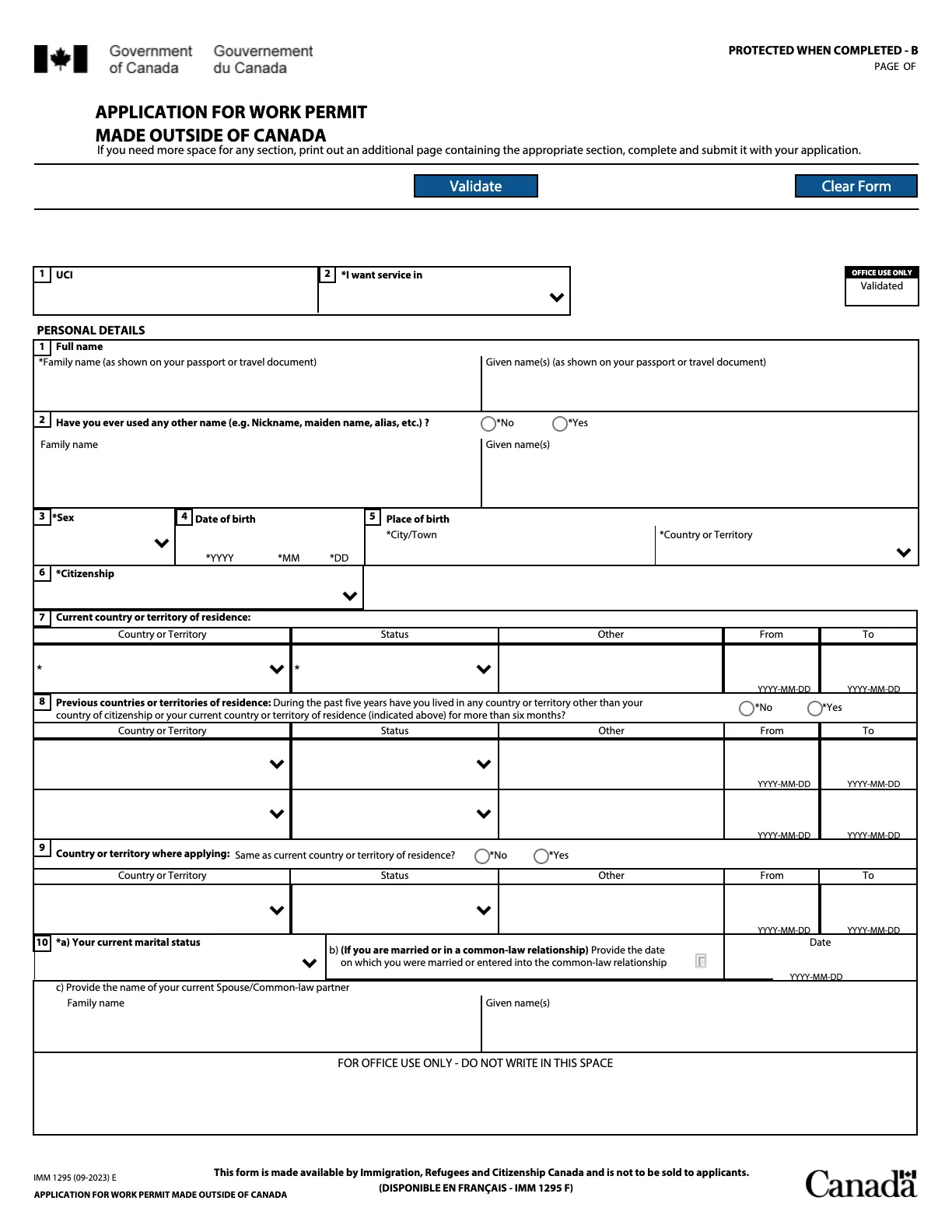
IMM 1295 – Application for Work Permit Made Outside of Canada (form version IMM 1295 (09-2023) E)
Fill out the form
 12
- 1 UCI
What they’re asking: Your IRCC client number (UCI), if you already have one.
Your Unique Client Identifier if you have one. If this is your first dealing with IRCC, leave it blank.
- 2 I want service in
What they’re asking: Which language you'd like IRCC's service in: English or French.
Choose English or French.
PERSONAL DETAILS
12345678910111213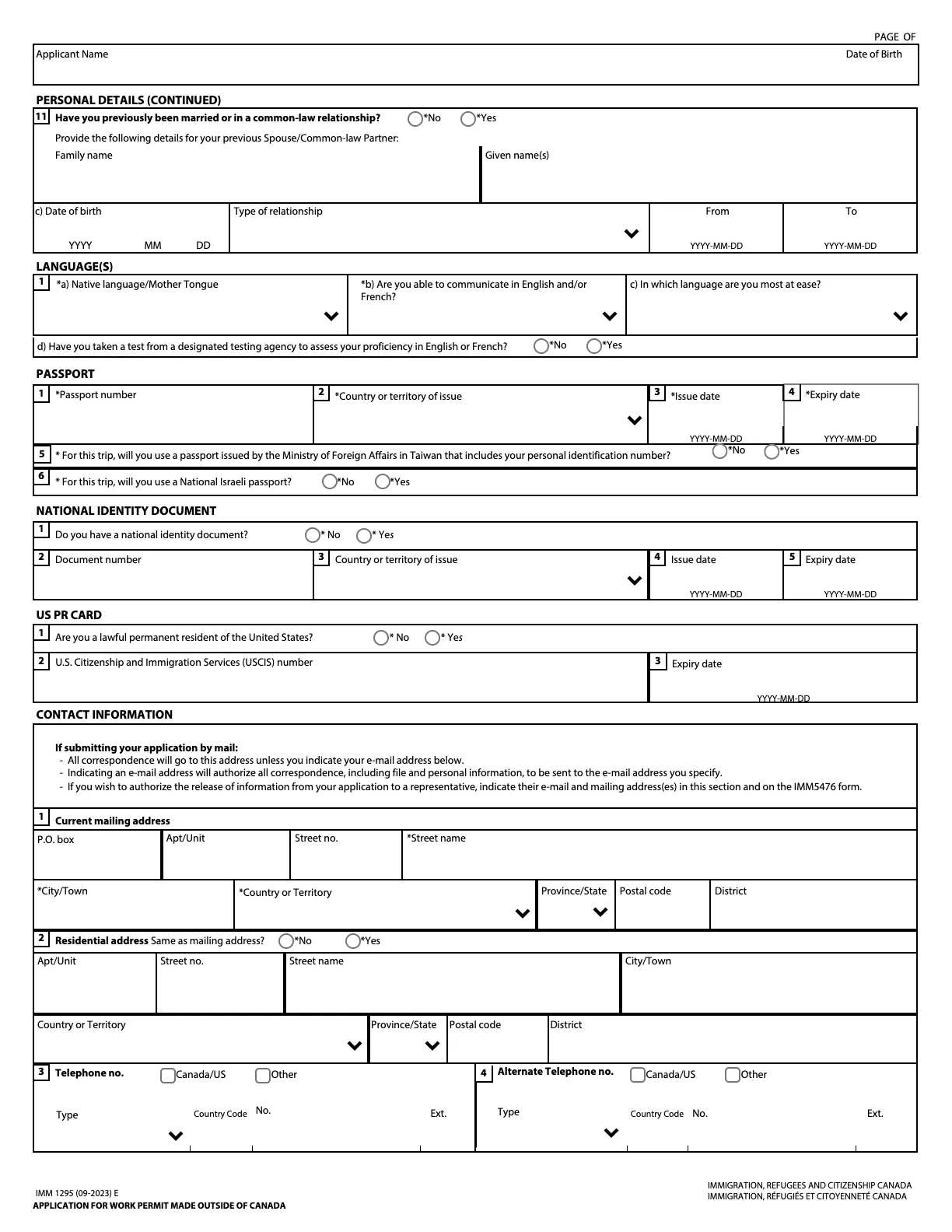 14
- 1 Family name (as shown on your passport or travel document)
What they’re asking: Your last name, exactly as your passport shows it.
Your surname exactly as on your passport, even if misspelled. No initials. If your passport has no family name, put all your names here.
e.g.
SMITHOfficial source for the field “Family name (as shown on your passport or travel document)”
- 2 Given name(s) (as shown on your passport or travel document)
What they’re asking: Your first and middle names, exactly as your passport shows them.
All given names exactly as on your passport. If there are none, leave this blank.
e.g.
AlexWatch out: Typing “*”, “Not applicable” or “NA” when you have no given name.
Official source for the field “Given name(s) (as shown on your passport or travel document)”
- 3 Have you ever used any other name (e.g. Nickname, maiden name, alias, etc.) ?
What they’re asking: Have you ever gone by another name, like a nickname or maiden name?
Tick Yes or No. If Yes, give the other family and given names.
- 4 Sex
What they’re asking: Your sex: female, male, unknown, or another gender.
Choose from the list (the instruction page lists F, M, U and X). If it differs from a previous Canadian document or from your passport, include form IRM 0002.
- 5 Date of birth
What they’re asking: When you were born: year, month and day.
Year, month and day. Use an asterisk for any unknown part.
- 6 Place of birth
What they’re asking: The city or town and country where you were born.
City/Town and Country or Territory. If your passport shows them, copy them as printed.
e.g.
Lyon, France- 7 Citizenship
What they’re asking: Which country you're a citizen of.
If you hold more than one, choose the country that issued the passport you are using.
- 8 Current country or territory of residence:
What they’re asking: Where you're legally allowed to live right now, and your status there.
The country or territory where you have been lawfully admitted to live, your status there, and From/To dates.
Official source for the field “Current country or territory of residence:”
- 9 Previous countries or territories of residence: During the past five years have you lived in any country or territory other than your country of citizenship or your current country or territory of residence (indicated above) for more than six months?
What they’re asking: Over the past five years, have you lived anywhere else for over six months?
Tick Yes or No. If Yes, list each country, your status and the dates.
- 10 Country or territory where applying:
What they’re asking: Are you applying from the country where you currently live?
First answer “Same as current country or territory of residence?”. If No, give the country you are applying from, your status there and dates. If you are not a citizen of the country where you apply, include proof of your legal status there.
Official source for the field “Country or territory where applying:”
- 11 a) Your current marital status
What they’re asking: Your marital status today, such as married or common-law.
Choose from the list. Common-law: include IMM 5409. Married: include a copy of the marriage licence or certificate.
Official source for the field “a) Your current marital status”
- 12 b) (If you are married or in a common-law relationship) Provide the date on which you were married or entered into the common-law relationship
What they’re asking: When you married, or when your common-law relationship began.
Date of marriage or start of the common-law relationship.
- 13 c) Provide the name of your current Spouse/Common-law partner
What they’re asking: Your current spouse or common-law partner's full name.
Their family name and given name(s).
e.g.
Family name SMITH, given name JordanOfficial source for the field “c) Provide the name of your current Spouse/Common-law partner”
- 14 Have you previously been married or in a common-law relationship?
What they’re asking: Have you ever been married or common-law before?
Tick Yes or No. If Yes, give the previous partner's names, date of birth, type of relationship and dates.
Official source for the field “Have you previously been married or in a common-law relationship?”
LANGUAGE(S)
1234- 1 a) Native language/Mother Tongue
What they’re asking: Your mother tongue, the first language you learned.
Your mother tongue.
Official source for the field “a) Native language/Mother Tongue”
- 2 b) Are you able to communicate in English and/or French?
What they’re asking: Can you communicate in English, French, both, or neither?
English, French, Both or Neither.
Official source for the field “b) Are you able to communicate in English and/or French?”
- 3 c) In which language are you most at ease?
What they’re asking: Whether you're more at ease in English or French.
If your native language is not English or French, choose the one you would most likely use.
Official source for the field “c) In which language are you most at ease?”
- 4 d) Have you taken a test from a designated testing agency to assess your proficiency in English or French?
What they’re asking: Have you taken an English or French test with a designated testing agency?
Tick Yes or No.
PASSPORT
123456- 1 Passport number
What they’re asking: Your passport number, exactly as printed.
Exactly as printed, with no spaces.
- 2 Country or territory of issue
What they’re asking: Which country issued your passport.
The issuing country, from the list.
Official source for the field “Country or territory of issue”
- 3 Issue date
What they’re asking: The date your passport was issued.
Date the passport was issued.
- 4 Expiry date
What they’re asking: The date your passport expires.
Date the passport expires. A work permit can't outlast it. If you need a visitor visa (TRV), you will have to send your original passport after approval so the visa can be placed in it.
- 5 For this trip, will you use a passport issued by the Ministry of Foreign Affairs in Taiwan that includes your personal identification number?
What they’re asking: Will you travel on a Taiwan-issued passport that shows your personal ID number?
Tick Yes or No.
- 6 For this trip, will you use a National Israeli passport?
What they’re asking: Will you travel on a National Israeli passport?
Tick Yes or No.
Official source for the field “For this trip, will you use a National Israeli passport?”
NATIONAL IDENTITY DOCUMENT
1- 1 Do you have a national identity document?
What they’re asking: Whether you have a national identity document, and its details if so.
Tick Yes or No. If Yes, give the Document number, Country or territory of issue, Issue date and Expiry date.
Official source for the field “Do you have a national identity document?”
US PR CARD
1- 1 Are you a lawful permanent resident of the United States?
What they’re asking: Are you a U.S. permanent resident with a green card?
Tick Yes or No. If Yes, fill in the number field (printed on the form as “U.S. Citizenship and Immigration Services (USCIS) number”) and the Expiry date. The instruction page calls this your alien registration card (green card) number.
Official source for the field “Are you a lawful permanent resident of the United States?”
CONTACT INFORMATION
1234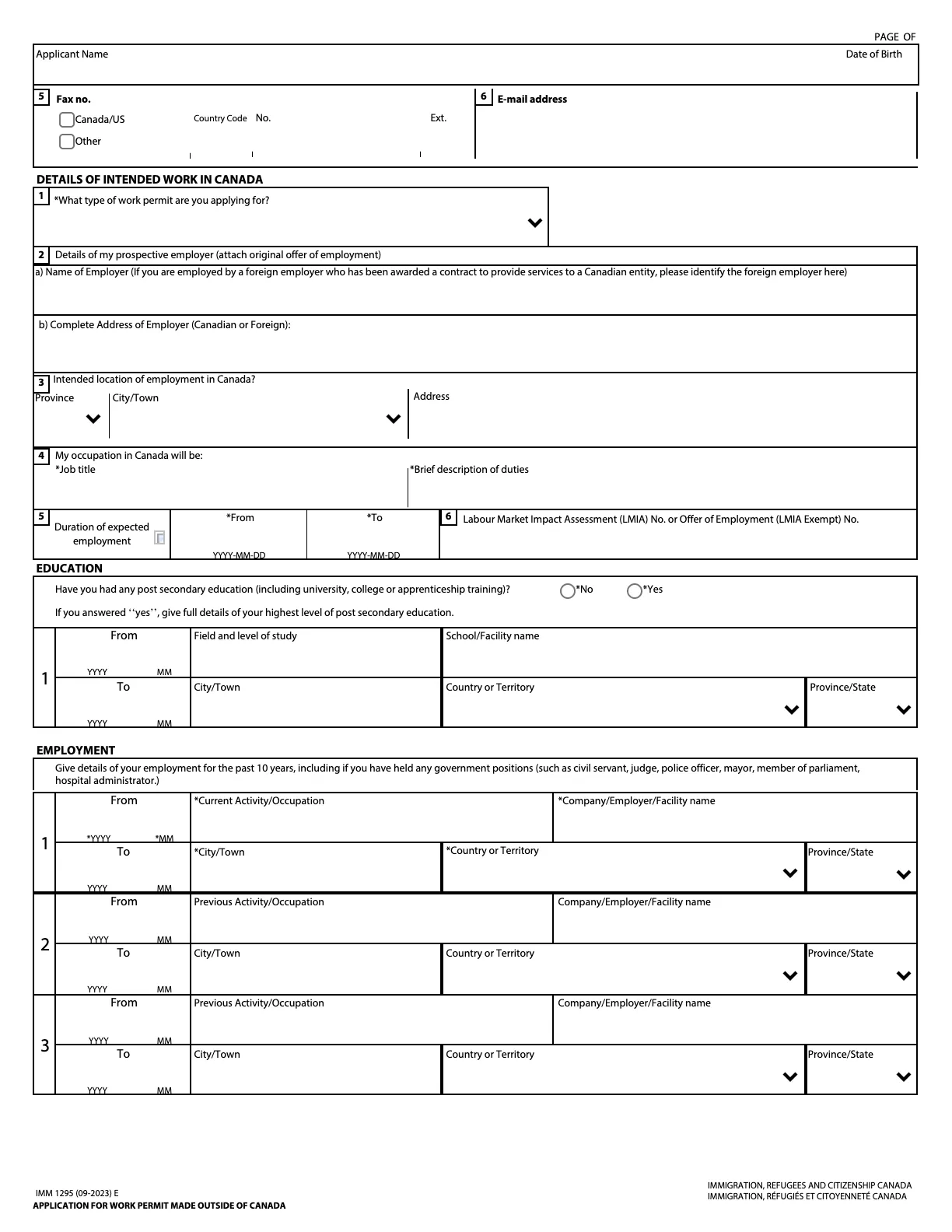 56
- 1 Current mailing address
What they’re asking: The address where IRCC should send your mail.
P.O. box, Apt/Unit, Street no., Street name, City/Town, Country or Territory, Province/State, Postal code, District. Spell out street words; abbreviate only directions. Correspondence goes here unless you give an email. A representative's addresses go here and on IMM 5476.
e.g.
123 Sample Street, Toronto- 2 Same as mailing address?
What they’re asking: Is the address you live at the same as your mailing address?
Tick Yes or No; if No, give your residential address.
- 3 Telephone no.
What they’re asking: Your main phone number, with country and area codes.
Tick Canada/US or Other, choose the type, and give the full number with country and area codes.
e.g.
1 416 555-0100- 4 Alternate Telephone no.
What they’re asking: An optional second phone number.
Optional second number.
- 5 Fax no.
What they’re asking: Your fax number, only if you have one.
Only if you have one.
- 6 E-mail address
What they’re asking: An email address you check often.
An address you check often. IRCC emails end in @cic.gc.ca, @canada.ca or @international.gc.ca. Giving an email authorizes electronic correspondence.
e.g.
alex.smith@example.com
DETAILS OF INTENDED WORK IN CANADA
12345678- 1 What type of work permit are you applying for?
What they’re asking: Which permit type you're applying for, usually the LMIA stream or exemption.
Options listed by IRCC: Exemption from Labour Market Impact Assessment; Labour Market Impact Assessment Stream; Open Work Permit; Other; Seasonal Agricultural Workers Program; Start-up Business Class. For an employer-specific permit you will normally choose the LMIA stream or the LMIA exemption. Ask your employer which. “Other” is only for foreign missions, international organizations, foreign governments, or bridge or tunnel authorities.
e.g.
Labour Market Impact Assessment StreamOfficial source for the field “What type of work permit are you applying for?”
- 2 a) Name of Employer (If you are employed by a foreign employer who has been awarded a contract to provide services to a Canadian entity, please identify the foreign employer here)
What they’re asking: The name of the employer hiring you.
With an LMIA: the employer's name exactly as on the LMIA. LMIA-exempt: the name of the employer that gave you the offer of employment number.
- 3 b) Complete Address of Employer (Canadian or Foreign):
What they’re asking: Your employer's full address, in Canada or abroad.
The employer's full address.
e.g.
456 Sample Avenue, CalgaryOfficial source for the field “b) Complete Address of Employer (Canadian or Foreign):”
- 4 Intended location of employment in Canada?
What they’re asking: Where in Canada you'll actually be working.
Province, City/Town and Address where you will work.
e.g.
Ontario, Toronto, 123 Sample StreetOfficial source for the field “Intended location of employment in Canada?”
- 5 Job title
What they’re asking: The title of the job you'll do in Canada.
Your job title. For priority processing in an eligible occupation, IRCC says to enter only the NOC number your employer used on the offer or LMIA.
e.g.
Line cook- 6 Brief description of duties
What they’re asking: A short summary of what you'll do in the job.
A short summary of your duties.
e.g.
Prepare menu items and clean the kitchen- 7 Duration of expected employment
What they’re asking: Your expected start and end dates of work in Canada.
From and To dates (YYYY-MM-DD) matching your LMIA or offer of employment. A permit can't be longer than your passport's validity.
e.g.
From 2027-01-04 to 2028-01-03Official source for the field “Duration of expected employment”
- 8 Labour Market Impact Assessment (LMIA) No. or Offer of Employment (LMIA Exempt) No.
What they’re asking: Your LMIA number, or your employer's offer of employment number.
The 7-digit LMIA number, or the offer of employment number (A followed by 7 digits).
e.g.
A1234567
EDUCATION
1- 1 Have you had any post secondary education (including university, college or apprenticeship training)?
What they’re asking: Have you studied after high school, like university, college or an apprenticeship?
Tick Yes or No. If Yes, give your highest level: dates, Field and level of study, School/Facility name, City/Town, Country or Territory, Province/State.
EMPLOYMENT
12- 1 Current Activity/Occupation
What they’re asking: Your current job, or what you're doing if you aren't working.
Your current job or activity (or what you are doing if not working), with dates, employer name and location.
- 2 Previous Activity/Occupation
What they’re asking: Your earlier jobs or activities over the past ten years.
Earlier jobs or activities covering the past 10 years. Print and add another page if you need space.
Official source for the field “Previous Activity/Occupation”
BACKGROUND INFORMATION
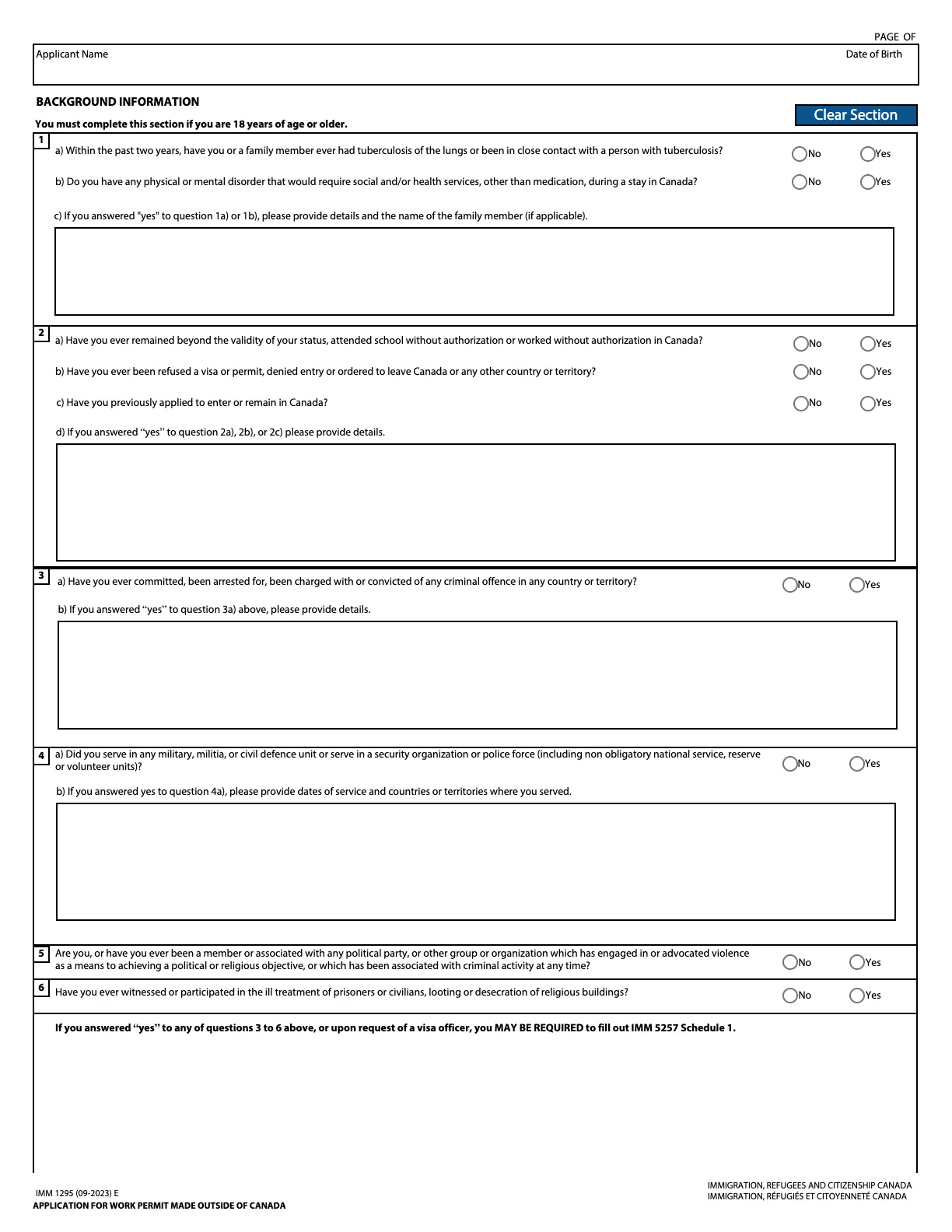 123456789
- 1 a) Within the past two years, have you or a family member ever had tuberculosis of the lungs or been in close contact with a person with tuberculosis?
What they’re asking: Within two years, have you or family had lung tuberculosis or close contact with it?
Tick Yes or No. Explain any Yes in 1c.
Watch out: Skipping any background question. The application is treated as incomplete and sent back.
- 2 b) Do you have any physical or mental disorder that would require social and/or health services, other than medication, during a stay in Canada?
What they’re asking: Will you need social or health services, beyond medication, for a physical or mental disorder?
Tick Yes or No.
- 3 a) Have you ever remained beyond the validity of your status, attended school without authorization or worked without authorization in Canada?
What they’re asking: Have you ever overstayed, or studied or worked without permission, in Canada?
Tick Yes or No; explain any Yes in 2d.
- 4 b) Have you ever been refused a visa or permit, denied entry or ordered to leave Canada or any other country or territory?
What they’re asking: Have you ever been refused a visa, permit or entry, or ordered to leave, anywhere?
Tick Yes or No. Refusals by any country count.
- 5 c) Have you previously applied to enter or remain in Canada?
What they’re asking: Have you applied to come to or stay in Canada before?
Tick Yes or No.
Official source for the field “c) Have you previously applied to enter or remain in Canada?”
- 6 a) Have you ever committed, been arrested for, been charged with or convicted of any criminal offence in any country or territory?
What they’re asking: Have you ever committed a crime, or been arrested, charged or convicted, anywhere?
Tick Yes or No; give details if Yes.
- 7 a) Did you serve in any military, militia, or civil defence unit or serve in a security organization or police force (including non obligatory national service, reserve or volunteer units)?
What they’re asking: Have you ever served in a military, militia, civil defence, security or police unit?
Tick Yes or No. If Yes, give dates and countries of service.
- 8 Are you, or have you ever been a member or associated with any political party, or other group or organization which has engaged in or advocated violence as a means to achieving a political or religious objective, or which has been associated with criminal activity at any time?
What they’re asking: Have you ever been part of, or linked to, a violent or criminal group?
Tick Yes or No. The form warns that a Yes to questions 3 to 6 may mean you have to fill out IMM 5257 Schedule 1.
- 9 Have you ever witnessed or participated in the ill treatment of prisoners or civilians, looting or desecration of religious buildings?
What they’re asking: Ever witnessed or taken part in mistreating prisoners or civilians, looting, or desecrating religious buildings?
Tick Yes or No.
SIGNATURE
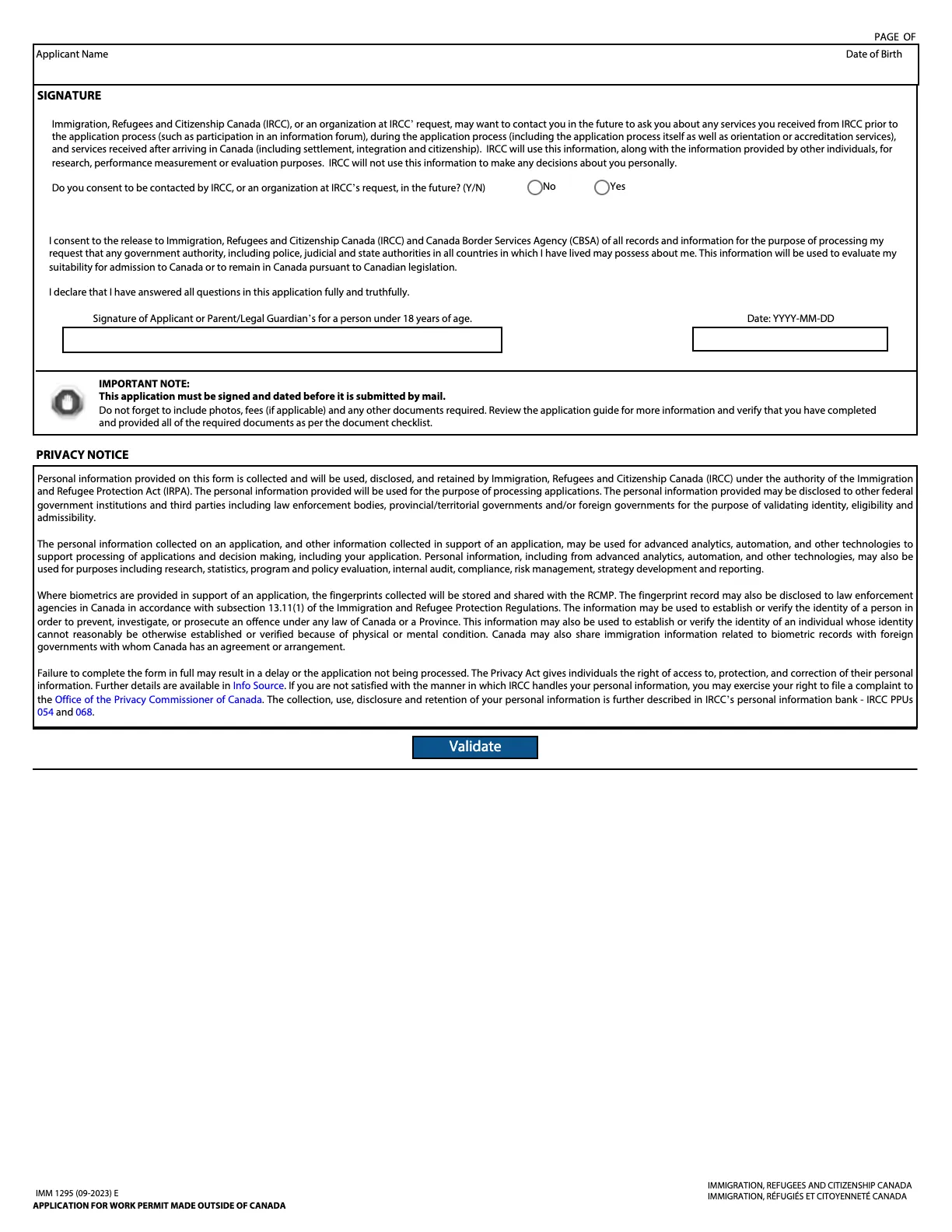 12
- 1 Signature of Applicant or Parent/Legal Guardian’s for a person under 18 years of age.
What they’re asking: Your signature, or a parent's or guardian's if you're under 18.
Sign (or a parent or guardian signs for a minor) to declare your answers are true. A paper application must be signed and dated before mailing.
- 2 Date: YYYY-MM-DD
What they’re asking: The date you sign the form.
The date you sign.
e.g.
2027-01-15
IMM 5710 – Application to Change Conditions, Extend my Stay or Remain in Canada as a Worker (form version IMM 5710 (09-2023) E)
Completing the form
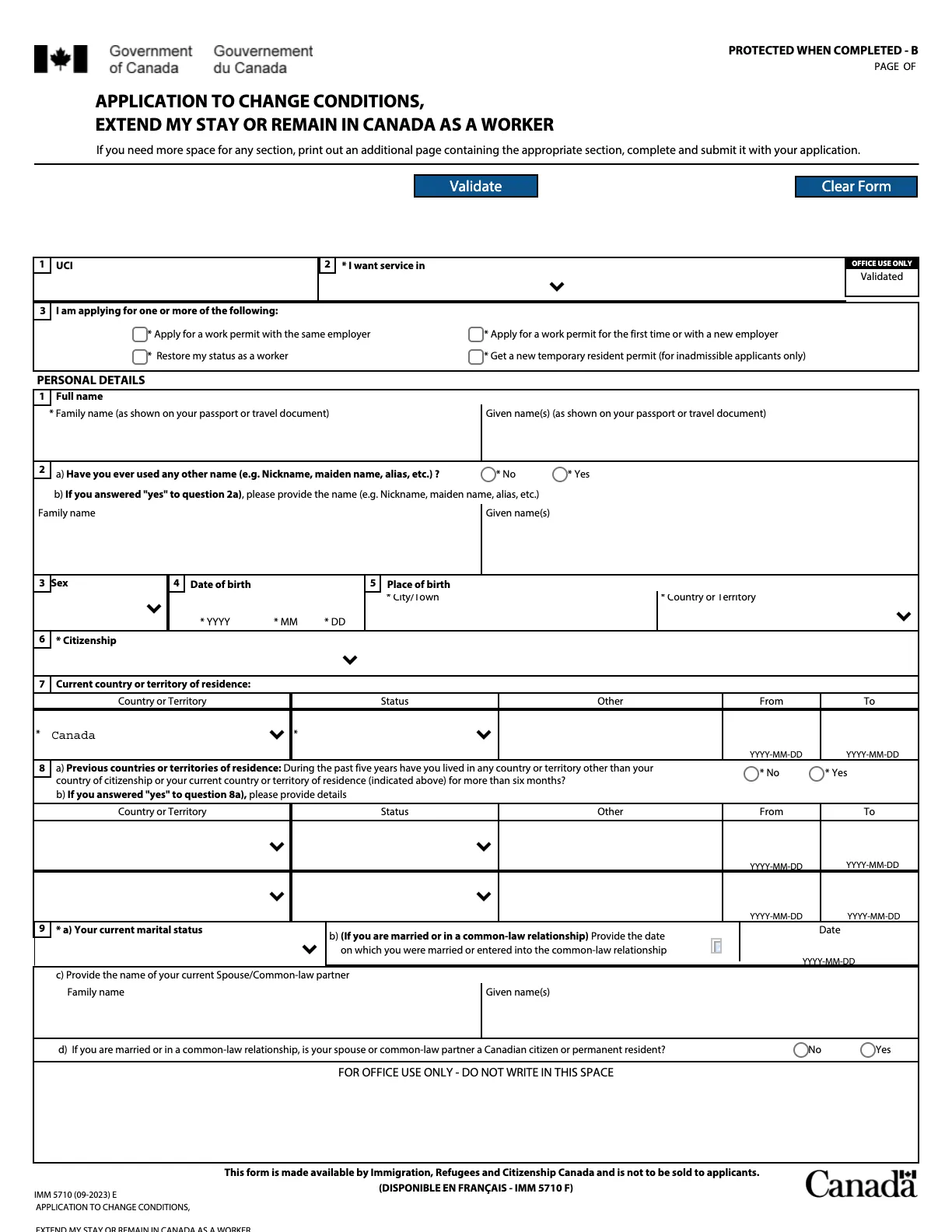 123
- 1 UCI
What they’re asking: Your IRCC client number (UCI), found on your study or work permit.
Your Unique Client Identifier (Client ID), if you have one. It is printed on your study or work permit.
- 2 I want service in
What they’re asking: Which language IRCC should use with you: English or French.
Choose English or French as the language IRCC uses with you.
- 3 I am applying for one or more of the following:
What they’re asking: Which of the four options matches what you're applying for.
The PDF has four tick boxes: “Restore my status as a worker”, “Apply for a work permit with the same employer”, “Apply for a work permit for the first time or with a new employer”, and “Get a new temporary resident permit (for inadmissible applicants only)”. If you are applying from inside Canada for a new employer-specific permit, the matching option is usually “Apply for a work permit for the first time or with a new employer”; to stay with the same employer, “Apply for a work permit with the same employer”.
Official source for the field “I am applying for one or more of the following:”
COMING INTO CANADA
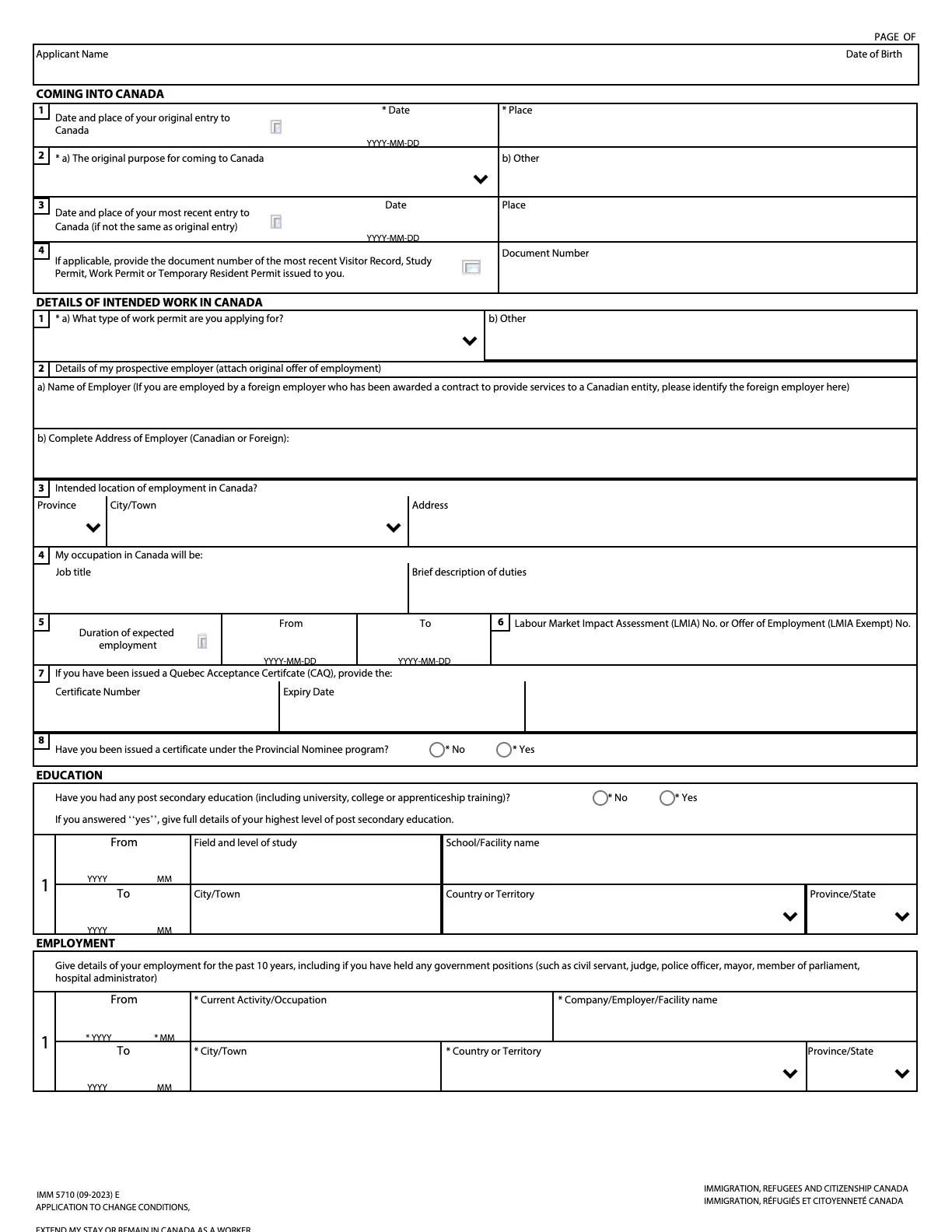 1234
- 1 Date and place of your original entry to Canada
What they’re asking: When and where you first entered Canada.
The date and place you first entered Canada. If you don't remember exactly, give your best estimate.
Official source for the field “Date and place of your original entry to Canada”
- 2 a) The original purpose for coming to Canada
What they’re asking: Why you first came to Canada.
Choose Business, Tourism, Study, Work, Other or Family Visit. If you choose Other, explain in “b) Other”.
Official source for the field “a) The original purpose for coming to Canada”
- 3 Date and place of your most recent entry to Canada (if not the same as original entry)
What they’re asking: When and where you last entered Canada, if different from your first entry.
Your most recent entry to Canada, if it differs from your first.
- 4 Document Number
What they’re asking: The number of your most recent visitor record or permit.
The number of your most recent visitor record, study permit, work permit or temporary resident permit.
DETAILS OF INTENDED WORK IN CANADA
1234567891011- 1 a) What type of work permit are you applying for?
What they’re asking: Which permit type applies, based on whether your employer got an LMIA.
Pick from the list. The instruction page lists Co-op Work Permit; Exemption from Labour Market Impact Assessment; Labour Market Impact Assessment Stream; Live-in Caregiver Program; Open Work Permit; Open Work Permit for Vulnerable Workers; Other; Post-Graduation Work Permit; Start-up Business Class. Choose “Labour Market Impact Assessment Stream” if your employer got an LMIA, or “Exemption from Labour Market Impact Assessment” if your job is LMIA-exempt. Ask your employer if you're not sure.
e.g.
Exemption from Labour Market Impact AssessmentWatch out: Selecting “Other” when your situation isn't on IRCC's list for it.
Official source for the field “a) What type of work permit are you applying for?”
- 2 b) Other
What they’re asking: Only if you chose Other: which listed situation applies to you.
Only if you chose “Other” in 1a. Say which permitted situation applies, for example that you want medical job conditions removed (not authorized to work in child care, primary or secondary school teaching, or health services).
- 3 a) Name of Employer (If you are employed by a foreign employer who has been awarded a contract to provide services to a Canadian entity, please identify the foreign employer here)
What they’re asking: The name of the employer hiring you.
The employer named in your LMIA or offer of employment. The form says to attach the original offer of employment.
- 4 b) Complete Address of Employer (Canadian or Foreign):
What they’re asking: Your employer's full address, in Canada or abroad.
The employer's full address, in Canada or abroad.
e.g.
456 Sample Avenue, CalgaryOfficial source for the field “b) Complete Address of Employer (Canadian or Foreign):”
- 5 Intended location of employment in Canada?
What they’re asking: Where in Canada you'll actually be working.
Province, City/Town and Address where you will work.
e.g.
Ontario, Toronto, 123 Sample StreetOfficial source for the field “Intended location of employment in Canada?”
- 6 Job title
What they’re asking: Your job title, as written in your job offer.
Your job title as in the job offer. IRCC has two special uses for this box: (1) for priority processing in certain occupations, enter only the NOC number from your offer or LMIA; (2) if you are extending before your employer's LMIA or CAQ decision arrives, IRCC currently tells you to type the code CPTS2026 here. Use a code only if IRCC's pages say it applies to you.
e.g.
Line cook- 7 Brief description of duties
What they’re asking: A short description of your role and responsibilities.
A short description of your role and responsibilities.
e.g.
Prepare menu items and clean the kitchen- 8 Duration of expected employment
What they’re asking: Your expected start and end dates of work.
From and To dates (YYYY-MM-DD). They should match your LMIA or offer of employment, or the length allowed for an open permit. A permit can't run past your passport's expiry date.
e.g.
From 2027-01-04 to 2028-01-03Official source for the field “Duration of expected employment”
- 9 Labour Market Impact Assessment (LMIA) No. or Offer of Employment (LMIA Exempt) No.
What they’re asking: Your LMIA number, or your employer's offer of employment number.
Either the 7-digit LMIA number, or the offer of employment number from your employer (the letter A followed by 7 digits). Not needed for co-op or post-graduation work permits.
e.g.
A1234567Watch out: Reusing an offer of employment number from an earlier application. IRCC says each number can be used only once.
- 10 If you have been issued a Quebec Acceptance Certifcate (CAQ), provide the:
What they’re asking: Your Quebec Acceptance Certificate (CAQ) number and expiry date, if you have one.
Only for CAQ holders (generally jobs in Quebec): the Certificate Number and an Expiry Date. CAQs no longer show a written expiry date, so IRCC says to work it out as your intended start date plus the CAQ's duration. (The PDF misspells “Certificate” in this label.)
- 11 Have you been issued a certificate under the Provincial Nominee program?
What they’re asking: Has a province or territory nominated you through its Provincial Nominee Program?
Tick Yes if a province or territory has nominated you under its Provincial Nominee Program; otherwise No.
EMPLOYMENT
1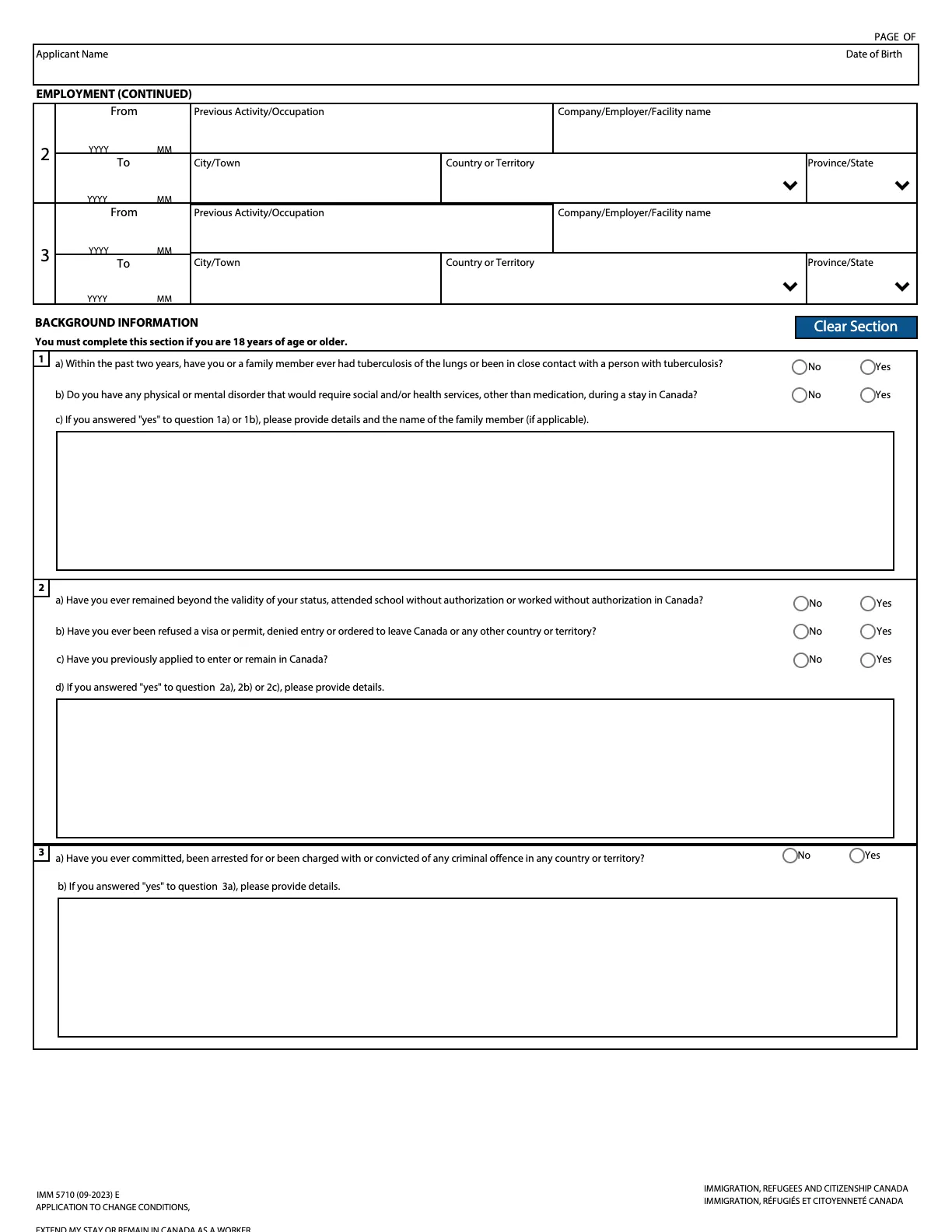 2
- 1 Current Activity/Occupation
What they’re asking: Your current job, or what you're doing now if not working.
Your current job, or what you are doing now if you don't work (for example a student or retired), with From dates, Company/Employer/Facility name, City/Town, Country or Territory and Province/State.
e.g.
Student- 2 Previous Activity/Occupation
What they’re asking: Your earlier jobs or activities over the past ten years.
Earlier jobs or activities covering the past 10 years (or the 10 years before you retired). If you run out of space, print another page of this section and include it.
Official source for the field “Previous Activity/Occupation”
BACKGROUND INFORMATION
123456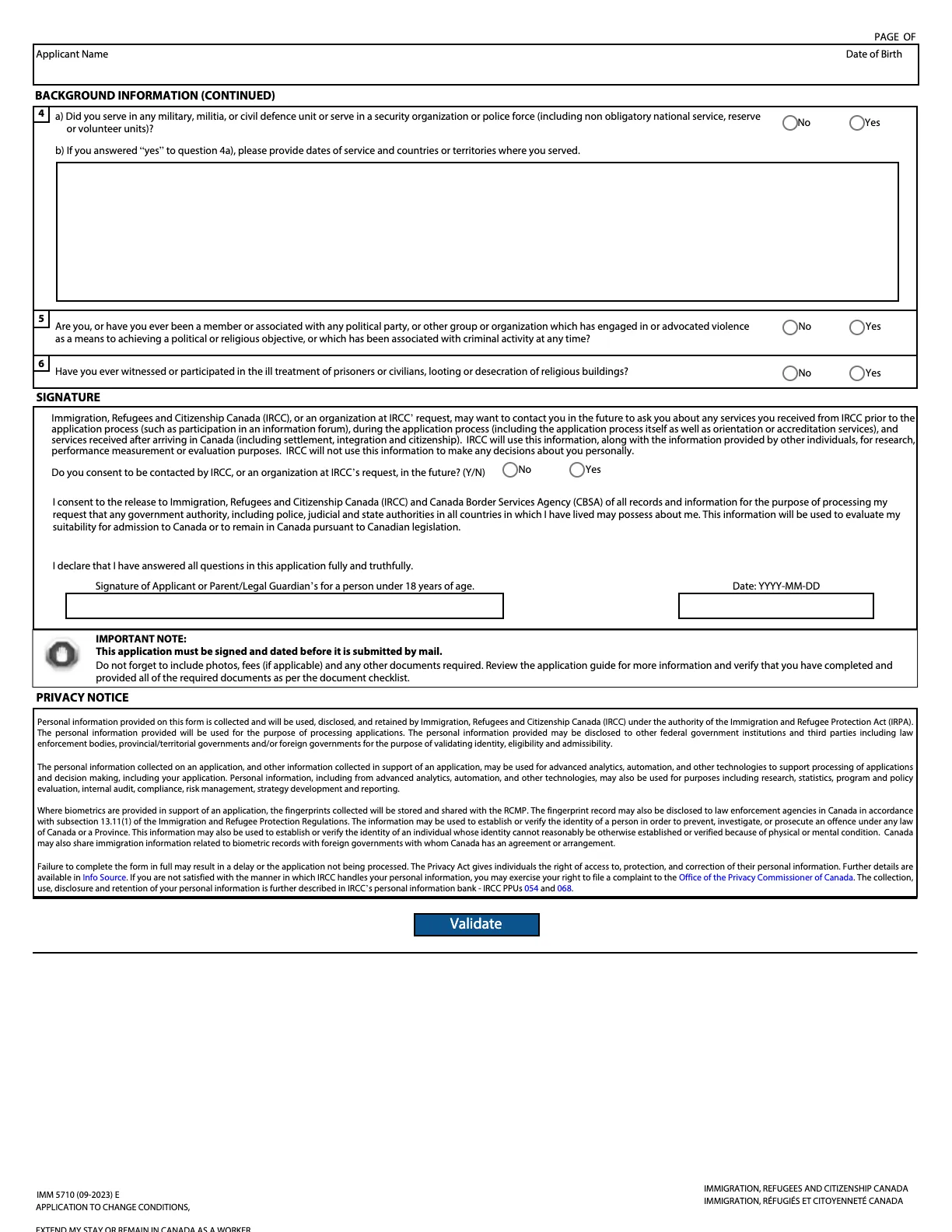 789
- 1 a) Within the past two years, have you or a family member ever had tuberculosis of the lungs or been in close contact with a person with tuberculosis?
What they’re asking: Within two years, have you or family had lung tuberculosis or close contact with it?
Tick Yes or No. If Yes, explain in 1c and name the family member if relevant.
Watch out: Leaving any background question blank. IRCC treats the application as incomplete.
- 2 b) Do you have any physical or mental disorder that would require social and/or health services, other than medication, during a stay in Canada?
What they’re asking: Will you need social or health services, beyond medication, for a physical or mental disorder?
Tick Yes or No. If Yes, give details in 1c.
- 3 a) Have you ever remained beyond the validity of your status, attended school without authorization or worked without authorization in Canada?
What they’re asking: Have you ever overstayed, or studied or worked without permission, in Canada?
Tick Yes or No. Any Yes in question 2 needs an explanation in 2d.
- 4 b) Have you ever been refused a visa or permit, denied entry or ordered to leave Canada or any other country or territory?
What they’re asking: Have you ever been refused a visa, permit or entry, or ordered to leave, anywhere?
Tick Yes or No. This covers refusals by any country, not just Canada.
- 5 c) Have you previously applied to enter or remain in Canada?
What they’re asking: Have you applied to come to or stay in Canada before?
Tick Yes or No. Earlier visa, study permit or work permit applications all count.
Official source for the field “c) Have you previously applied to enter or remain in Canada?”
- 6 a) Have you ever committed, been arrested for or been charged with or convicted of any criminal offence in any country or territory?
What they’re asking: Have you ever committed a crime, or been arrested, charged or convicted, anywhere?
Tick Yes or No. If Yes, give details in 3b.
- 7 a) Did you serve in any military, militia, or civil defence unit or serve in a security organization or police force (including non obligatory national service, reserve or volunteer units)?
What they’re asking: Have you ever served in a military, militia, civil defence, security or police unit?
Tick Yes or No. If Yes, give your dates of service and the countries or territories where you served.
- 8 Are you, or have you ever been a member or associated with any political party, or other group or organization which has engaged in or advocated violence as a means to achieving a political or religious objective, or which has been associated with criminal activity at any time?
What they’re asking: Have you ever been part of, or linked to, a violent or criminal group?
Tick Yes or No.
- 9 Have you ever witnessed or participated in the ill treatment of prisoners or civilians, looting or desecration of religious buildings?
What they’re asking: Ever witnessed or taken part in mistreating prisoners or civilians, looting, or desecrating religious buildings?
Tick Yes or No.
Mistakes IRCC warns about
- Applying before your employer has given you the LMIA decision letter or the offer of employment number. Guide 5487 says to apply once you have both the job offer and one of these. Official source for this mistake
- Reusing an offer of employment number from an earlier application. Each number works only once. Official source for this mistake
- Submitting an incomplete application. From outside Canada, it is refused without processing. Official source for this mistake
- Planning to work for an employer listed as “ineligible” on the non-compliant employers list. Official source for this mistake
- Giving untruthful answers to the background (statutory) questions, or misrepresenting information. Official source for this mistake
- Having yourself or a family member translate your documents. Official source for this mistake
- Treating the port of entry letter of introduction as a work permit. Official source for this mistake
- Using a biometric instruction letter from an earlier application. Official source for this mistake
- Not checking your passport's expiry date. The permit can't outlast the passport. Official source for this mistake
After you apply
- Give biometrics after you receive the biometric instruction letter, if required (see the biometrics step).
- An officer reviews the application and may ask for an interview, a medical exam, a police certificate or more documents (see 'Wait for a decision').
- Outside Canada: if approved you get a port of entry letter of introduction and, if needed, a visa or eTA. The border services officer issues the permit when you arrive (see the border step).
- Inside Canada: if approved you get a decision letter in your account, can start working once you have the approval note, and the permit is mailed to you (see the inside-Canada step).
- After approval, follow your permit's conditions. Get a SIN and arrange health coverage.
Not covered here
- How employers apply for an LMIA or submit offers of employment (Official page)
- Open work permits (no job offer) (Official page)
- Post-graduation work permits — see the post-graduation work permit walkthrough (Official page)
- Extending or changing conditions from inside Canada — see the work permit extension walkthrough (Official page)
- Applying at a port of entry (Official page)
- Programs with their own special instructions (Global Skills Strategy, IEC, caregivers, agricultural workers, family members) (Work permits with special instructions)
- Paper applications (only for the limited cases IRCC allows) (Official page)
Official IRCC pages
- Employer-specific work permits
- Find out what type of work permit you need
- Work permit: Applying from outside Canada
- Work permit: Applying from inside Canada
- Forms and documents (outside Canada)
- Forms and documents (inside Canada)
- IMM 1295 – form and instructions
- IMM 5710 – form and instructions
- Guide 5487 – Applying for a work permit outside Canada
- Guide 5553 – Applying for a work permit inside Canada
- Find out if you (the employer) need an LMIA
- Employers who failed to comply (non-compliant list)
- Work permits with special instructions
- IRCC fee list
- Check processing times
- Find out if you need to give biometrics
- Medical exam requirements for temporary residents
- Sign in or create an IRCC secure account